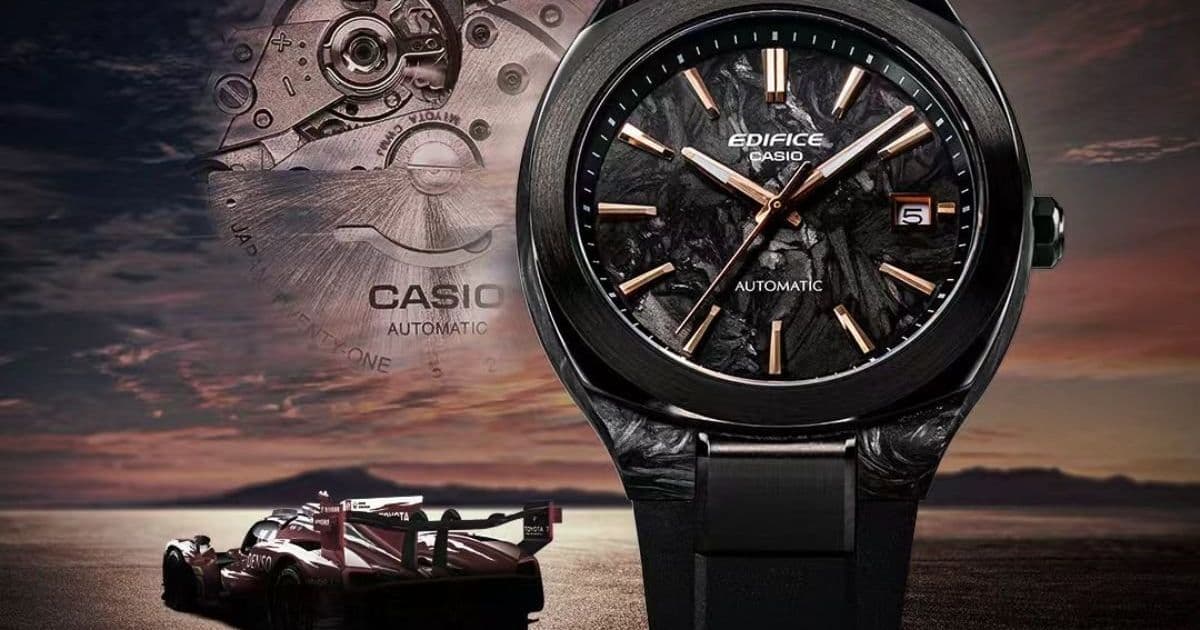
Five mechanical Edifice watches built on the Miyota 8215 movement have gone on sale in China, from a 2,490 CNY entry point to the 3,990 CNY forged-carbon Toyota Racing flagship. Here's how the specs stack up and which one earns its premium.
Casio has pushed its EFK-200 Edifice Automatic series past the announcement stage and onto store shelves in China, just weeks after the official reveal. The retail availability was confirmed by @geesgshock on Instagram, though Casio's own China website still hadn't updated to reflect the change at the time of writing. For a mechanical line that builds directly on the brand's first automatic Edifice from 2024, this is the first real chance buyers get to put numbers and hands-on weight against the marketing.
What's new
The EFK-200 family launches as five distinct models that share one mechanical heart. The EFK-200D-1A, EFK-200D-2A, and EFK-200D-4A all sit at 2,490 CNY (roughly $367), giving you black, blue, and red gradient dials respectively on stainless steel bracelets. Step up to the gold-toned EFK-200DG-5A and the price moves to 3,390 CNY (about $500). The flagship is the EFK-200XPB-1A, the product of the Casio-Toyota Racing partnership announced in January 2026, and it asks the most at ¥3,990 ($589).
Every model in the lineup runs the Miyota 8215, which Casio relabels as Module 5766. This is a well-known Japanese automatic caliber with 21 jewels, a 42-hour power reserve, and an accuracy spec of -20 to +40 seconds per day. That accuracy window is wide by quartz standards but completely normal for an affordable mechanical movement, and the Miyota 8215 has a long track record of being cheap to service and reliable to run. You can read more about the Edifice line on Casio's official product site.
The case dimensions come in at 43.6 x 38 x 11.9 mm across the board. Casio fits sapphire crystal up front, which is the right call at this price and a meaningful upgrade over the mineral glass that often shows up on sub-$400 watches. The caseback uses a transparent mineral crystal so you can watch the automatic rotor do its work, a feature buyers at this tier increasingly expect.
How it compares
The standard variants separate themselves mostly through dial color and finish. Black, blue, red, and gold options all carry gradient texturing on stainless steel bracelets, so the choice between them is aesthetic rather than functional. They weigh the same, run the same movement, and carry the same crystal package.
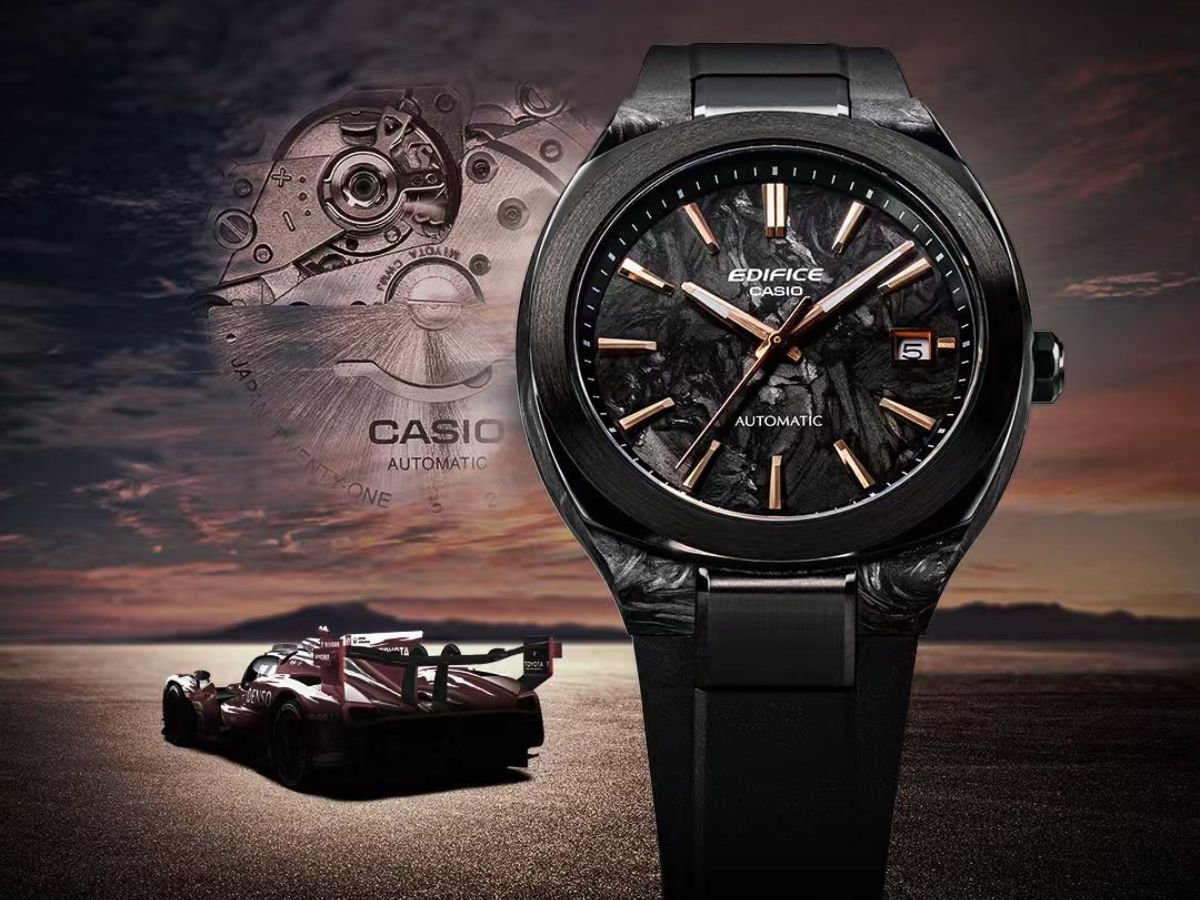
The EFK-200XPB-1A is where the engineering story changes. Instead of a steel case and bracelet, it uses a forged carbon fiber dial and casing paired with rose gold baton indexes and a rubber strap. Forged carbon is the same material approach you see in higher-end sports chronographs from brands charging several times more, and the practical payoff is weight. Casio says the carbon construction and rubber strap bring the total mass down considerably compared to the bracelet models, which matters if you actually wear a 43.6 mm watch all day. That weight reduction, plus the racing-derived styling, is what justifies the roughly $222 jump over the entry models.
Against the broader market, the EFK-200 lands in a crowded segment. Plenty of microbrands and mainstream players sell Miyota 8215 automatics in the $300 to $600 range, so Casio is competing on finishing, brand recognition, and the Toyota tie-in rather than on raw movement specs. Sapphire front glass and a display caseback are the standout value points here, since not every competitor includes both at this price.
Who it's for
If you want a mechanical Edifice and care more about color than carbon, any of the three 2,490 CNY models gives you the full spec sheet at the lowest cost, and the steel bracelet is the more versatile daily-wear choice. The gold EFK-200DG-5A is a styling upgrade rather than a technical one, so it appeals to buyers who want a dressier finish.
The EFK-200XPB-1A is the enthusiast pick. The forged carbon case, rose gold accents, and significant weight savings make it the most interesting watch in the lineup to actually wear, and the Toyota Racing connection gives it a story the others lack. Whether $589 is worth it depends on how much you value the carbon construction and the lighter feel on the wrist.
For now, all of this applies to the Chinese market only. Casio's first mechanical Edifice in 2024 sold well enough to justify this follow-up, but global pricing and availability for the EFK-200 series still have not been confirmed. Buyers outside China will have to wait to see whether the conversions hold up once regional pricing lands.
Comments
Please log in or register to join the discussion