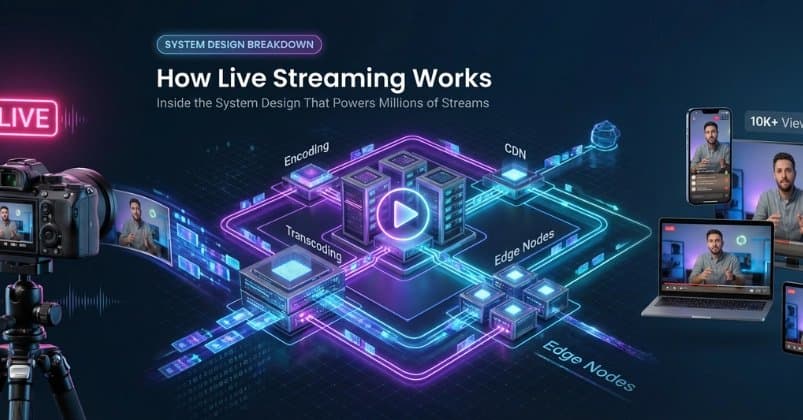
A comprehensive exploration of live streaming system design, covering ingestion protocols, transcoding workflows, CDN delivery, and the critical trade-offs between latency, quality, and cost in modern video infrastructure.
In 2026, live streaming has evolved from a novelty feature to the fundamental infrastructure of digital interaction. From global product launches and real-time betting to telehealth consultations and metaverse experiences, the demand for high-fidelity, zero-latency video has never been greater. For CTOs and engineering leaders, building a streaming pipeline that scales to millions of concurrent viewers while maintaining sub-second latency represents one of the most complex challenges in modern software architecture.
This deep dive explores the internal mechanics of live streaming system design, the protocols that power it, and the strategic infrastructure decisions required to build enterprise-grade solutions.
The High-Level Architecture: From Glass to Glass
To understand live streaming, we must view it as a continuous data pipeline where "glass-to-glass" refers to the journey from the camera lens (source) at one end to the end-user's screen (playback) at the other. The pipeline consists of four critical phases:
- Ingestion: Capturing and pushing the raw video to a server
- Processing: Transcoding the video into multiple resolutions and formats
- Distribution: Pushing the processed fragments to a Content Delivery Network (CDN)
- Playback: The client-side player requesting and rendering the video
Ingestion: The First Mile
The "First Mile" is the process of getting video from the encoder (software like OBS or hardware like Blackmagic) to your cloud infrastructure. The choice of protocol here determines your baseline latency.
The Protocol Face-off
RTMP (Real-Time Messaging Protocol): Despite being "legacy," RTMP remains the industry standard for ingestion. It's reliable and widely supported, though it sits on top of TCP, which can introduce head-of-line blocking.
SRT (Secure Reliable Transport): The modern challenger. SRT uses UDP but adds an error-recovery layer. It is designed for unpredictable networks, making it the go-to for remote broadcasts over public internet.
WebRTC (Web Real-Time Communication): For sub-500ms latency. WebRTC is peer-to-peer by nature but is increasingly used in "Wheels-up" ingestion for interactive streaming.
Technical Insight: For enterprise-scale events, many organizations leverage specialized IT consulting services to design hybrid ingestion strategies that fallback from SRT to RTMP automatically to ensure 99.99% uptime.
Processing: Transcoding and Packaging
Once the video hits your ingest server, it is likely a high-bitrate, single-resolution stream. This is unusable for a global audience with varying internet speeds.
Transcoding vs. Transmuxing
Transcoding: Decoding the original video and re-encoding it into multiple "renditions" (e.g., 1080p, 720p, 480p). This is CPU/GPU intensive.
Transmuxing (Packaging): Changing the container format (e.g., from RTMP to HLS) without altering the underlying video data.
Adaptive Bitrate Streaming (ABR)
ABR is the "magic" that prevents buffering. The video is sliced into small segments (usually 2–6 seconds). The client-side player monitors the user's bandwidth and dynamically requests the highest quality segment the connection can handle.
Delivery: The Role of CDNs and Edge Computing
Distributing a 4K stream to 100,000 people simultaneously from a single origin server is impossible. This is where the cloud migration of your delivery layer becomes vital.
HLS vs. DASH
The two dominant delivery protocols are HLS (HTTP Live Streaming) by Apple and DASH (Dynamic Adaptive Streaming over HTTP). Both leverage standard HTTP web servers, allowing them to scale via CDNs.
| Origin | Apple | International Standard (ISO) | Container fMP4 / MPEG-TS | Mostly fMP4 |
|---|---|---|---|---|
| Compatibility | Universal (iOS/Android/Web) | Strong (Mostly Android/Web) | Latency 2s - 30s (LL-HLS reduces this) | 2s - 30s |
The Edge Advantage
By moving the "Packaging" and "Caching" to the Edge—servers physically closer to the user—enterprises can reduce the Round Trip Time (RTT). This is a critical component of a modern cloud migration strategy, moving away from centralized data centers to a distributed edge architecture.
The Latency Spectrum: Trade-offs in System Design
In live streaming, you must pick your poison: Latency, Quality, or Cost.
- Standard Latency (15–30s): Standard HLS. Best for VOD-like quality and maximum reach.
- Low Latency (2–5s): LL-HLS or Low-Latency DASH. The "sweet spot" for sports and social streaming.
- Ultra-Low Latency (<1s): WebRTC. Essential for auctions, betting, and real-time communication.
The mathematical relationship for latency in chunk-based streaming can be simplified as:
$$L = N \times D + T$$
Where:
- L = Total Latency
- N = Number of segments in the buffer (usually 3)
- D = Duration of each segment
- T = Transmission and decoding time
To reduce latency, you must reduce segment duration $D$, but this increases HTTP overhead and risks buffering.
Engineering for Enterprise Scale
Building this in-house is a massive undertaking. Enterprise leaders often face the "Build vs. Buy" dilemma.
Cloud Migration of Video Workloads
Migrating video workloads to the cloud (AWS Elemental, Google Cloud Video Intelligence, or Azure Media Services) allows for "Elastic Transcoding." You only pay for the compute power used during the live event.
The Importance of IT Consulting Services
Designing a resilient system requires expertise in:
- DRM (Digital Rights Management): Implementing Widevine, FairPlay, and PlayReady to prevent piracy
- Multi-CDN Strategy: Switching providers in real-time if one CDN experiences a localized outage
- Observability: Tracking Quality of Service (QoS) metrics like VPF (Video Playback Failures) and EBVS (Exit Before Video Start)
Engaging with specialized IT consulting services ensures that these architectural hurdles are cleared before the first frame is ever broadcast.
Future Trends: AI and 5G
As we look further into 2026, two technologies are redefining the system design:
AI-Enhanced Encoding: Using Neural Networks to identify areas of a frame that need more detail (like faces) while compressing static backgrounds more aggressively.
5G Slice Networking: Allowing broadcasters to reserve a "slice" of 5G bandwidth for ingestion, ensuring a clean signal even in crowded stadiums.
Conclusion
Live streaming system design is an exercise in balancing conflicting requirements. For the enterprise, the goal is to build a pipeline that is robust, scalable, and cost-effective. Whether you are navigating a cloud migration of legacy broadcasting hardware or seeking IT consulting services to architect a new interactive platform, understanding these technical layers is the first step toward delivery excellence.
The future is live. Is your infrastructure ready?
Comments
Please log in or register to join the discussion