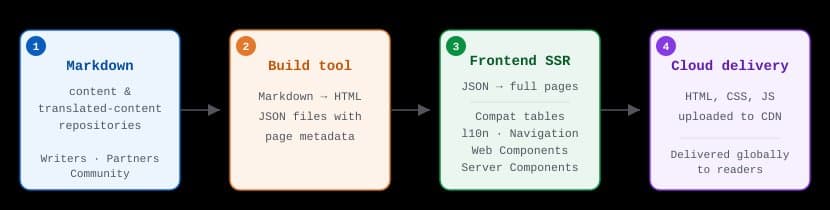
MDN's complete frontend overhaul represents a fundamental shift from monolithic React applications to a sophisticated component architecture leveraging web components and server-side rendering, addressing years of technical debt while dramatically improving performance and developer experience.
In the ever-evolving landscape of web development, few projects carry the weight and responsibility of Mozilla Developer Network (MDN). As the definitive documentation for web technologies, MDN's architecture decisions resonate throughout the developer ecosystem. Last year's frontend overhaul wasn't merely a visual refresh—it represented a profound philosophical shift in how documentation sites can and should be built.
The Weight of Technical Debt
The previous incarnation of MDN's frontend, known as "yari," had become a case study in technical debt accumulation. What began as a straightforward "Create React App" gradually evolved into an architectural monster. The fundamental problem was conceptual: React was being used as a wrapper around static content rather than an integral part of the content system itself.
This led to the uncomfortable practice of using dangerouslySetInnerHTML to inject documentation into the React application, creating a boundary between the application and the content it was meant to serve. The documentation team's Markdown files were processed into HTML by a build tool, then essentially dropped into the React application as inert content. Any interactivity had to be implemented using direct DOM manipulation, creating a schizophrenic development experience where React components and DOM API calls coexisted uneasily.
The CSS architecture had fared no better. What started as Sass gradually incorporated CSS variables, creating a Frankenstein's monster of styling approaches. The lack of proper scoping meant that changes to one component frequently triggered unintended side effects elsewhere. The solution—shipping a massive, render-blocking CSS blob—became increasingly untenable as the site grew.
A New Architectural Philosophy
The rebuild wasn't merely about fixing these immediate problems; it was about reimagining what a documentation site could be. The development team recognized that MDN's content is predominantly static—HTML, CSS, and code examples—with only occasional islands of interactivity. This realization led to a fundamental shift away from the Single Page Application (SPA) paradigm toward a component-driven architecture.
Web Components as the Foundation
At the heart of this transformation lies web components, specifically built using the Lit library. This choice wasn't arbitrary. Web components provide several advantages for documentation sites:
- Encapsulation: Each interactive element is self-contained, with its own HTML, CSS, and JavaScript.
- Progressive Enhancement: Components can degrade gracefully when JavaScript isn't available.
- Direct Content Integration: Custom elements can be embedded directly in Markdown content without complex integration logic.
The implementation began with relatively simple components like the MDN Scrim component, which embeds interactive coding tutorials from Scrimba. This prototype demonstrated how web components could solve the longstanding problem of adding interactivity within static content. The component handles loading the iframe only when a user clicks to open it, manages fullscreen functionality using the <dialog> element, and provides a clean API for content authors.
Interactive Examples: A More Complex Challenge
The true test came with the interactive examples that appear under "Try it" sections throughout MDN's documentation. These had historically been among the most complex and maintenance-heavy parts of the site, split across multiple repositories and requiring synchronization between content and example code.
The new implementation involved creating a suite of specialized web components:
<play-editor>: A CodeMirror-powered code editor<play-console>: For formatting and rendering console output<play-runner>: Responsible for rendering the current state of each editor<play-controller>: Coordinates events and state between other components
These components were then assembled into an <interactive-example> element that could be embedded directly in content using simple macros. This approach dramatically simplified the authoring process while providing a more cohesive user experience.
Server Components: Bridging Static and Dynamic
While web components solved the client-side interactivity problem, a deeper architectural issue remained: the fundamental mismatch between React's SPA model and MDN's predominantly static content. The React documentation itself acknowledges this problem, noting that traditional SPAs force users to download significant JavaScript bundles just to render static content that will never change.
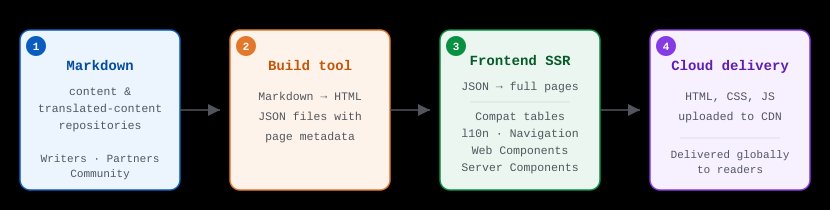
React Server Components (RSC) offer one solution, but adopting them would require migrating to a completely different framework. Instead, MDN's team implemented their own concept of server components using Lit's HTML template literals. These components render on the server using Node.js, producing HTML that can be delivered directly to users without requiring client-side JavaScript execution for static content.
The brilliance of this approach lies in how it eliminates the "wrapper problem" that plagued the previous architecture. The Markdown-to-HTML build tool becomes a first-class citizen in the templating system, rather than content to be injected into a React application. Server components can include web components, which are rendered to Declarative Shadow DOM (DSD) when supported, ensuring proper styling before JavaScript loads.
Resource Loading: From Monoliths to Granularity
Perhaps the most significant improvement lies in the new approach to resource loading. The old frontend suffered from the classic SPA problem of shipping everything in massive bundles, regardless of whether a particular user would ever need specific functionality.
The new architecture implements a flat, name-based component structure that enables intelligent resource loading:
- Web components: Loaded asynchronously and in parallel only when present on the page
- Server component CSS: Included only for components actually rendered on the current page
- Global styles: Minimized and bundled separately
This approach leverages modern web capabilities like HTTP/2 and HTTP/3, which make multiple small asset requests far more efficient than they once were. The result is a site where users only download the resources they actually need, with components becoming interactive as their JavaScript loads rather than waiting for a monolithic bundle to parse.
The dropdown component exemplifies this philosophy. When rendered to DSD, it displays a CSS-native dropdown menu that's immediately usable. As the component's JavaScript loads, it progressively enhances to a more sophisticated JavaScript-powered dropdown. This ensures functionality is available immediately while providing enhanced capabilities once the component is fully loaded.
Development Experience: From Pain to Pleasure
Beyond the user-facing improvements, the new architecture transformed the development experience. The previous environment had become notorious for its slow startup times (approximately 2 minutes), complex command structure, and unreliable hot reloading.
The new system, built on Rspack (a Rust-based alternative to Webpack with a Webpack-compatible API), reduces startup time to approximately 2 seconds. The simplified command structure means developers need only a single command for most development tasks. Changes reliably trigger hot reloading without requiring environment restarts, creating a fluid development workflow.
This improvement isn't merely a quality-of-life enhancement—it significantly lowers the barrier to contribution, making it easier for community members to participate in MDN's development. The closer resemblance between development and production environments also reduces the "it works on my machine" problem that plagues many web development projects.
Technology Strategy: Baseline and Progressive Enhancement
Implementing such a modern architecture raises questions about browser compatibility. MDN's solution leverages the Baseline project, a cross-vendor initiative that categorizes web technologies based on availability:
- Baseline Widely Available: Safe to use without feature detection
- Baseline Newly Available: Use with progressive enhancement or polyfills
- Baseline Limited Availability: Avoid unless absolutely necessary
This strategic approach allows MDN to confidently adopt modern web technologies while ensuring broad compatibility. Features like Custom Elements and Shadow DOM are used freely, while newer capabilities like Declarative Shadow DOM are implemented with progressive enhancement fallbacks.
Broader Implications for Documentation Architecture
MDN's transformation offers valuable insights for anyone building documentation or content-heavy sites:
- Component-driven architecture can provide a middle ground between static sites and full SPAs, offering both performance and interactivity.
- Web components are particularly well-suited for documentation, allowing interactive elements to be embedded directly in content.
- Server-side rendering isn't just about SEO—it can fundamentally improve how sites are architected.
- Resource loading strategies should be designed around actual usage patterns rather than theoretical optimization principles.
- Developer experience directly impacts community participation and maintenance burden.
The MDN team has open-sourced their work, inviting contributions and feedback. This transparency benefits not just Mozilla but the broader web development community, which can learn from both the technical implementation and the architectural philosophy that guided it.
As web technologies continue to evolve, documentation sites must adapt to serve developers effectively. MDN's transformation demonstrates that adaptation doesn't have to mean blindly following every new trend. Instead, it involves understanding fundamental principles—performance, maintainability, developer experience—and applying modern web capabilities in service of those principles.
The result is a documentation platform that's not only faster and more reliable but also more enjoyable to develop and contribute to. In an ecosystem where documentation quality directly impacts technology adoption, this is a significant achievement with implications that extend far beyond Mozilla's own walls.
Comments
Please log in or register to join the discussion