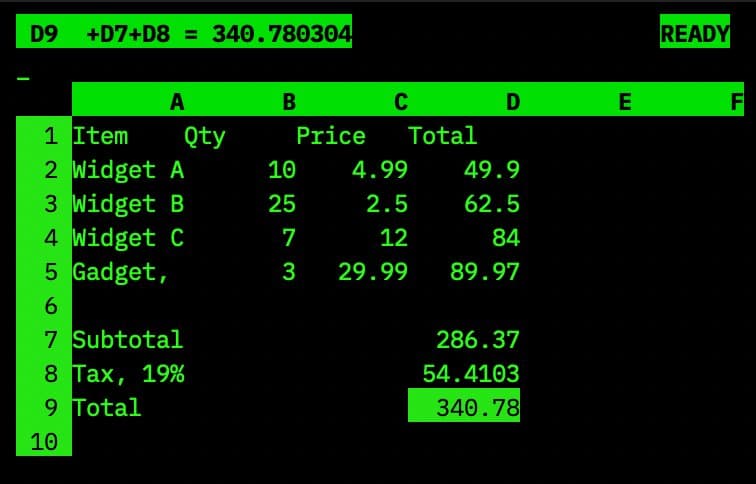
A deep dive into the technical reconstruction of VisiCalc, the groundbreaking spreadsheet software that transformed personal computers into business tools, exploring its elegant design principles and continued relevance in modern computing.
The recent reconstruction of VisiCalc represents more than just an interesting programming exercise—it offers a window into the foundational architecture that has undergirded spreadsheet technology for nearly half a century. When Dan Bricklin and Bob Frankston first created VisiCalc in 1979, they inadvertently established a paradigm so enduring that it remains largely unchanged in modern spreadsheet applications. The author's meticulous recreation of this software in minimal C code demonstrates not only the elegance of the original design but also reveals the fundamental principles that continue to govern how we interact with structured data today.
At its core, the VisiCalc reconstruction illustrates three architectural pillars that define spreadsheet systems: the cell data model, the formula evaluation engine, and the reactive recalculation system. The cell model, as implemented in the article, appears deceptively simple—a structure capable of storing numbers, text, or formulas. Yet this minimalism belies the sophistication required to handle the complex interdependencies that emerge when cells reference one another. The author's implementation wisely distinguishes between raw user input and calculated values, a crucial separation that enables both display flexibility and computational integrity.
The formula evaluator represents perhaps the most technically interesting component of the reconstruction. By implementing a recursive descent parser capable of handling mathematical expressions, cell references, and function calls, the author recreates the computational engine that made VisiCalc revolutionary. What's particularly noteworthy is the parser's awareness of the grid structure—it can resolve cell references by converting column letters to indices and row numbers to positions, creating a seamless bridge between user-facing notation and internal representation. This design choice, seemingly minor, actually embodies a fundamental principle of user interface design: creating an abstraction that feels natural to humans while remaining computationally tractable.
Perhaps most fascinating is the recalculation system, which reveals both the constraints and ingenuity of early spreadsheet design. The author's implementation opts for a simple approach: re-evaluating the entire spreadsheet iteratively until no further changes occur. While computationally intensive by modern standards, this brute-force method was pragmatically necessary given the severe memory constraints of the original VisiCalc, which ran on machines with as little as 16K of RAM. The author's decision to automate the recalculation process rather than requiring manual intervention—as the original did—represents an interesting evolution in user experience expectations, reflecting how we've come to demand instantaneous responsiveness even from computationally intensive operations.
The user interface component of the reconstruction further illuminates the design philosophy behind VisiCalc. By implementing a modal interface using ncurses, the author captures the essential interaction patterns that made spreadsheets accessible to non-technical users. The distinction between READY, ENTRY, and GOTO modes, along with the command-driven approach initiated by the "/" key, reveals how early software designers created efficient interaction models without the benefit of graphical interfaces. This reconstruction demonstrates that effective user experience design transcends technological limitations—principles established in the text-based VisiCalc continue to inform modern spreadsheet interfaces, albeit with more sophisticated visual presentation.
The technical choices made in this reconstruction merit deeper examination. By limiting the grid to 26 columns and 50 rows, the author deliberately constrains the scope to match the spirit of the original while keeping the implementation manageable. Similarly, the decision to support only basic mathematical operations and a handful of functions (@SUM, @ABS, @INT, @SQRT) underscores the philosophy that spreadsheet power emerges not from feature enumeration but from the elegant interaction of simple components. This minimalist approach stands in contrast to modern spreadsheet applications, which have grown increasingly complex with each iteration, sometimes obscuring their fundamental purpose beneath layers of advanced features.
The implications of this reconstruction extend beyond mere technical interest. In an era where software development increasingly emphasizes frameworks and abstractions, the VisiCalc reconstruction serves as a valuable reminder of the enduring value of understanding foundational principles. By building a spreadsheet from first principles, the author demonstrates how complex systems can emerge from simple components, and how thoughtful design can create tools that remain useful for decades. This exercise also highlights the importance of computational efficiency—particularly relevant in today's environment where computational resources are often taken for granted.
Counter-perspectives to this approach might question the practical value of recreating outdated technologies when modern alternatives exist. One could argue that time spent reconstructing VisiCalc might be better invested in learning contemporary spreadsheet frameworks or developing entirely new paradigms for data manipulation. However, such criticisms miss the point that understanding historical implementations provides unique insights into design trade-offs and problem-solving approaches that remain relevant. The VisiCalc reconstruction serves not as a replacement for modern tools but as a lens through which to examine the evolution of interactive computing and to appreciate the design principles that have stood the test of time.
The article concludes by acknowledging the limitations of the reconstruction—missing features like file I/O, range operations, and advanced formatting commands. Yet these omissions actually strengthen the author's central argument: that the essence of spreadsheet functionality can be captured in remarkably few lines of code when focusing on core principles rather than peripheral features. This minimalist approach resonates with contemporary movements toward software simplicity and computational efficiency.
In examining this VisiCalc reconstruction, we see not merely an exercise in retro-computing but a meditation on the nature of software design and the enduring power of well-conceived abstractions. The spreadsheet paradigm, established nearly five decades ago, continues to shape how we organize, analyze, and interact with data—a testament to the foresight of its creators and the fundamental soundness of its design principles. As we continue to develop increasingly sophisticated data manipulation tools, revisiting these foundational implementations offers valuable perspective on what remains essential in our technological toolkit.
The technical details provided in the article—from the recursive descent parser to the iterative recalculation algorithm—demonstrate how computational constraints can foster elegant solutions. In an age where memory and processing power are abundant, such constraints might seem irrelevant, yet they continue to inform best practices in software design. The VisiCalc reconstruction reminds us that the most powerful computational tools are often those that balance capability with simplicity, creating systems that are both accessible to users and transparent in their operation.
Ultimately, this exploration of VisiCalc's architecture serves as a valuable case study in software archeology, demonstrating how understanding historical implementations can inform contemporary design practices. As we continue to push the boundaries of what's possible with computational tools, revisiting these foundational systems provides grounding in the principles that have proven most enduring. The spreadsheet, in all its apparent simplicity, represents one of the most successful and long-lived interfaces for human-computer interaction—a paradigm whose origins in VisiCalc continue to shape our relationship with data today.
Comments
Please log in or register to join the discussion