
curl's unique position outside traditional package ecosystems creates fundamental challenges for dependency tracking, SBOM generation, and vulnerability management - a problem that affects billions of installations but remains largely invisible to modern tooling.
Dependency tracking has become a cornerstone of modern software security and supply chain management. Tools that generate Software Bills of Materials (SBOMs), vulnerability scanners, and package managers all rely on the assumption that software components belong to identifiable ecosystems with clear dependency relationships. But what happens when a critical piece of software exists outside these ecosystems entirely? The case of curl and libcurl provides a fascinating illustration of this problem.
The Ecosystem Paradox
curl and libcurl are written in C, positioning them as low-level components that exist in a curious liminal space within the software world. Unlike projects that clearly belong to ecosystems like npm, Go modules, Rust crates, or Python packages, curl operates independently. This independence creates a fundamental challenge: when you mention curl on the web, there's no ecosystem dropdown to select. It's simply a tool and a library that exists everywhere but belongs nowhere.
The recent push for Package URLs (PURLs) in contexts like CVE descriptions highlights this issue. PURLs only work when components are part of ecosystems, creating a catch-22 for projects like curl. When generating SBOMs or running dependency scanners, these tools frequently miss libcurl entirely because it's not listed by package managers. It's simply there, ready to be used, as if by magic.
The Build-Time Conundrum
At build time, developers select which additional libraries libcurl will use, but the curl project primarily ships tarballs with source code rather than pre-built packages. This means the project cannot tell users what dependencies their specific builds will have. The additional libraries that libcurl uses are themselves often outside standard ecosystems, creating a cascading problem of dependency invisibility.
This issue is compounded by the fact that libcurl and curl are frequently shipped bundled with operating systems or perceived as part of the OS. Most dependency graphs, SBOM tools, and dependency trackers stop at the binding or system that uses curl or libcurl without including curl itself. They capture the layer above, so to speak, but miss the foundational layer that makes everything work.
The Scale of the Problem
The scale of this issue becomes apparent when we consider that curl is installed in approximately thirty billion installations worldwide. Most of these are libcurl instances embedded in other applications. Given this ubiquity, one might expect GitHub's vast repository collection to show millions of dependencies on curl. The reality is far more revealing.
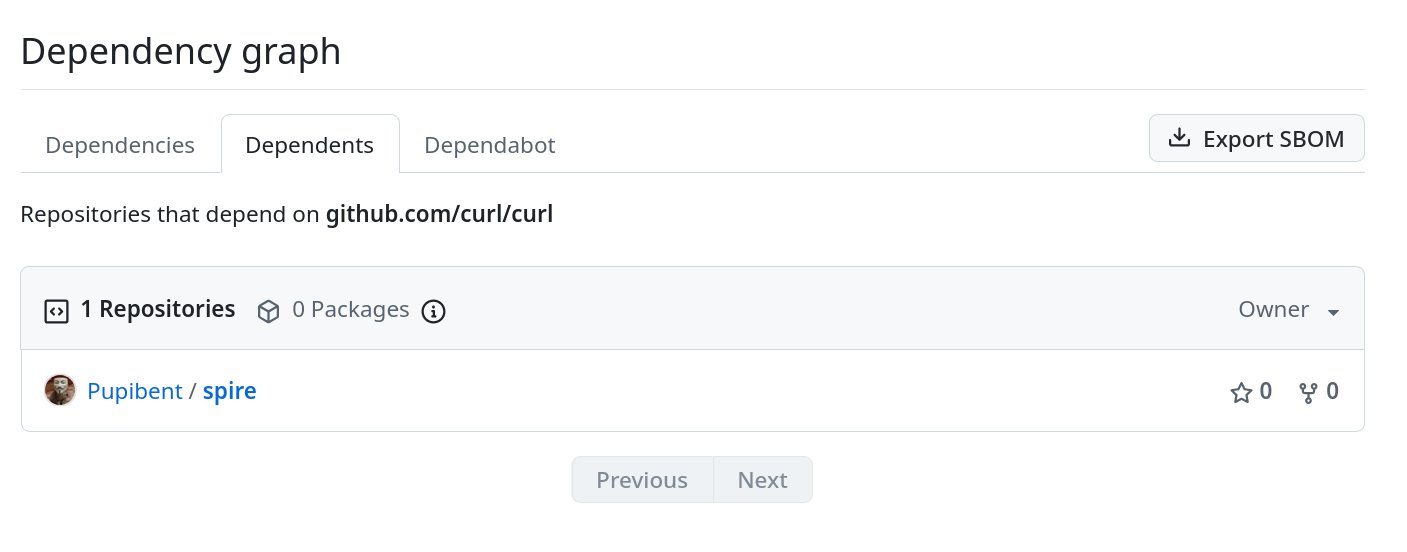
Repositories that depend on curl/curl: one.
This screenshot, taken on March 9, 2026, shows exactly one repository depending on curl: Pupibent/spire. Even more telling, this single dependency appears to be a mistake, suggesting that GitHub's dependency tracking system doesn't properly capture curl's actual usage patterns.
Why This Matters
This invisibility creates real security and maintenance challenges. When vulnerabilities are discovered in curl or its dependencies, there's no straightforward way to identify all affected systems. Security teams cannot generate accurate SBOMs that include these foundational components. The very tools designed to improve software supply chain security are blind to one of the most widely used pieces of software in existence.
The problem extends beyond curl. Any software that exists outside traditional package ecosystems faces similar tracking challenges. This includes many system libraries, legacy components, and specialized tools that form the backbone of modern computing infrastructure.
The Broader Implications
This situation reveals a fundamental limitation in how we think about software dependencies. Our tools and processes are optimized for tracking dependencies within ecosystems, but they struggle with the reality that much of the software we rely on exists in a gray area between packaged components and system-level tools.
The curl case suggests we need new approaches to dependency tracking that can handle software existing outside traditional ecosystems. This might involve creating new metadata standards, improving system-level dependency detection, or developing tools that can trace dependencies through compiled binaries rather than relying on package manager information.
Until then, projects like curl will continue to be the invisible foundation upon which much of modern software is built - ubiquitous, essential, and largely untracked by the very systems designed to monitor software dependencies. The one dependency shown on GitHub for curl isn't just a data point; it's a stark reminder of how much of our software infrastructure remains in the shadows, unseen by the tools we trust to keep our systems secure.
Comments
Please log in or register to join the discussion