A growing class of tools, BitBoard among them, is betting that the real friction in AI-assisted analytics isn't generating the chart. It's keeping the work after the conversation ends.
Ask a developer how they built a quick metrics breakdown last month and you'll often get the same answer: they asked an AI chat to write the query, pasted the result somewhere, and moved on. The analysis worked. Then the thread scrolled into oblivion, the logic went with it, and three weeks later someone asked for the same numbers and nobody could reproduce them.
This is the quiet failure mode of the current wave of AI-assisted data work, and a small group of tools is starting to organize around fixing it. BitBoard is one of the clearer examples. Its pitch is not "AI generates a dashboard" (plenty of products claim that now) but rather that the dashboard, its connections, its queries, and its underlying code persist as durable assets instead of evaporating into a conversation.
The trend: from generation to retention
For roughly two years the marketing energy around AI and data has fixated on generation. Type a prompt, get a chart. The demos are genuinely impressive, and tools like ChatGPT's data analysis mode and various notebook copilots made ad hoc exploration accessible to people who would never write a window function by hand.
The community sentiment, though, has shifted from "look what it made" toward "where did it go." Threads on Hacker News and r/dataengineering increasingly circle the same complaint: AI makes it trivially easy to produce analysis and almost as easy to lose it. The output lives inside a chat session. The provenance of the numbers is fuzzy. Rerunning the same logic next quarter means re-prompting and hoping the model lands in the same place, which it frequently does not.
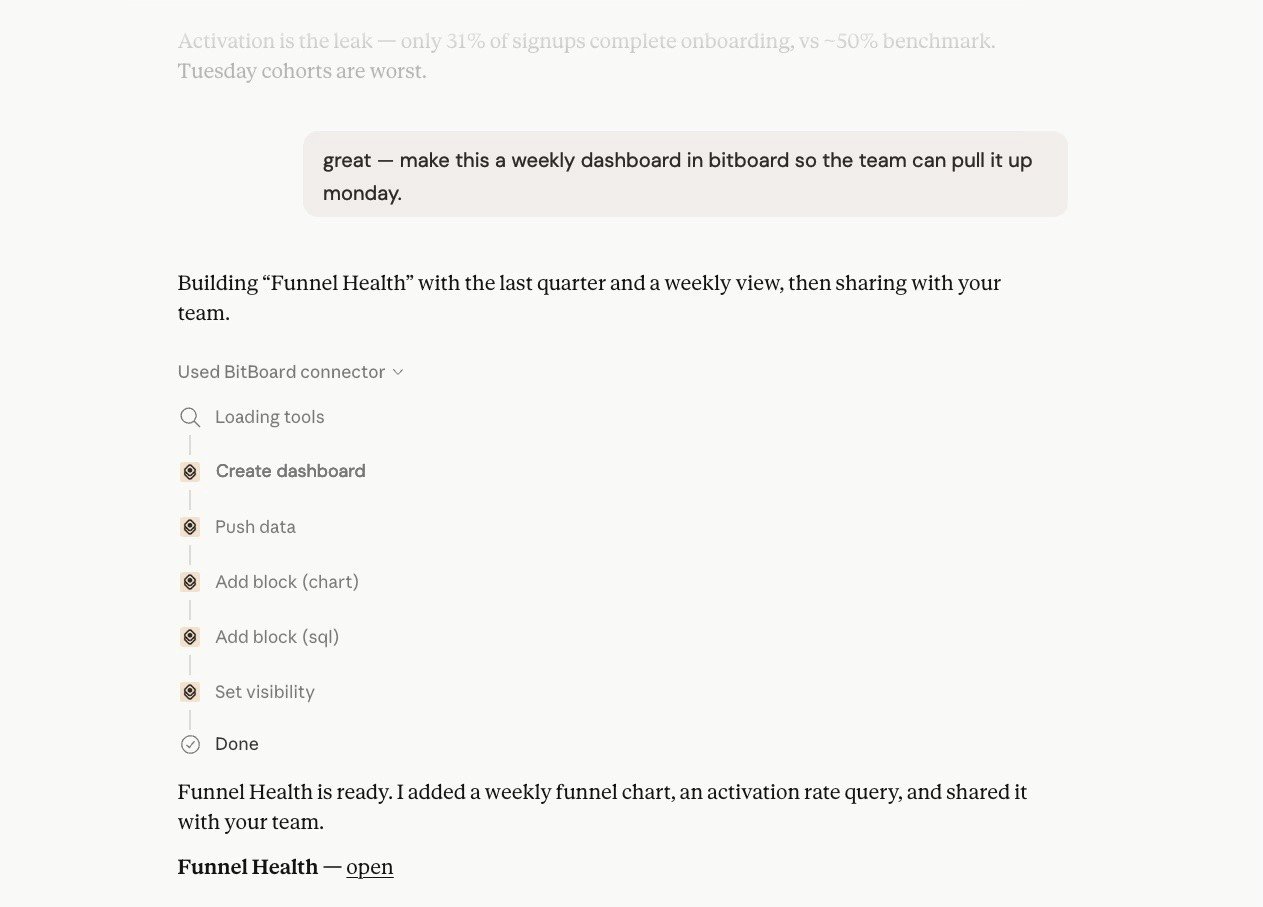
BitBoard's framing speaks directly to that frustration. It connects to your data sources for live queries, or lets an agent push data into existing connections, then stores the connection, the query, and the code so you can trace where a number came from and rerun it with consistent logic. The selling point is repeatability, the thing chat threads structurally cannot offer.

The evidence behind the shift
A few signals suggest this isn't just one vendor's positioning. The rise of agent-oriented workflows, where a coding agent like Claude or Cursor does multi-step work rather than answering a single question, has made the durability gap more visible. When an agent builds something across twenty steps, the value isn't the final message. It's the artifact, and an artifact needs somewhere to live.
You can see the same instinct in how teams have started treating AI-generated SQL: checking it into version control, wrapping it in dbt models, attaching it to scheduled jobs. The pattern is consistent. People trust the generation but distrust the ephemerality, so they bolt on infrastructure to make the output stick. Tools that bake that durability in, rather than leaving users to improvise it, are responding to a real and repeated pain.
There's also a collaboration dimension. Analysis trapped in an individual's chat history is invisible to the rest of a team. BitBoard leans on this explicitly, pitching browser-based sharing so the logic and context survive past one person's session. That maps onto a broader move away from personal AI scratchpads toward shared, inspectable surfaces.

The counter-perspectives
Not everyone is convinced the persistence layer needs to be a new product. The obvious skeptical reading is that this is a feature, not a category. If your agent already writes the query, a thin layer of git plus a scheduler plus an existing BI tool covers much of the same ground, and many engineering teams would rather assemble those pieces than adopt another platform with its own data connections to secure and maintain.
There's a sharper critique too, aimed at the repeatability promise. Storing AI-generated logic so you can rerun it is only valuable if the logic was correct in the first place. A durable, traceable, repeatable wrong answer is arguably worse than a disposable one, because it carries an air of authority and gets reused. The provenance features address "where did this come from," but they don't address "is this right," and that second question is the one that actually burns analytics teams. Any tool in this space inherits the underlying problem that AI-written SQL can be subtly, confidently incorrect.
The trust question cuts the other way as well. Giving a product direct access to your data sources, or letting an agent push data through it, is a meaningful surface to hand over. Teams that have spent the last year tightening governance around where their data flows may hesitate, and "minimal setup" is precisely the phrase that makes a security reviewer nervous. The convenience and the caution are in genuine tension here, and different organizations will weigh them differently.
What's actually changing
Strip away the marketing and the underlying movement is real: AI made analysis cheap to produce and, almost as a side effect, cheap to lose. The first generation of tools optimized the producing. The interesting work now is in the keeping, the sharing, and the proving. BitBoard and tools like it are a bet that the durable artifact, not the clever prompt, is where the lasting value sits.
Whether that becomes a standalone category or gets absorbed as a feature into the chat and coding agents people already use is the open question. The need is legitimate. The packaging is still being argued over, and that argument is worth watching, because it's really a proxy for a larger one about whether AI output should be treated as conversation or as code. You can try the approach yourself at bitboard.work, but the more useful exercise is to look at your own team's last month of AI-assisted analysis and ask how much of it you could actually reproduce today.
Comments
Please log in or register to join the discussion