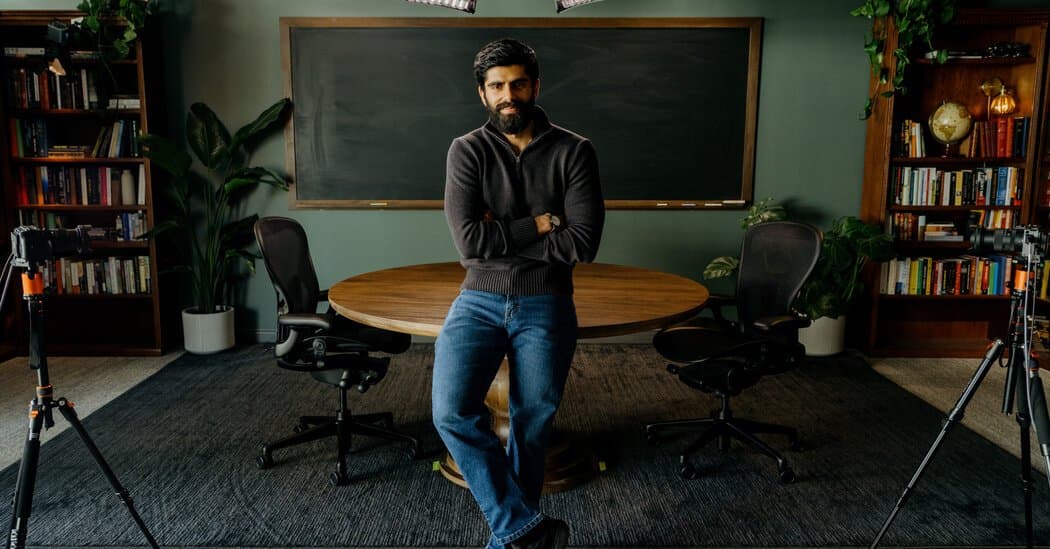
Dwarkesh Patel, once a bored college sophomore, has built a podcast that has become mandatory listening in the AI community, featuring interviews with tech industry titans like Jensen Huang, Elon Musk, and Mark Zuckerberg. His rise reflects the evolving landscape of tech media and the growing importance of AI discourse.
Dwarkesh Patel was a bored college sophomore looking for intellectual stimulation. Now he commands interviews with Jensen Huang, Elon Musk, Mark Zuckerberg, and other tech industry titans whose words move markets and shape conversations. His podcast, aptly named 'Dwarkesh Podcast,' has evolved from a side project to what many consider mandatory listening in the artificial intelligence community.
The transformation of Patel's career mirrors the changing nature of media influence in the tech world. Unlike traditional journalists who climb through established outlets, Patel built his platform independently, capitalizing on the AI boom to create a space where industry leaders speak with unusual candor. His interviews, often running two hours or more, have become known for their depth and the willingness of guests to share unvarnished thoughts on the future of technology.
"What's remarkable is how Dwarkesh has positioned himself as both insider and outsider," says Sarah Chen, a venture capitalist at Future Ventures. "He understands the technical nuances but maintains enough distance to ask the questions others won't. That combination is rare in today's media landscape."
Patel's ascent wasn't accidental. He began his podcast while studying computer science at Stanford, dropping out to pursue full-time podcasting in 2023. His early episodes focused on AI research and technical topics, gradually expanding to include conversations with entrepreneurs, investors, and executives. The turning point came when NVIDIA CEO Jensen Huang agreed to appear in late 2024, bringing unprecedented attention to the show.
"I was surprised by how much access Dwarkesh has been able to secure," notes tech journalist Kara Swisher. "These are some of the most guarded executives in the world, yet they seem comfortable speaking with him. That speaks to both his preparation and the authenticity he brings to these conversations."
The podcast's format contributes to its appeal. Patel typically spends weeks researching each guest, often reading their academic papers, past interviews, and company materials. This preparation allows him to ask technically informed questions that go beyond surface-level discussions. His interview with OpenAI's Sam Altman, for example, explored the technical challenges of AGI development with surprising depth.
Yet Patel's influence extends beyond his podcast. His Twitter account, where he shares interview highlights and tech analysis, has become a must-follow for industry insiders. His ability to distill complex technical concepts into accessible insights has earned him a loyal following among engineers, investors, and executives alike.
Not everyone is impressed by Patel's rise. Some traditional journalists question whether his approach constitutes journalism or merely celebrity worship. "There's a difference between asking prepared questions and holding power accountable," argues tech journalist Casey Newton. "Dwarkesh's interviews are fascinating, but they rarely challenge guests in the way investigative journalism does."
Others note that Patel's success is partly a function of timing. The AI explosion has created unprecedented demand for content about the technology, and Patel positioned himself perfectly to capture that attention. "He's benefited from being in the right place at the right time," suggests media analyst Ben Thompson. "The AI community was hungry for thoughtful discussion, and Dwarkesh filled that void."
Despite these critiques, Patel's impact is undeniable. His interviews often generate headlines and move markets. When Huang discussed NVIDIA's roadmap on the podcast, the company's stock rose 5% the following day. When Zuckerberg spoke candidly about Meta's AI strategy, competitors took note.
Looking ahead, Patel shows no signs of slowing down. He's expanding into video production and plans to launch a newsletter covering AI research. Some speculate he might eventually transition to venture capital or a leadership role in an AI company, given his deep connections in the industry.
For now, however, Patel remains focused on what he does best: facilitating conversations that matter. As the AI landscape continues to evolve, his podcast serves as both a historical record and a shaping force in one of technology's most consequential developments.
"The question isn't whether Dwarkesh will maintain his influence," concludes Chen, "but how he'll leverage it as the AI field matures. That's what makes him someone to watch, not just listen to."
The podcast continues to attract high-profile guests, with recent episodes featuring Google CEO Sundar Pichai, OpenAI's Ilya Sutskever, and DeepMind's Demis Hassabis. As the AI revolution accelerates, Dwarkesh Patel has positioned himself not just as a chronicler, but as an integral part of the conversation itself.
Comments
Please log in or register to join the discussion