
The 2025 Go Developer Survey reveals persistent satisfaction with Go's simplicity and tooling, while highlighting tensions between developer expectations from other languages and Go's deliberate minimalism. With 91% satisfaction but notable friction around error handling, enums, and dependency trust, the survey captures a language at a crossroads between consistency and evolution.
The 2025 Go Developer Survey of 5,379 developers reveals a language ecosystem experiencing both profound stability and subtle tensions. While 91% of respondents report satisfaction with Go—continuing a six-year trend—the survey exposes cognitive dissonance between developer expectations formed in other ecosystems and Go's intentionally constrained design philosophy. This tension manifests most clearly in three areas: the persistent desire for features like enums and exceptions, friction in writing idiomatic Go, and challenges in evaluating module quality.
The Paradox of Satisfaction
Despite Go's deliberate omission of features common in other languages, satisfaction remains remarkably high. Developers consistently praise Go's "holistic platform" value, with specific appreciation for its standard library (net/http, crypto, sync) and built-in tooling. As one 10-year veteran in the energy sector noted: "The entire reason I use Go is the great tooling and standard library... making service-oriented applications easy and reliable."
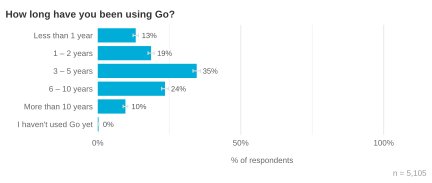
Yet beneath this satisfaction lies significant cognitive load. 81% of respondents learned Go after beginning their professional careers, primarily coming from ecosystems where inheritance (71%), type-safe enums (65%), and exceptions (60%) are commonplace. This creates friction when switching contexts between languages, as developers must mentally shift between different paradigms for basic tasks like error handling.
The Three Frictions
1. Idiomatic Guidance Gap
33% of developers cited "ensuring Go code follows best practices" as their top frustration. The absence of authoritative, up-to-date guidance (like an expanded "Effective Go") leaves developers—especially those from Java or Python backgrounds—struggling with project structure and idiomatic patterns. As a healthcare developer observed: "Especially if developers come from other languages, e.g. Java, aspects [of Go] can differ quite a lot."
2. The Missing Feature Dilemma
28% expressed frustration over absent features from other languages. The desire for Rust-like enums, better nil safety, and reduced verbosity surfaced repeatedly. One developer lamented: "There is nothing in the compiler that stops me from using a maybe nil pointer... That should be baked into the type system." This tension highlights the challenge of balancing Go's philosophy of simplicity against developer desires for expressive power.
3. Module Trust Crisis
26% reported difficulty evaluating third-party module quality. With no authoritative signals for module reliability—beyond manual checks of activity graphs and maintainer reputation—developers struggle to distinguish between robust solutions and "one-off projects with no history/maintenance." Many requested curated quality indicators on pkg.go.dev, such as adoption trends and stability metrics.
Tooling Blind Spots
A surprising finding emerged around Go's tooling documentation: 15-25% of developers frequently need to consult documentation for core commands like go build and go run. Navigation difficulties—not just unfamiliarity—were cited as the primary pain point. One developer described the experience: "go test --help didn't work... go help testflag # visually parsing through text that looks all the same without much formatting." This suggests room for improvement in command help organization.
The AI Inflection Point
AI tool adoption presents a paradox: 53% use AI assistants (ChatGPT, Copilot, Claude) daily—primarily for generating tests, boilerplate, and documentation—yet satisfaction lags significantly behind Go itself. Only 13% reported being "very satisfied" with AI tools versus 62% for Go. The core issue? Quality control. 53% cited non-functional code generation, while 30% complained about poor-quality working code. As one financial services developer noted: "I'm never satisfied with code quality or consistency, it never follows the practices I want to."
Implications for Go's Future
The survey reveals Go at an inflection point. High satisfaction confirms the strength of its foundational philosophy, but pressure points suggest areas needing attention:
- Guidance Systems: There's clear demand for context-sensitive learning resources (e.g., "Error handling for Java developers") and enhanced IDE integrations.
- Progressive Enhancement: Could features like improved enums or nil safety be added without compromising core simplicity? The proposal process (github.com/golang/go) remains crucial.
- Trust Architecture: Module ecosystems need better signaling mechanisms—possibly through enriched pkg.go.dev metrics—to reduce evaluation overhead.
As AI tools become ubiquitous, their role in Go development warrants careful observation. Current usage patterns suggest developers compartmentalize AI for non-critical tasks while maintaining manual control over core logic—a pragmatic approach given quality concerns.
Conclusion: Consistency as Strategy
The survey ultimately validates Go's "boring is good" ethos. While developers occasionally chafe at Go's constraints, they overwhelmingly value the consistency that enables focus on problem-solving rather than language intricacies. As the language matures, the challenge isn't chasing feature parity with other ecosystems, but carefully evolving while preserving what one 10-year veteran called Go's "great long-lasting foundation." The 2026 roadmap appears focused on this balance: reducing friction through better guidance and tooling without compromising the simplicity that defines Go's identity.
Raw survey data will be available in Q1 2026 for further analysis.
Comments
Please log in or register to join the discussion