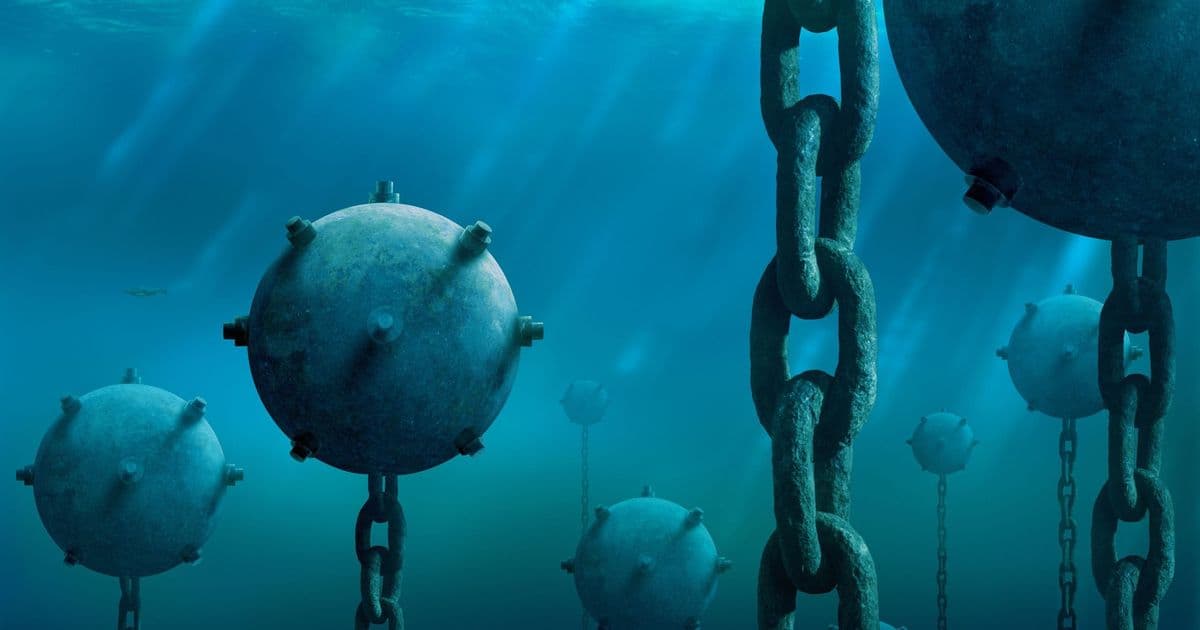
The US Navy has secured a $100 million contract with an AI technology firm to develop advanced underwater drone systems capable of detecting and neutralizing sea mines in the strategically vital Strait of Hormuz, significantly reducing detection times from months to days while enhancing operational safety in high-risk geopolitical waters.
In a significant advancement in naval technology and artificial intelligence integration, the US Navy has entered into a $100 million agreement with an unspecified AI technology firm to develop sophisticated underwater drone systems capable of detecting and neutralizing sea mines in the Strait of Hormuz. This strategic investment represents a major leap forward in maritime security operations, potentially reducing the time required for mine detection from months to mere days while significantly enhancing safety for personnel operating in one of the world's most geopolitically sensitive waterways.
The AI-powered mine detection system leverages multiple sensor technologies, including side-scan sonar and advanced visual imaging systems, to create a comprehensive underwater surveillance network. What sets this technology apart is its ability to continuously monitor and evaluate other AI detection models operating in the field, enabling real-time identification of system failures and immediate deployment of corrective measures. This autonomous learning capability eliminates the traditional bottleneck of sending data back to distant laboratories for model retraining, allowing for unprecedented responsiveness to emerging threats.
"The fundamental breakthrough here is the shift from batch processing to continuous learning," explains Dr. Evelyn Reed, a naval technology analyst with 15 years of experience in autonomous underwater systems. "Previous systems required weeks or months to collect sufficient data, transmit it to secure facilities, retrain models, and then redeploy updated algorithms. This new architecture enables on-the-fly updates, potentially reducing response times from 90 days to less than 5 days when encountering new mine types or countermeasures."
The Strait of Hormuz presents a particularly challenging environment for mine detection operations. This narrow waterway, which connects the Persian Gulf to the Gulf of Oman, sees approximately 20% of the world's petroleum passing through it daily. The ongoing geopolitical tensions between the United States and Iran, characterized by an on-again, off-again ceasefire, have made mine-clearing operations exceptionally dangerous. Naval mines, while technologically relatively simple, remain a potent threat due to their ability to disable or destroy multi-billion dollar vessels with minimal warning.
"From a strategic perspective, this AI-powered detection system represents a force multiplier," notes Admiral Michael Torres (Ret.), former commander of the US Naval Forces Central Command. "It not only reduces risk to personnel but also increases the operational tempo in a region where every hour counts. The ability to detect and neutralize threats in days rather than weeks provides commanders with unprecedented flexibility in maintaining freedom of navigation in these critical chokepoints."
The broader context of this development is the Pentagon's increasing reliance on artificial intelligence across its operational domains. Over the past year, the Department of Defense has established partnerships with seven leading AI technology companies, including SpaceX, OpenAI, Google, Nvidia, Microsoft, and Amazon Web Services. These collaborations focus on deploying large language models and other AI systems across classified networks to rapidly analyze vast datasets and identify patterns that would be impossible for human analysts to detect in a timely manner.
DARPA, the Pentagon's advanced research arm, has simultaneously issued calls for proposals to develop next-generation deep-sea underwater drones with rapid deployment capabilities. This suggests a comprehensive strategy to modernize naval mine countermeasures through a combination of advanced hardware and intelligent software systems.
From a market perspective, this $100 million contract signals growing investment in AI applications for defense, particularly in maritime domains. The underwater AI detection market, currently valued at approximately $2.3 billion globally, is projected to grow at a compound annual growth rate of 14.7% through 2030, reaching an estimated $5.8 billion. This growth is being driven by increasing geopolitical tensions, rising maritime security concerns, and technological advancements in autonomous systems and AI.
The successful implementation of this technology could have far-reaching implications beyond the Strait of Hormuz. Similar AI-powered underwater detection systems could be deployed in other strategically important waterways, including the South China Sea, the Mediterranean, and the Baltic Sea, where naval mines could potentially disrupt global trade routes.
Technical specifications of the system remain largely classified, but industry experts suggest it likely incorporates advanced machine learning algorithms specifically trained on diverse mine types and environmental conditions. The system's ability to process multiple sensor inputs simultaneously and cross-reference detection results suggests a sophisticated approach to reducing false positives while maintaining high sensitivity to actual threats.
"This isn't just about faster detection—it's about smarter detection," comments Dr. Sarah Jenkins, AI researcher specializing in defense applications. "The system's multi-sensor approach and continuous learning capability mean it can adapt to changing conditions and countermeasures in real-time. This represents a paradigm shift from static, rule-based detection systems to dynamic, self-improving ones that evolve with the threat environment."
The contract also highlights the growing intersection of AI and traditional defense industries. As military operations increasingly depend on autonomous systems and intelligent decision-making support, partnerships between defense contractors and specialized AI technology firms are becoming more common. This trend is expected to accelerate as the Pentagon continues to prioritize AI integration across all domains of warfare.
For the AI firm involved, this contract represents both a significant commercial opportunity and a showcase for their technology's capabilities. While the company's identity has not been disclosed, the scale of the contract and the strategic importance of the application suggest a well-established player in the AI defense space with proven experience in developing robust, mission-critical systems.
The implementation timeline for this technology remains unclear, but given the urgency of the strategic situation in the Strait of Hormuz, we can expect accelerated development and deployment schedules. The successful fielding of this system could set new standards for naval mine countermeasures worldwide and establish important precedents for the integration of AI in complex, high-stakes operational environments.
As geopolitical tensions continue to evolve and maritime security challenges grow, investments in AI-powered detection systems like this one are likely to increase. The ability to rapidly detect and neutralize underwater threats represents not just a technological advancement but a strategic necessity in an increasingly contested maritime domain.
Comments
Please log in or register to join the discussion