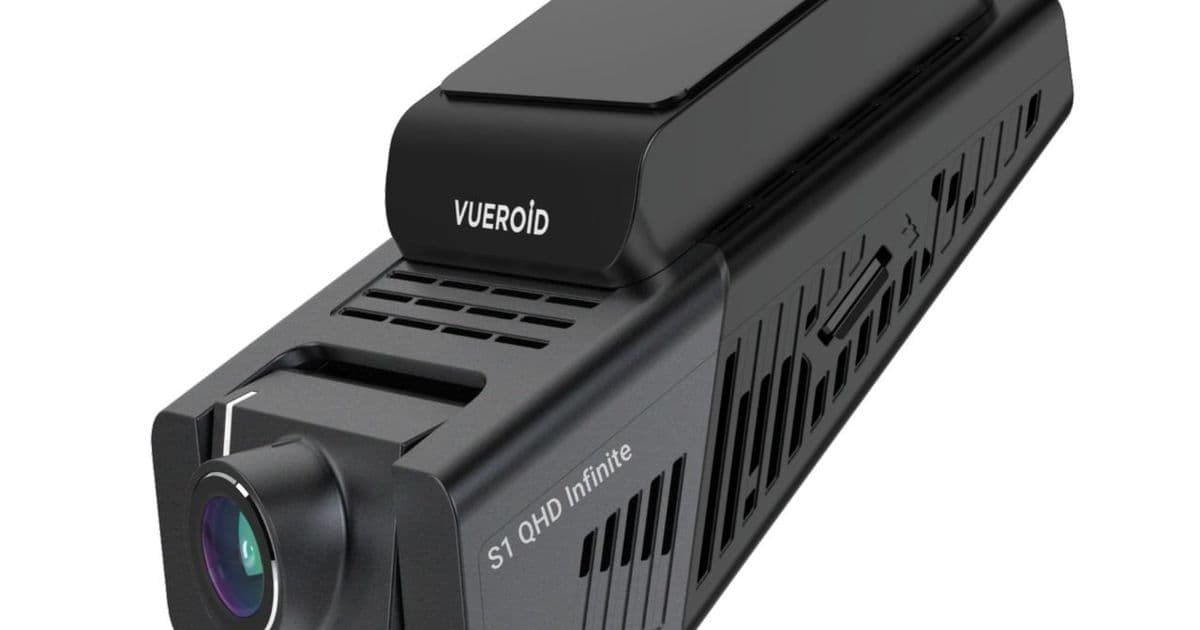
Vueroid's new S1 QHD Infinite leans on dual Sony Starvis 2 sensors and a software trick called Infinite Plate Capture to pull readable license plates out of HDR footage, while sipping just 1 mA during parked surveillance.
Vueroid has expanded its dash cam lineup with the S1 QHD Infinite, a 2-channel recorder that pairs QHD capture with a built-in screen, onboard GPS, and a license plate enhancement feature aimed at hit-and-run scenarios. It slots in as a mid-tier option, and the spec sheet reads like a direct response to what buyers have been asking dash cams to do better: see clearly at night and actually resolve the plate of the car that just clipped you.
What's new
The headline addition is Infinite Plate Capture (IPC), Vueroid's plate enhancement processing. Most dash cams record a plate that looks fine until you zoom in, at which point it dissolves into a smear of pixels. IPC works on the HDR recordings to keep plate digits legible, which is the difference between a clip that's useful to insurers and police and one that just proves something happened. Whether it holds up against fast cross-traffic and oncoming glare is the kind of thing that only shows up in real testing, but the intent is clear.
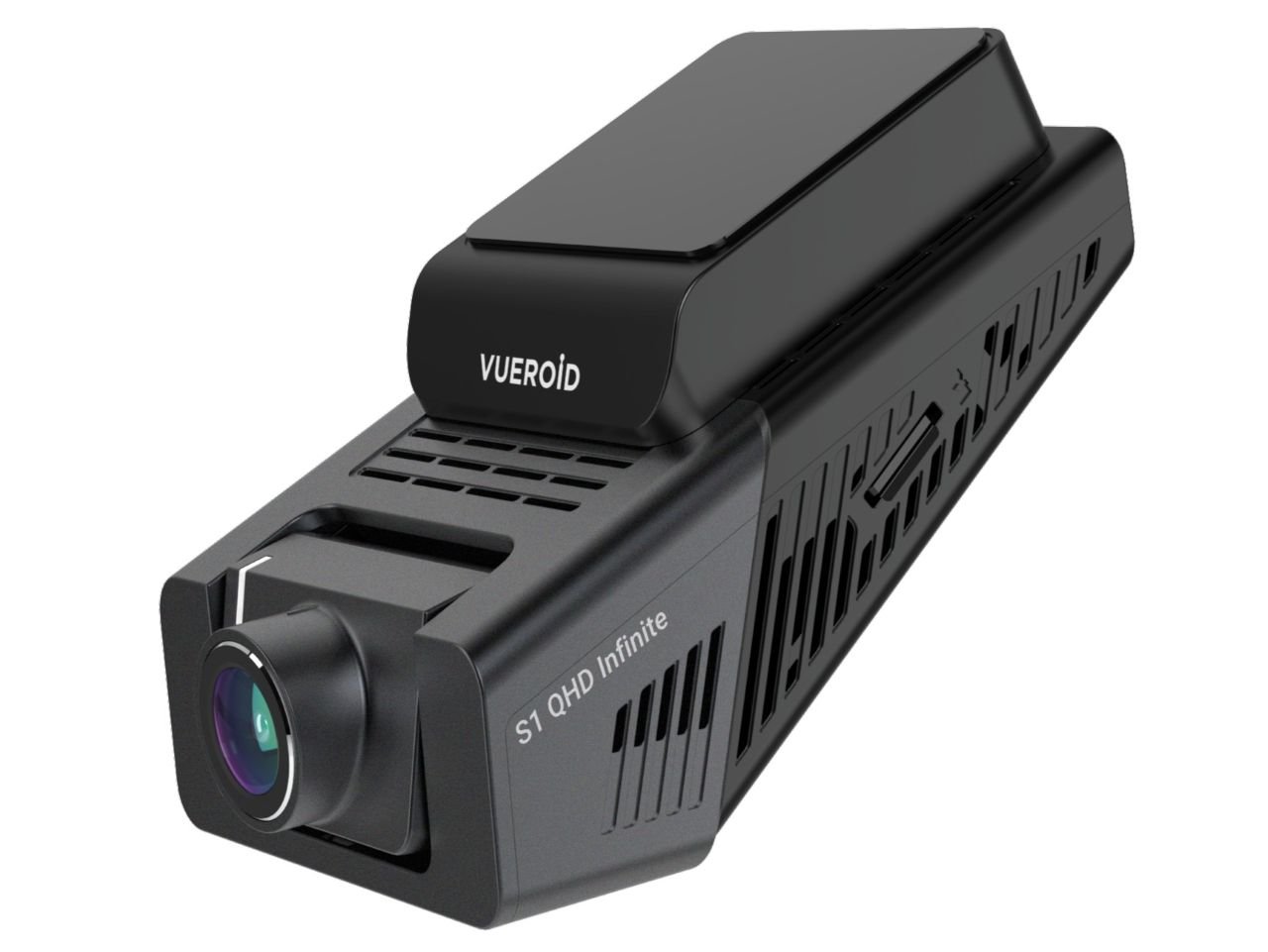
Both the front and rear cameras use Sony Starvis 2 sensors, the current generation Sony pushes for automotive and security use because of its low-light sensitivity. Each shoots 2,560 x 1,440 at 30 fps through a 160-degree wide-angle lens. That resolution and frame rate combination is now the practical standard for a serious two-channel setup. The 30 fps cap is worth flagging: it captures plates well at typical speeds but gives you less to work with when you need to freeze a single frame at highway pace. The 160-degree field of view is wide enough to catch side-swipes and lane intrusions without warping the center of the frame into uselessness.
A 2.3-inch LCD sits on the body for framing, playback, and menu navigation. That's a small but genuine convenience over screenless units that force you into a phone app just to confirm the camera is aimed correctly. A three-camera variant adds an interior cam, which matters mostly to rideshare and delivery drivers who need to document the cabin.
{{IMAGE:2}}
How it compares
Against its own predecessors, the S1 QHD's biggest jump is the move to Starvis 2 paired with the IPC processing rather than a resolution bump. The QHD/30 fps format puts it in the same bracket as competing two-channel cams from Viofo, Vantrue, and Thinkware, most of which also land in the $250 to $320 range for a front-and-rear kit. Where Vueroid is trying to differentiate is the parking story.
The S1 QHD includes 24-hour parking surveillance that draws roughly 1 mA when armed but not actively recording. That low idle draw is the figure that determines whether you come back to a dead car battery after a long weekend, and 1 mA is genuinely frugid for an always-on system. It also leans on a buffered approach so that when motion or impact triggers a recording, the seconds before the event are preserved rather than lost while the camera spins up.
The geofencing behavior is a nice practical touch. The cam can automatically disable parking surveillance when the vehicle is parked inside a defined safe zone, like your own locked garage, so it isn't burning battery and filling storage in a place where nothing is going to happen. That's the sort of feature you appreciate three months in, not on day one.
Rounding out the list are collision detection, time-lapse recording, and the built-in GPS, which stamps location and speed onto footage. GPS is increasingly table stakes at this price, but it remains the data that turns a video into evidence by tying it to a place and a velocity.
Who it's for
The two-camera S1 QHD carries an MSRP of $279.99, with the three-camera interior-cam model at $309.99. Both are sold through Vueroid directly and on Amazon.
The two-channel model makes the most sense for a daily commuter who wants front and rear coverage, reliable plate capture, and a parking mode that won't murder the battery. The three-camera version is the one to look at if you drive for a living and need cabin footage for passenger or cargo disputes. Buyers who prioritize high-frame-rate capture for highway incident analysis, or who want 4K front resolution, will still find reasons to look elsewhere, but for the common case of documenting fender-benders and parking-lot hits with a plate you can actually read, the S1 QHD covers the fundamentals at a competitive price.
Comments
Please log in or register to join the discussion