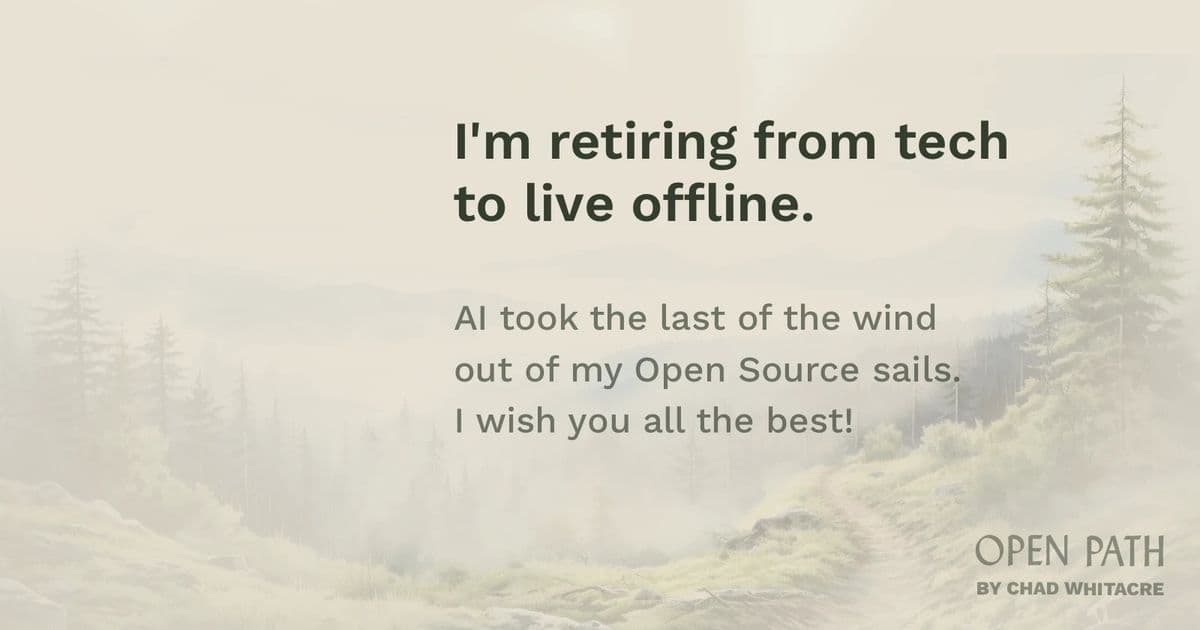
Chad Whitacre announces his departure from the tech industry, citing the overwhelming influence of AI on open‑source development. The piece reflects on how AI has reshaped community dynamics, personal motivation, and the broader meaning of contribution, while also considering what his exit suggests for the future of offline living and the sustainability of open‑source ecosystems.
When Open Source Meets the Exhaustion of AI: A Personal Reckoning
By Chad Whitacre – published May 28 2026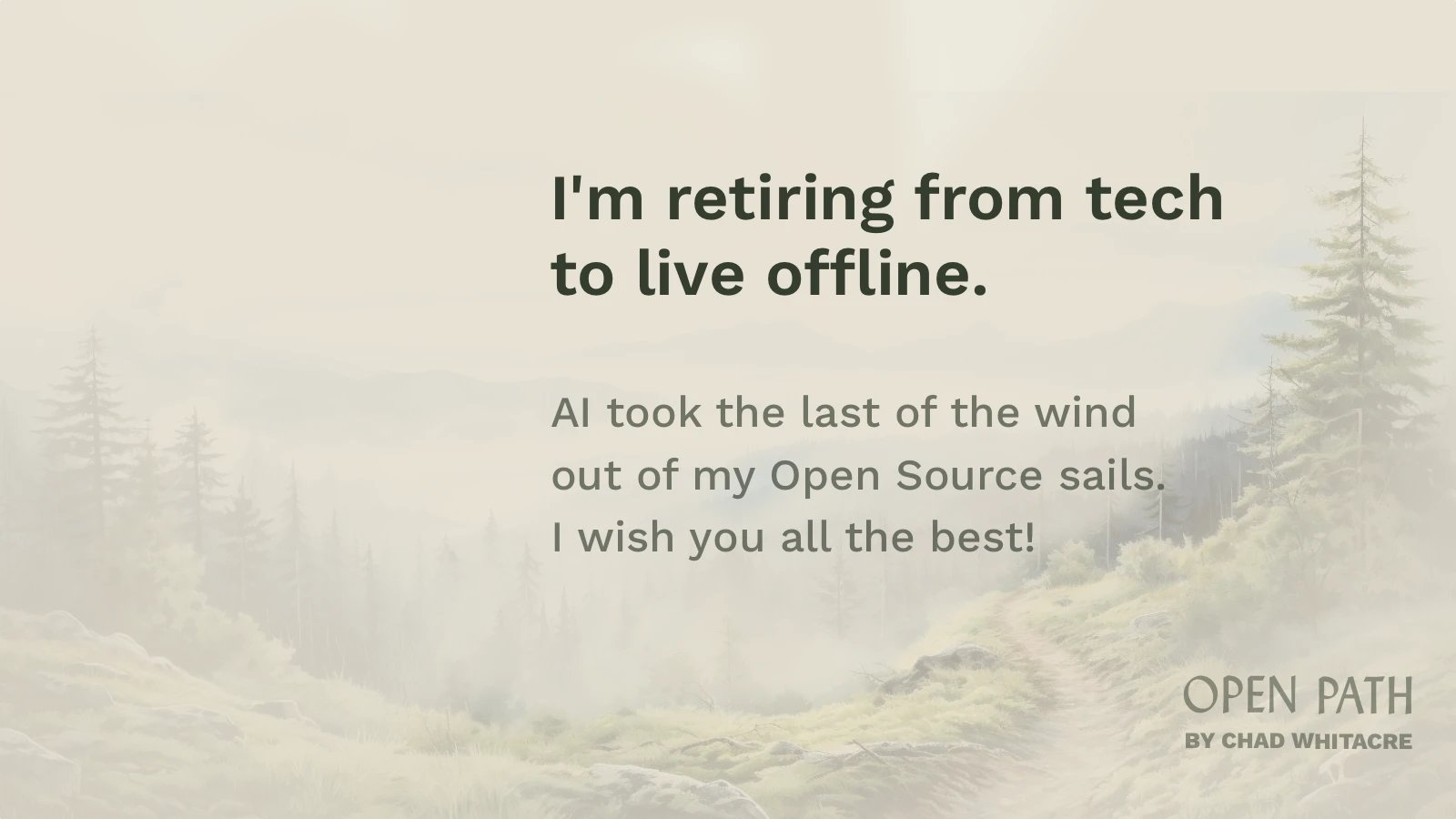
Thesis
Chad Whitacre’s brief but emotionally resonant announcement—“I am retiring from tech to live offline”—is less a dramatic exit than a meditation on how the rapid infusion of artificial intelligence into open‑source workflows has eroded the very motivations that once sustained his decades‑long engagement with the community. The article serves as a personal case study of a broader tension: as AI tools become ubiquitous, the line between craft and automation blurs, and many contributors find their sense of agency and purpose slipping away.
Key Arguments
1. AI as the “last wind” that emptied his sails
Whitacre frames AI as the final gust that drained the momentum of his open‑source involvement. Early in his career, he described the thrill of debugging a kernel panic or polishing a library’s API as a form of craft—a tangible, human‑centric process that rewarded curiosity and perseverance. Over the past few years, however, tools such as GitHub Copilot, OpenAI Codex, and increasingly sophisticated code‑generation pipelines have begun to pre‑write large swaths of code, leaving contributors to review rather than create. The shift from authoring to curating has, for Whitacre, turned the act of contribution into a supervisory role that feels detached from the creative spark that originally drew him to the field.
“AI took the last of the wind out of my Open Source sails.” – Whitacre
2. The erosion of community reciprocity
Open‑source communities have historically relied on a tacit social contract: contributors give time and expertise, and in return receive mentorship, reputation, and a sense of belonging. Whitacre observes that AI‑generated pull requests, while technically correct, often bypass the iterative dialogue that fuels learning. When a bot suggests a change, the human conversation that would normally unpack the design rationale is replaced by a terse comment such as “LGTM” (looks good to me). This compression of discourse reduces opportunities for mentorship and, consequently, for the inter‑generational transmission of knowledge that sustains open‑source ecosystems.
3. Professional fatigue amplified by corporate expectations
Whitacre’s disclosure that he previously worked for Sentry adds a layer of context: large SaaS companies have begun to embed AI into their internal development pipelines, creating an expectation that engineers continuously adopt the newest model‑driven tools. The pressure to keep pace with ever‑faster release cycles, while simultaneously maintaining the quality standards of a public codebase, compounds burnout. The author’s decision to step away can be read as a response not only to personal fatigue but also to a systemic culture that prizes output speed over reflective craftsmanship.
Implications
For Individual Contributors
Whitacre’s choice underscores a growing need for intentional disengagement strategies. Developers who feel their creative agency diminishing might benefit from setting boundaries around AI usage—perhaps reserving AI assistance for repetitive scaffolding while preserving manual coding for core algorithmic work. Communities could formalize “offline” periods, encouraging contributors to share experiences of stepping back and returning with renewed perspective.
For Open‑Source Projects
Projects may need to re‑evaluate contribution guidelines to ensure that AI‑generated code does not become a shortcut that sidesteps peer review. Some maintainers have already instituted policies requiring explicit attribution of AI assistance, akin to licensing disclosures. By making the provenance of code transparent, projects can preserve the educational value of review cycles and maintain a culture of shared learning.
For the Industry at Large
If the trend Whitacre describes continues, we could see a bifurcation: a segment of developers who fully embrace AI‑augmented development, and another that retreats to more analog forms of programming—perhaps focusing on low‑level systems work, hardware design, or niche languages where AI models lack sufficient training data. Companies that value deep technical expertise may need to create roles that explicitly protect time for non‑AI‑mediated problem solving, lest they lose talent to the very automation they champion.
Counter‑Perspectives
Some observers argue that AI merely accelerates the open‑source feedback loop rather than stifling it. By handling boilerplate, AI can free contributors to focus on higher‑level design and architecture, potentially enriching the community’s intellectual output. Moreover, AI‑generated suggestions can serve as teaching tools when paired with thorough explanations, turning a “copy‑paste” moment into a learning opportunity.
However, Whitacre’s experience suggests that without deliberate scaffolding—such as mandatory explanatory comments or mentorship pairings—these benefits can be eclipsed by a sense of alienation. The technology itself is neutral; the surrounding processes determine whether it amplifies or diminishes human agency.
Closing Reflection
Chad Whitacre’s announcement is a poignant reminder that the human element of software creation cannot be fully outsourced to algorithms. His decision to live offline is both a personal act of self‑preservation and a subtle critique of an industry racing toward ever‑greater automation. As we continue to embed AI deeper into our tooling, the challenge will be to design ecosystems that honor the craft, mentorship, and community that have historically made open source a vibrant, collaborative endeavor.
For readers interested in following Whitacre’s journey or learning more about responsible AI usage in open source, see his original post on the Open Path blog.
Comments
Please log in or register to join the discussion