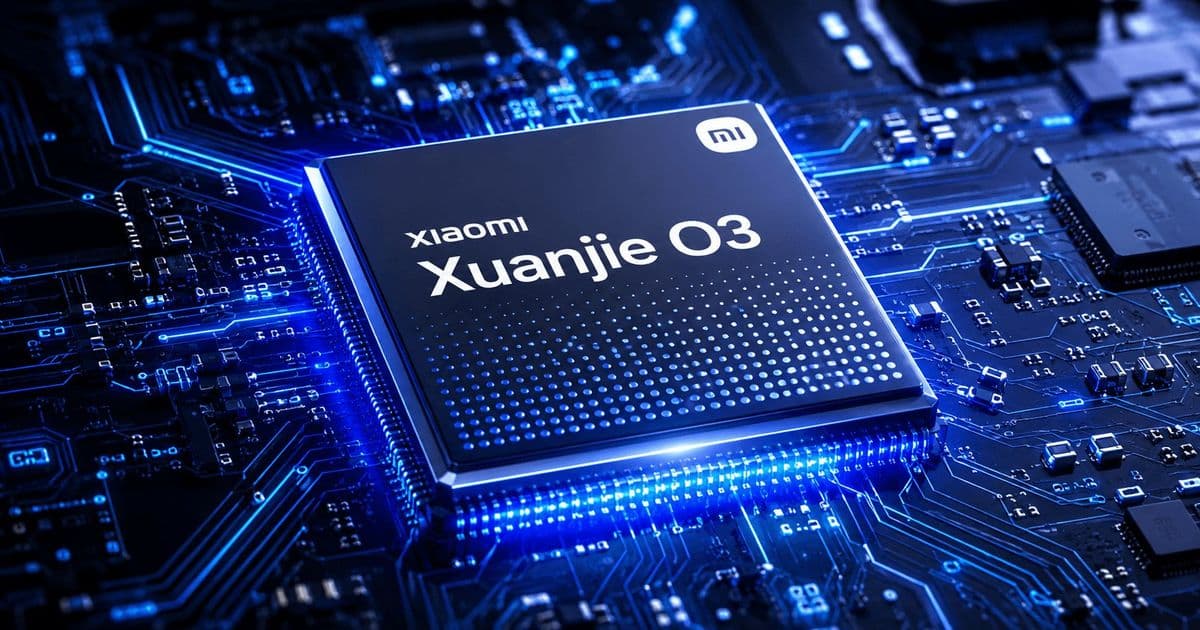
A single blogger post and a vague executive quote have Xiaomi's next in-house SoC pegged as a Snapdragon 8E5 competitor. Here's what's actually confirmed, what isn't, and why matching a flagship chip on paper is the easy part.
Xiaomi is preparing the next iteration of its in-house Xuanjie mobile processor, and the rumor mill has already decided it will trade blows with Qualcomm's upcoming flagship. The reality is more modest: what exists right now is one social media claim, one executive quote with no numbers attached, and a lot of extrapolation.
What's claimed
The specific claim comes from blogger @That_Kartikey, who posted on X on June 11 that, based on the chip's iteration cycle, the next-generation Xuanjie processor (widely assumed to carry the name Xuanjie O3) will deliver performance "on par with" Qualcomm's next-generation Snapdragon 8E5. That is the entire technical basis for the headline comparison. No benchmark figures, no silicon, no process node, no die shots. "Based on the iteration cycle" is a polite way of saying someone drew a trend line and pointed at where it lands next.
The more credible thread is the corporate one. Xiaomi Group President Lu Weibing said during a livestream that the company will launch the next Xuanjie chip in the second half of 2026, describing it as a "very strong comprehensive self-developed processor." He also said it would debut in a "flagship product with quite eye-catching performance," which most observers read as the Xiaomi MIX Fold 5. Executives describing their own unreleased silicon as strong is not data. It is the floor for what any company says about a product it is about to sell.
What's actually new
Strip away the comparison and there is a real story underneath. Xiaomi shipped its first self-developed application processor, the Xring O1, earlier in this cycle, built on a 3nm-class process and aimed at the high end rather than the budget tier where most first-party chip attempts start. Committing the next version to a high-profile foldable, the MIX Fold 5, rather than burying it in a mid-range device, signals that Xiaomi intends to be judged against flagship SoCs rather than graded on a curve.
That matters because designing a competitive smartphone SoC is one of the hardest things a consumer hardware company can attempt. It requires licensing or designing CPU and GPU cores, integrating a modem (or carving out the cellular problem separately, which is what most newcomers do), building an image signal processor that can keep up with multi-camera flagship systems, and securing leading-edge fab capacity at TSMC against competitors with far larger volume commitments. Apple spent years and acquired a chip company to get there. Google's Tensor line, co-developed with Samsung, still trails Qualcomm on raw performance and efficiency several generations in. Xiaomi reaching parity with a current Qualcomm flagship would be a genuine achievement; reaching parity with Qualcomm's next flagship, before either chip is benchmarked, is a forecast, not a finding.
For reference, the current MIX Fold 4 launched in July 2024 at RMB 8,999, running the Snapdragon 8 Gen 3, with a 7.98-inch inner display, a 6.56-inch cover screen, a Leica-branded quad-camera array, and a 5,100mAh battery. Moving the successor onto Xiaomi silicon would mean trusting first-party power tuning and thermals in one of the most thermally constrained form factors there is. Foldables have less internal volume for heat spreaders than slab phones, which makes them an aggressive place to debut a new chip, not a safe one.
Limitations
The gap between "matches on paper" and "matches in a phone you can buy" is where most in-house chip programs lose. A few things the current rumors say nothing about:
- Sustained performance. Peak Geekbench or AnTuTu numbers are easy to hit for a few seconds. Holding clocks under thermal load, especially inside a foldable, is the real test, and Qualcomm's advantage there comes from years of tuning.
- Efficiency. "On par" in raw performance can still mean significantly worse performance-per-watt, which shows up as worse battery life and more throttling. Newcomers usually trail here even when peak numbers look close.
- The modem question. Qualcomm's cellular and RF stack is a large part of why it dominates Android flagships. It is unclear how Xiaomi is handling connectivity on Xuanjie, and a separate or licensed modem changes the integration story considerably.
- GPU and ISP maturity. Gaming stability, driver support, and camera processing are areas where first-party Android silicon has historically been weakest, regardless of CPU benchmark results.
The Snapdragon 8E5 itself is also unreleased, so the comparison pits one unannounced chip against another based on a hobbyist's projection. Both could shift before launch.
The strategic logic is sound. Owning the silicon gives Xiaomi tighter control over performance tuning, power efficiency, and software-hardware integration, and reduces its dependence on Qualcomm for its most expensive devices. That is the same calculus Apple and Google followed. Whether the Xuanjie O3 delivers on it is a question that benchmarks in the second half of 2026 will answer, not a tweet in June. Until there is shipping hardware to measure, the honest read is that Xiaomi is making a serious bet on its own chips, and the rest is speculation wearing a spec sheet.
Comments
Please log in or register to join the discussion