
A Commerce order against noise infusion would hit the machinery behind modern public data releases, creating risk for privacy, accuracy, and the startups building tools around both.
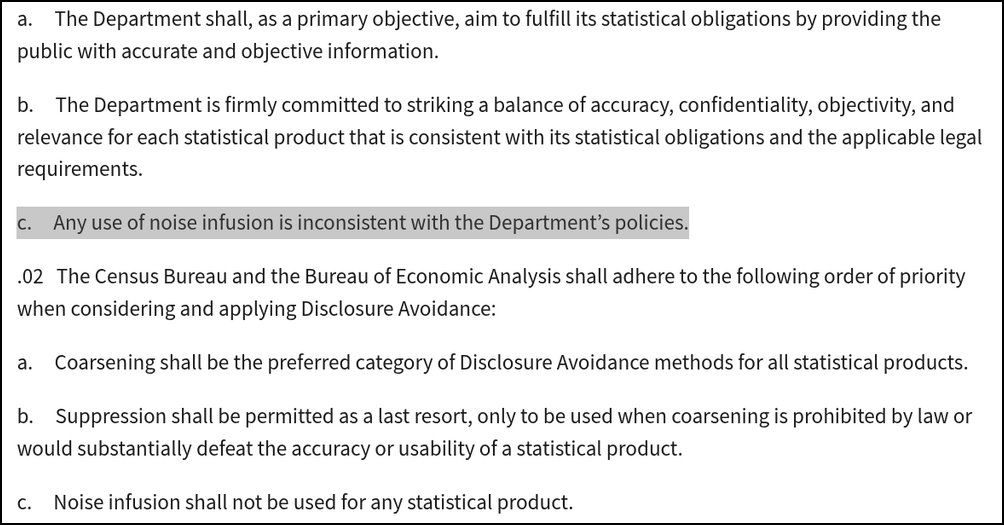
The reported Commerce Department order banning noise infusion from statistical products is not a funding story, but it is very much a market story. It threatens a core technical assumption behind modern public data infrastructure: useful aggregate data often needs carefully measured randomness if it is going to protect the people inside the dataset.
Company
The companies and labs most exposed here are the privacy-preserving analytics vendors, disclosure avoidance specialists, civic data platforms, and GovTech data teams that help agencies publish statistics without exposing individual records. One name tied to recent Census disclosure work is Tumult Analytics, whose technology appears in 2025 Census-related research on privacy-preserving demographic files. The broader category also includes teams building differential privacy systems, secure analytics workflows, synthetic data tools, and privacy accounting software.
No funding amount, investors, or new round were disclosed in the source material. That absence matters. This is not a clean venture announcement where a startup raises $40 million from familiar enterprise investors and declares a category. It is a policy shock that may change the buyer’s problem. If federal statistical agencies are pushed away from noise-based disclosure avoidance, vendors selling formal privacy tooling into government will need to reposition from “help agencies add calibrated noise” toward a harder pitch: helping agencies quantify privacy risk, compare weaker alternatives, and document the trade-offs of suppression, coarsening, swapping, sampling, or reduced publication.
Problem They Solve
The problem is simple to state and hard to solve: statistical agencies publish tables made from confidential records. A census table, labor statistic, business survey, or economic release may look harmless because it is aggregate data. But if enough tables are published, and especially if they slice the population into many small groups, attackers can combine those outputs and infer information about individuals.
That is why the U.S. Census Bureau’s disclosure avoidance program has treated random noise as part of the privacy toolkit. The Bureau says it has used small random changes since the 1990 Census. The 2020 Census went further by adopting differential privacy for major data products, a formal framework that gives agencies a way to measure how much privacy risk is consumed when statistics are released.
Differential privacy is often misunderstood as a way to make data “wrong.” A more useful framing is that it makes uncertainty explicit. The raw confidential dataset is not safe to publish. Every public table is a partial view of it. If all those views are exact, an attacker can set up equations and solve backward. Noise makes that reverse engineering harder because the attacker no longer knows whether a small count is exact, shifted, rounded, or the result of a privacy mechanism.
The technical trade-off is real. Too much noise damages usefulness, especially for small geographies and minority populations. Too little noise can leave people exposed. That tension is why the 2020 Census privacy system drew criticism from demographers and social scientists who rely on fine-grained data. But banning noise does not remove the tension. It removes one of the more precise tools for managing it.
The technical record is not thin. The 2020 Census TopDown Algorithm paper describes how noisy measurements and privacy accounting were used to protect redistricting data. Later Census-related work on PHSafe and SafeTab-P shows how noise drawn from statistical distributions can support more specialized demographic releases. These are not decorative math exercises. They are attempts to publish high-value public data while obeying confidentiality duties.
Funding And Traction
There is no disclosed financing event here, but traction exists in a different form: deployment. Differential privacy has already moved from research into production data systems, including the 2020 Census and private-sector telemetry systems. For privacy infrastructure startups, that kind of adoption is usually the hard part. The buyer has to believe the risk is real, the method is auditable, and the output is still useful.
A federal ban on noise infusion would complicate that sales motion. Some vendors may lose a direct path into Census and Bureau of Economic Analysis workflows if agencies interpret the order broadly. Others may find demand shifting toward risk assessment, policy simulation, audit tooling, and alternatives comparison. The market positioning changes from “we provide the privacy mechanism” to “we help you prove what happens when the best mechanism is unavailable.”
The skeptical read is that this may create more consulting revenue than product revenue. Agencies facing a ban still have legal confidentiality obligations. If they cannot add calibrated noise, they may publish less data, publish coarser data, suppress more cells, or accept higher privacy risk. Each path requires analysis, documentation, stakeholder management, and technical review. That is fertile ground for expert services, but it is a messier foundation for scalable software.
The opportunity is also broader than the Census. AI companies, health systems, data brokers, financial platforms, and public agencies all face the same underlying issue: aggregate outputs can leak private inputs. As more organizations publish benchmarks, dashboards, synthetic datasets, and model evaluations, the need for privacy accounting grows. A backlash against noise in federal statistics does not make that need disappear. It may make the gap more visible.
What Changes
If noise infusion is removed, agencies are left with blunter tools. Coarsening can turn a county into a state or an exact age into an age band. Suppression can hide small cells. Sampling can reduce exposure but introduces its own uncertainty. Swapping can exchange attributes across records, though the Census Bureau moved away from older swapping-heavy approaches after finding reconstruction risks.
The key distinction is that these techniques do not all provide the same control. Differential privacy gives data publishers a privacy budget and a way to reason about cumulative releases. Coarsening and suppression can be useful, but they become awkward when users need many detailed tables across geography, race, age, household structure, income, and business characteristics. The smaller and more numerous the groups, the more the privacy problem starts to look like algebra.
This is where the policy debate becomes a product debate. Data users want accuracy. Privacy teams want confidentiality. Agencies want legal compliance. Startups want repeatable software buyers. Differential privacy was attractive because it converted an uncomfortable judgment call into a measurable engineering constraint. It did not solve every dispute, but it gave the dispute a shared technical language.
A ban would push the system back toward less transparent compromises. Published data may look cleaner because the tables no longer carry obvious privacy noise. That does not mean the data is safer or more useful. It may mean hidden suppression rules, larger aggregation buckets, fewer releases, or privacy risk that is harder for outsiders to evaluate.
For the startup ecosystem, the lesson is not that privacy tech is dead in government. It is that privacy tech is exposed to policy risk when its main value is uncomfortable honesty. Differential privacy tells users that there is no free version of detailed public statistics. Accuracy, granularity, and confidentiality compete. Markets often reward tools that hide trade-offs. Public data systems need tools that surface them.
Comments
Please log in or register to join the discussion