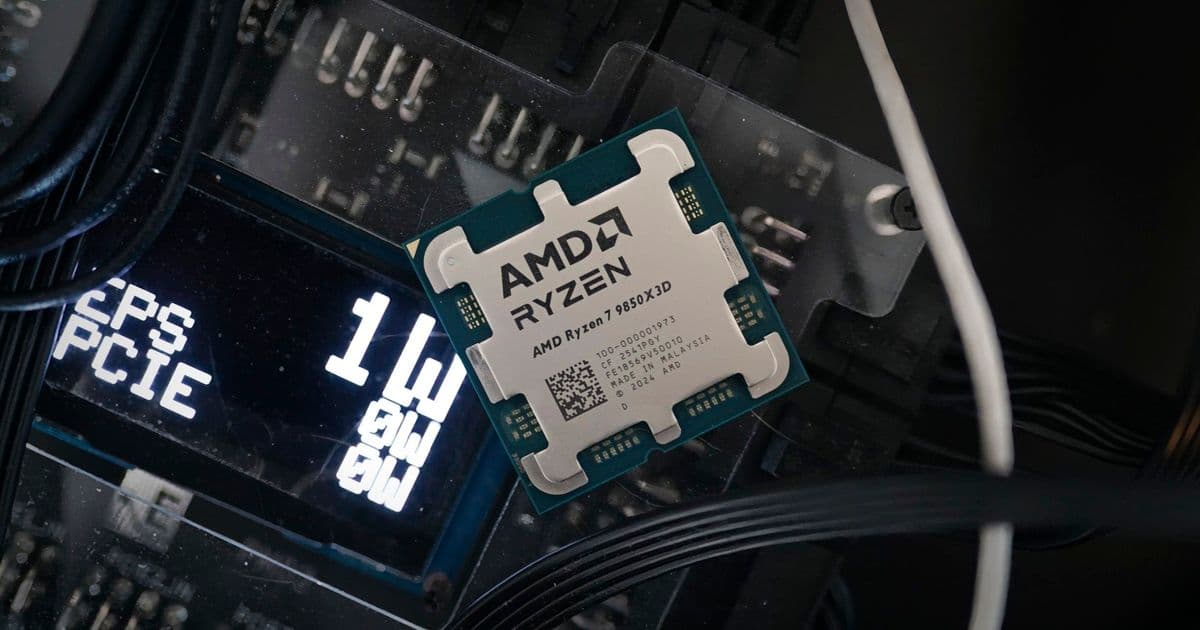
Intel and AMD executives report surging CPU demand driven by AI agents, with supply constraints emerging in key markets like China as the industry shifts toward multi-processor AI workloads.
Both Intel and AMD executives reported significant increases in CPU demand during the 2026 Morgan Stanley Technology, Media & Telecom Conference, citing artificial intelligence as the primary driver. The surge comes as AI agents require more sophisticated computing architectures that combine CPUs, GPUs, and NPUs to handle complex workflows.
Intel CFO David Zinsner told investors that "the CPU has become cool again this year," noting that AI agents need CPUs to orchestrate the computationally-heavy tasks that GPUs and NPUs execute. The company is now seeing customers seeking long-term agreements to ensure continuous chip supply for expanding operations. Meanwhile, AMD CEO Lisa Su reported that "the CPU portion of the business has actually far exceeded my expectations in terms of demand," driven by growing inference workloads.
This CPU demand surge follows a pattern established during the AI boom that began in late 2022. The industry first experienced GPU shortages as data centers and hyperscalers purchased components en masse to build massive GPU clusters. By mid-2025, graphics card supply began normalizing, but experts warned of emerging memory and storage chip shortages due to massive demand for high-bandwidth memory and enterprise-grade storage in AI data centers.
The current situation represents a broader challenge than previous component shortages. While GPU shortages primarily affected desktop PCs and gaming laptops with discrete graphics cards, memory and storage shortages impact virtually every modern digital device. From consumer electronics like smart TVs and smartphones to automobiles and industrial equipment, virtually all digital devices require memory and storage components.
AI advancement from large language models to autonomous agents has created new computational demands. These agents must observe, reason, plan, act, and learn independently, requiring multi-processor computing power that combines CPUs, GPUs, NPUs, and other specialized processors. This architectural shift has particularly impacted the Chinese market, where both Intel and AMD report server CPU supply shortages.
The shortage extends beyond traditional data center applications. The rise of local AI agents has driven increased demand for high-end Mac Studio and Mac mini systems, as developers build custom solutions using open-source frameworks like ClawedBot, MoltBot, and OpenClaw. However, both companies are primarily discussing data center demand, as consumer systems typically lack the memory capacity needed for sophisticated AI workloads.
This situation creates potential ripple effects for the consumer market. Over recent generations, AMD and Intel have converged their data center and consumer offerings, using similar microarchitectures across both segments to maximize yields. While some silicon unsuitable for data centers will still flow to consumers, a shift in focus toward enterprise applications could put downward pressure on consumer supply, similar to what occurred with RAM and SSD markets.
Despite the data center growth, both companies maintain significant consumer market presence. Unlike Nvidia, which has seen exponential data center revenue growth, AMD and Intel each derive approximately half their quarterly revenue from consumer markets. This balance suggests the consumer segment remains strategically important, though data center demand growth could strain overall supply chains.
The industry faces potential long-term consequences if supply constraints persist. Some analysts predict the end of entry-level PCs by 2028 if current trends continue, as component shortages and pricing pressures make basic systems economically unviable. Both Intel and AMD must navigate these challenges while maintaining their dual-market strategies to prevent further deterioration of the computer industry's health.
The AI-driven CPU demand represents a fundamental shift in computing architecture, moving from single-purpose processors to integrated systems where CPUs play a crucial orchestration role. As this transition accelerates, the ability of semiconductor manufacturers to scale production while maintaining supply chain stability will determine the pace of AI advancement across all computing segments.
Comments
Please log in or register to join the discussion