AMD is preparing a new CPPC Performance Priority feature for Linux, allowing users to set different minimum performance levels for individual CPU cores on upcoming Zen 6 processors.
AMD is preparing a new CPPC Performance Priority feature for Linux, allowing users to set different minimum performance levels for individual CPU cores on upcoming Zen 6 processors.

New Performance Control for Zen 6 Processors
Patches were posted today to the Linux kernel mailing list for enabling a new feature called AMD CPPC Performance Priority as a new hardware feature being found with "future AMD processors"... Which given the timing of these patches, almost certainly means the upcoming Zen 6 processors.
AMD CPPC Performance Priority is being added to the AMD P-State Linux driver used for handling of the CPU performance states / frequency scaling as part of the Linux CPUFreq power management code.
How It Works
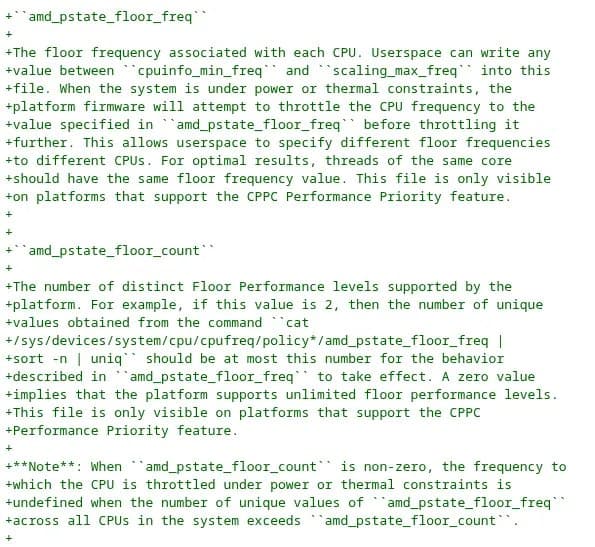
The feature is described as allowing userspace to specify different floor performance levels for different CPUs. The platform firmware takes these different floor performance levels into consideration while throttling the CPUs under power/thermal constraints.
The presence of this feature is advertised through bit 16 of EDX register for CPUID leaf 0x80000007. The number of distinct floor performance levels supported on the platform will be advertised through the bits 32:39 of the MSR_AMD_CPPC_CAP1. Bits 0:7 of a new MSR MSR_AMD_CPPC_REQ2 (0xc00102b5) will be used to specify the desired floor performance level for that CPU.
Practical Applications
This capability allows for granular control over CPU performance floors, enabling scenarios such as:
- Pinning important tasks to specific cores while setting high performance minimums for those cores
- Assigning low priority tasks to cores with reduced performance floors
- Optimizing power efficiency by matching performance requirements to workload importance
- Better thermal management through intelligent core prioritization
Linux Implementation
With these patches to the AMD P-State Linux driver, system administrators and user-space daemons can now specify desired performance floor values through new sysfs attributes:
floor_freq- Specifies the desired frequency floorfloor_count- Controls the number of distinct performance levels
This represents a significant extension of the existing ACPI Collaborative Processor Performance Control (CPPC) capabilities, giving Linux users unprecedented control over CPU performance management at the core level.
Windows Support Expected
Presumably Microsoft Windows will be implementing similar support for this AMD CPPC Performance Priority feature, though no official announcements have been made yet.
The AMD P-State patches for this AMD CPPC Performance Priority functionality are currently out for review on the kernel mailing list, indicating that support for this feature is actively being developed and should be available in upcoming Linux kernel releases alongside the launch of Zen 6 processors.
Comments
Please log in or register to join the discussion