AMD EPYC processors show 11-20% performance advantages in OCUDU's 5G/6G Radio Access Network benchmarks, positioning them as leaders for next-generation telco infrastructure.
AMD EPYC processors have demonstrated clear performance leadership in the emerging OCUDU (Open Centralized Unit Distributed Unit) 5G/6G Radio Access Network benchmarks, with the flagship EPYC 9755 "Turin" Zen 5 chips delivering 11-20% higher per-thread performance compared to Intel's top-tier Xeon 6980P "Granite Rapids" processors.
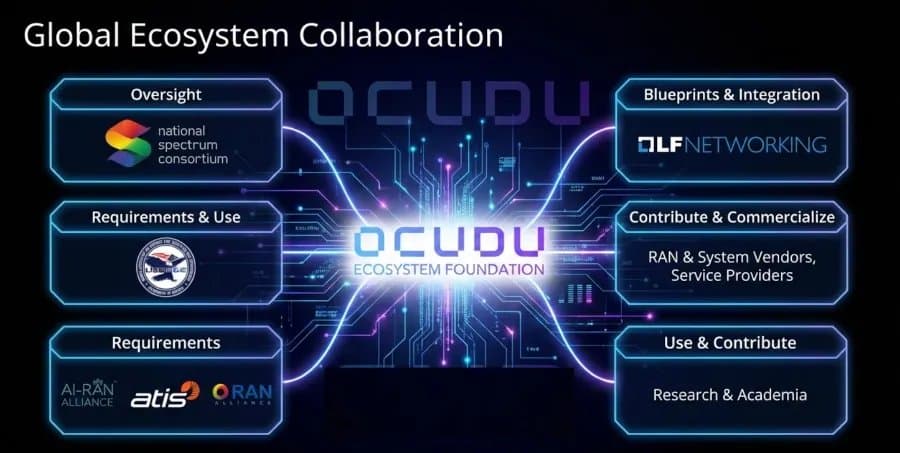
OCUDU Foundation Launches at MWC 2026
The Linux Foundation officially announced the OCUDU Ecosystem Foundation at Mobile World Congress, establishing a new open-source initiative for advancing 5G and early 6G network solutions. OCUDU builds upon the successful srsRAN Project by Software Radio Systems, evolving it into a comprehensive open-source stack for CU (Centralized Unit) and DU (Distributed Unit) components within Open RAN architectures.
The project has attracted significant industry backing, with premier members including SoftBank, NVIDIA, AMD, Nokia, Ericsson, AT&T, and Verizon. Development began last year with funding from the US Department of War National Spectrum Consortium through DeepSig and SRS, positioning OCUDU as a major player in the future of telecommunications infrastructure.
Benchmark Methodology and Test Configuration
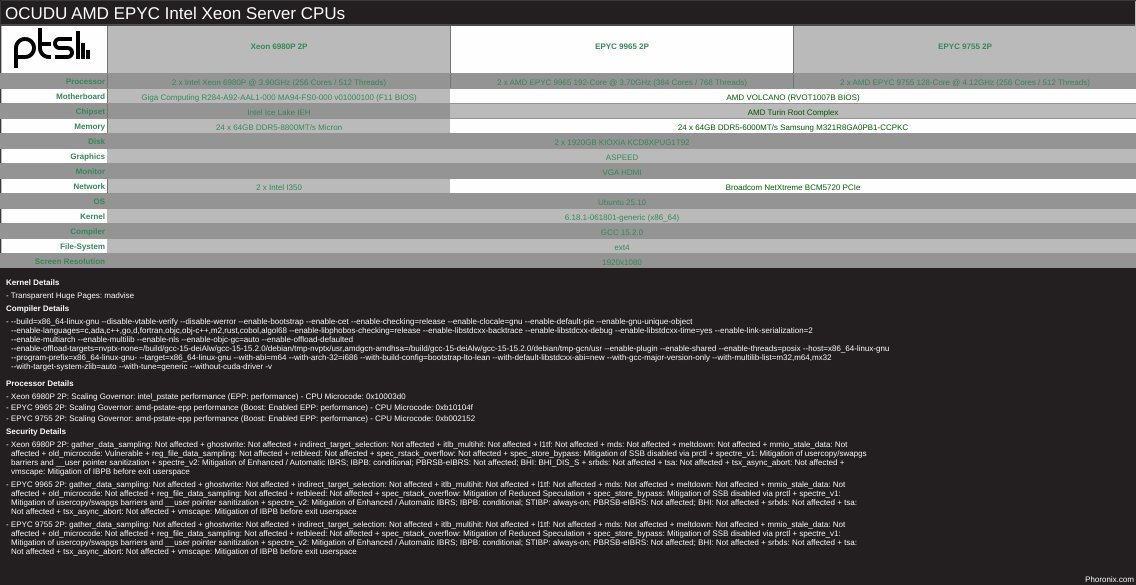
For this initial performance analysis, testing was conducted on dual-processor server configurations using Ubuntu 25.10 with Linux 6.18 kernel. The comparison included:
- Dual 128-core Intel Xeon 6980P (Granite Rapids) with MRDIMM-8800 memory
- Dual 128-core AMD EPYC 9755 "Turin" (Zen 5) with standard DDR5
- Dual 192-core AMD EPYC 9965 "Turin" (Zen 5C) with standard DDR5
All systems utilized identical PCIe Gen 5 NVMe SSD storage to ensure consistent I/O performance. The OCUDU benchmarks focused on per-thread performance metrics, as the total throughput benchmark currently has a hard-coded 256-thread limit that presented unresolved issues when manually adjusted.
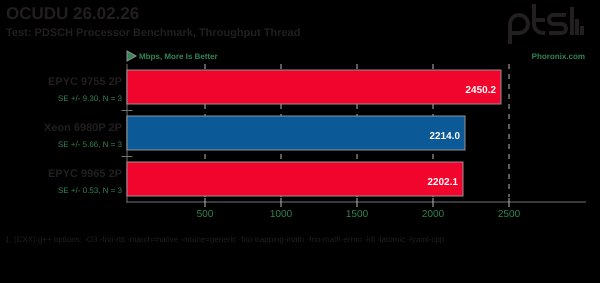
PDSCH Benchmark Results: EPYC 9755 Leads by 11%
The Physical Data Shared Channel (PDSCH) benchmark revealed the AMD EPYC 9755's "full fat" Zen 5 cores delivering 11% better single-thread performance than the Intel Xeon 6980P, despite the latter benefiting from high-bandwidth MRDIMM-8800 memory. The dense Zen 5C cores in the EPYC 9965 matched the Xeon's per-thread performance, though the 192-core configuration would dominate in total throughput scenarios due to its 1.5x core count advantage.
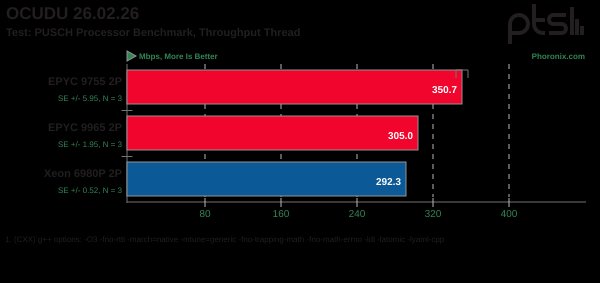
PUSCH Benchmark: EPYC Extends Lead to 20%
The Physical Uplink Shared Channel (PUSCH) benchmark showed even more compelling results for AMD. The EPYC 9965's Zen 5C cores achieved 4% higher per-thread performance than the Xeon 6980P, while the EPYC 9755's Zen 5 cores delivered approximately 20% better single-thread performance. This significant margin demonstrates AMD's architectural advantages in the specific workloads that OCUDU stresses.
Industry Implications and Future Outlook
These benchmark results position AMD EPYC processors as the preferred choice for telco operators and infrastructure providers building 5G/6G networks. The performance advantages are particularly relevant as the industry transitions toward Open RAN architectures that require efficient, high-performance compute for radio signal processing.
AMD's timing is strategic, with the company having announced its EPYC 8005 "Sorano" processors last week, specifically targeting Telco and RAN applications. Given the strong per-thread performance demonstrated by the current EPYC 9005 series, the Sorano processors should be exceptionally well-positioned for OCUDU and similar workloads when they ship.
Looking further ahead, AMD's EPYC Venice processors based on Zen 6 architecture are not far from release, promising to extend AMD's performance leadership even further in the server and telco segments.
The OCUDU project itself is targeting its first official release in April 2026, and these initial benchmark numbers suggest that AMD EPYC processors will be the dominant platform for organizations deploying open-source 5G/6G infrastructure solutions.
Comments
Please log in or register to join the discussion