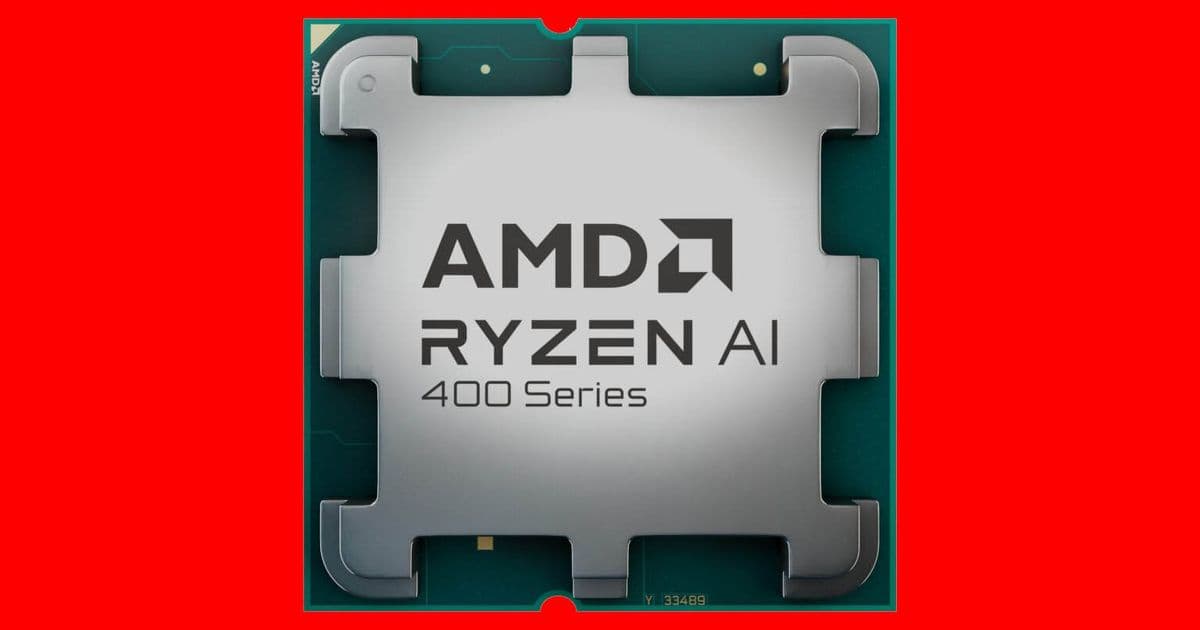
AMD unveils its first desktop processors with RDNA 3.5 graphics and XDNA 2 NPUs, bringing mobile-class AI capabilities to the AM5 platform.
At Mobile World Congress 2026, AMD has unveiled the Ryzen AI 400 and Ryzen AI PRO 400 desktop processor families, marking the company's first desktop chips to feature RDNA 3.5 integrated graphics and XDNA 2 neural processing units. These processors represent a significant shift in AMD's desktop strategy, bringing mobile-class architectures to the AM5 platform.
Mobile Architecture Comes to Desktop
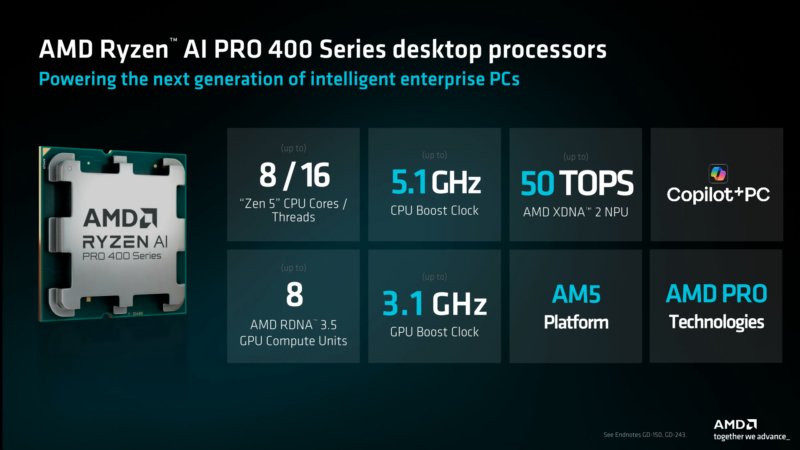
The Ryzen AI 400 desktop series is built on AMD's Gorgon Point silicon, specifically using the Krackan Point configuration that many users will recognize from AMD's mobile lineup. This architecture combines 4 Zen 5 performance cores with 4 Zen 5c efficiency cores, delivering a total of 8 CPU cores. The chips also feature 8 RDNA 3.5 GPU compute units and a 50 TOPS XDNA 2 NPU.
This marks the first time RDNA 3.5 and XDNA 2 have been available in desktop form factor, having previously only appeared on AMD's Ryzen AI 300 and Ryzen AI 400 mobile chips. The integration of these technologies brings desktop systems in line with Microsoft's Copilot+ local AI inference requirements, which demand NPUs capable of at least 40 TOPS performance.
Performance Positioning and Power Efficiency
AMD is positioning the Ryzen AI 400 series as lower-cost, lower-power alternatives to its existing Zen 5-based Ryzen 7 and Ryzen 5 processors. These chips are essentially the desktop successors to AMD's Ryzen 8000G lineup, targeting the same market segment with improved AI capabilities.
However, there's a notable performance trade-off. Compared to AMD's existing Ryzen 9000 (Granite Ridge) processors, the Ryzen AI 400 chips will have lower CPU performance due to their use of Zen 5c cores versus the pure Zen 5 cores in the Ryzen 9000 series. The Zen 5c cores, while more power-efficient, typically offer lower single-threaded performance than their standard Zen 5 counterparts.
On the graphics side, the newer RDNA 3.5 architecture and larger number of CUs provide better GPU performance than previous generations. The integrated GPUs range from 4 to 8 CUs depending on the SKU, with the top models featuring the 8 CU configuration.
TDP Options and SKU Lineup
AMD is offering the Ryzen AI 400 series in both standard and low-power configurations. The nominal TDP is 65 Watts, matching AMD's current lower-power Ryzen 9000 SKUs. Additionally, AMD is providing 35 Watt versions of all chips, which will carry the "E" suffix in their model names (e.g., Ryzen AI 7 450GE).
The initial lineup consists of six SKUs:
- Ryzen AI 7 450G/450GE: 4 Zen 5 + 4 Zen 5c cores, 16MB L3 cache, 5.1GHz boost, 8 CU GPU
- Ryzen AI 5 440G/440GE: 3 Zen 5 + 3 Zen 5c cores, 16MB L3 cache, 4.8GHz boost, 4 CU GPU
- Ryzen AI 5 435G/435GE: 2 Zen 5 + 4 Zen 5c cores, 8MB L3 cache, 4.5GHz boost, 4 CU GPU
Notably absent from the desktop lineup are the higher-end Ryzen AI 400 mobile chips like the Ryzen AI 9 HX 475, which features more CPU cores and twice as many GPU cores. This means desktop users won't get socketed equivalents of AMD's most powerful mobile AI processors.
PRO Series for Commercial Markets
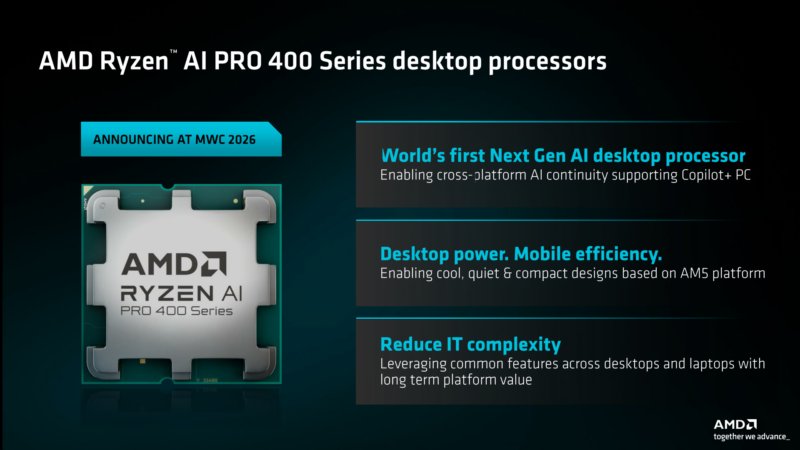
Alongside the standard desktop chips, AMD is simultaneously launching the PRO versions under the Ryzen AI PRO 400 branding. These are AMD's primary focus at MWC, targeting the commercial client market.
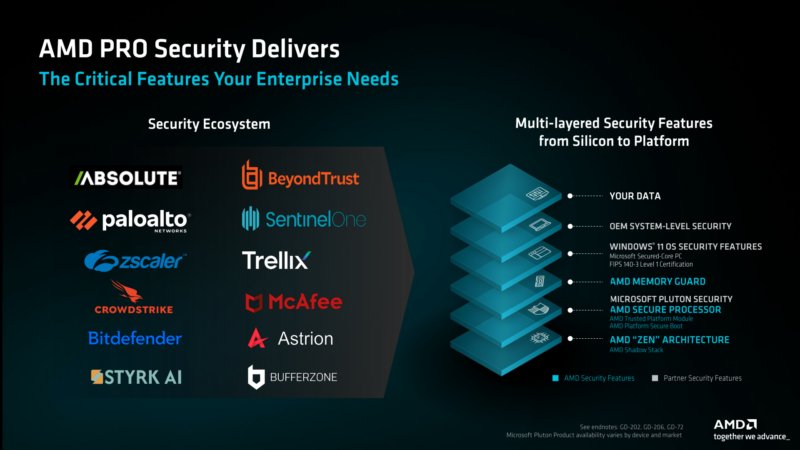
The PRO chips include AMD's suite of IT management and security technologies, such as AMD Memory Guard for full memory encryption and cloud-based recovery capabilities. This makes them particularly attractive for enterprise deployments where security and manageability are paramount.
Market Availability and System Integration
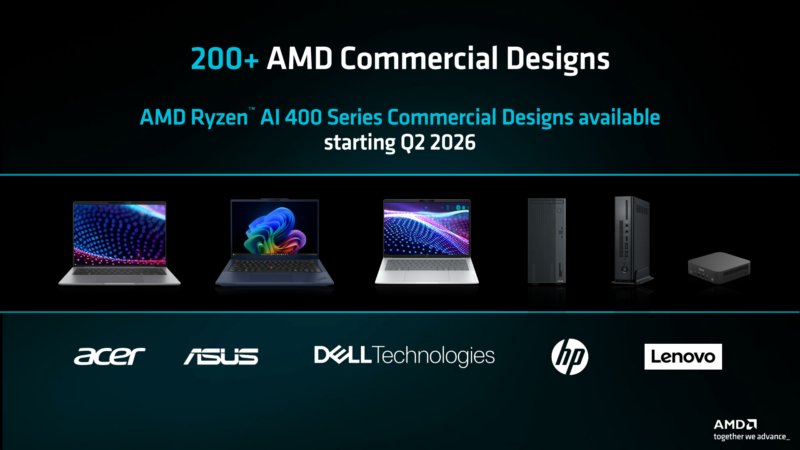
AMD indicates that the first Ryzen AI 400 desktop systems should be available shortly, with some systems already shipping now. The majority of systems are expected to land in Q2 of 2026. The use of AMD's tried-and-true AM5 socket means these chips can be quickly integrated into existing commercial system designs without requiring new motherboard platforms.
This launch represents AMD's strategy to bring AI acceleration capabilities to a broader range of desktop systems while maintaining power efficiency and competitive pricing. By leveraging mobile architectures, AMD can offer features like NPUs and advanced integrated graphics at price points that would be difficult to achieve with discrete components.
The Ryzen AI 400 series fills an important niche in AMD's product stack, providing an accessible entry point to AI-accelerated computing for both consumer and commercial desktop users. As AI workloads become increasingly common in everyday applications, having integrated NPUs and capable integrated graphics becomes more valuable, even for users who don't require the absolute highest CPU performance.
Comments
Please log in or register to join the discussion