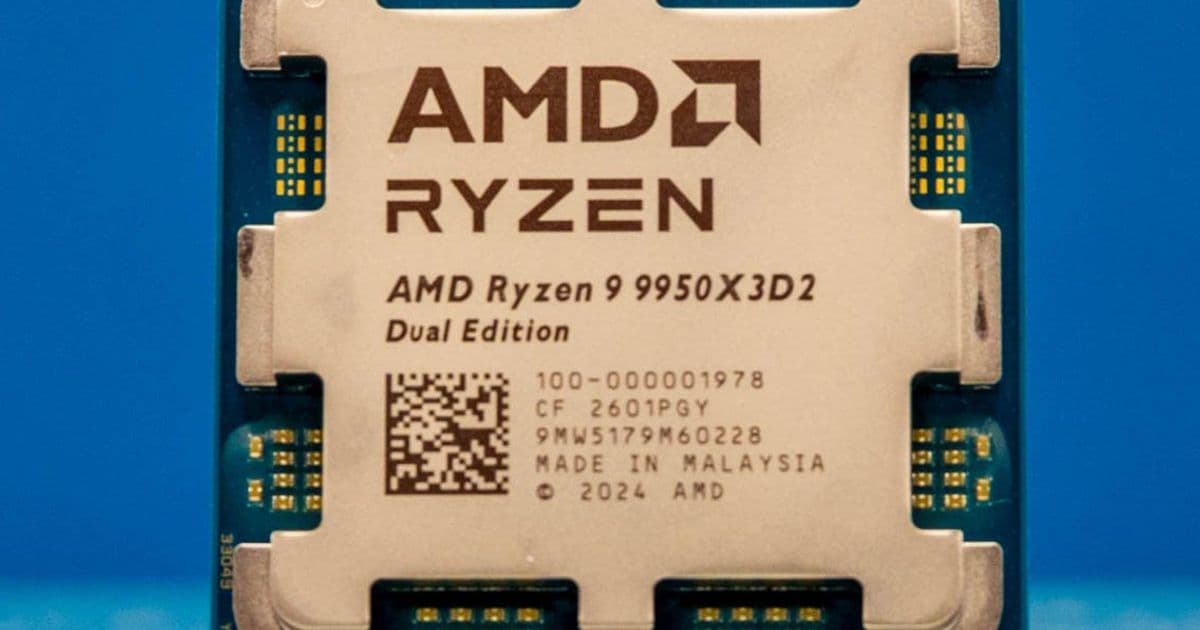
AMD's final Zen 5 flagship brings dual V-Cache to both CCDs for the first time in consumer CPUs, targeting professional workloads with 192MB of L3 cache and 200W TDP.
Workstation processors have reached new heights with AMD's latest halo product, the Ryzen 9 9950X3D2 Dual Edition. As the Zen 5 architecture enters its second half, AMD is delivering something unprecedented: a consumer CPU with V-Cache technology on both CPU dies.
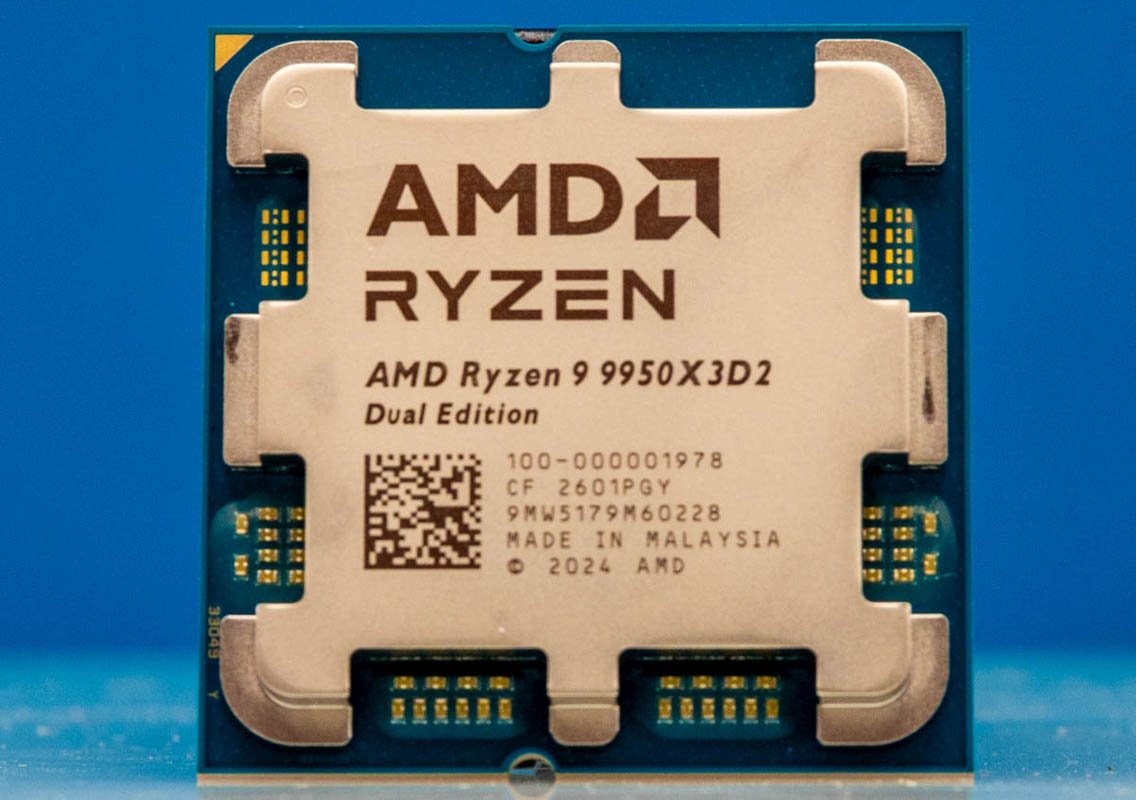
The Architecture Behind Dual V-Cache
The Ryzen 9 9950X3D2 represents a significant evolution in AMD's cache technology. While previous X3D processors only featured stacked cache on a single Core Complex Die (CCD), this new flagship places 96MB of V-Cache on each of its two CCDs, totaling an unprecedented 192MB of L3 cache.
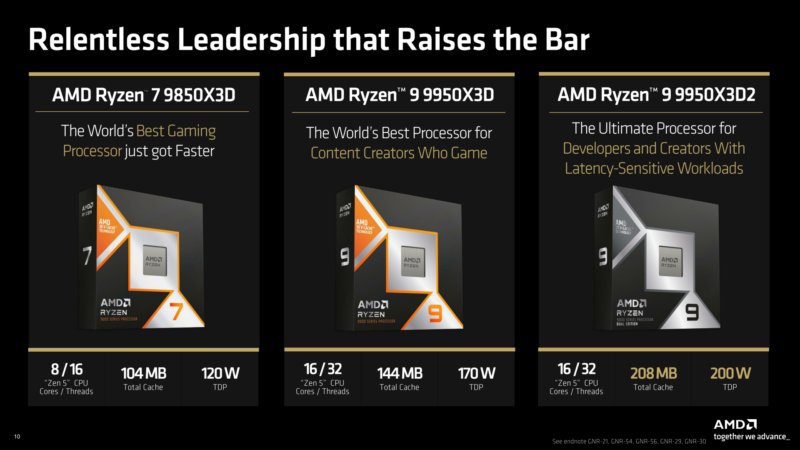
This configuration addresses a long-standing architectural challenge. In AMD's chiplet design, CPU cores within a single CCD communicate with minimal latency, but accessing data across CCDs through the I/O die incurs approximately 65ns of additional latency. For workloads that frequently access data stored in another CCD's cache, this cross-die communication can significantly impact performance.
Technical Specifications
| Processor | Cores | Standard Cores | Turbo Freq | L2 Cache | L3 Cache | TDP | Price |
|---|---|---|---|---|---|---|---|
| Ryzen 9 9950X3D2 | 16 | n/a | 5.6GHz | 16 MB | 192 MB | 200W | $899 |
| Ryzen 9 9950X3D | 8 | 8 | 5.7GHz | 16 MB | 128 MB | 170W | $657 |
| Ryzen 9 9950X | n/a | 16 | 5.7GHz | 16 MB | 64 MB | 170W | $520 |
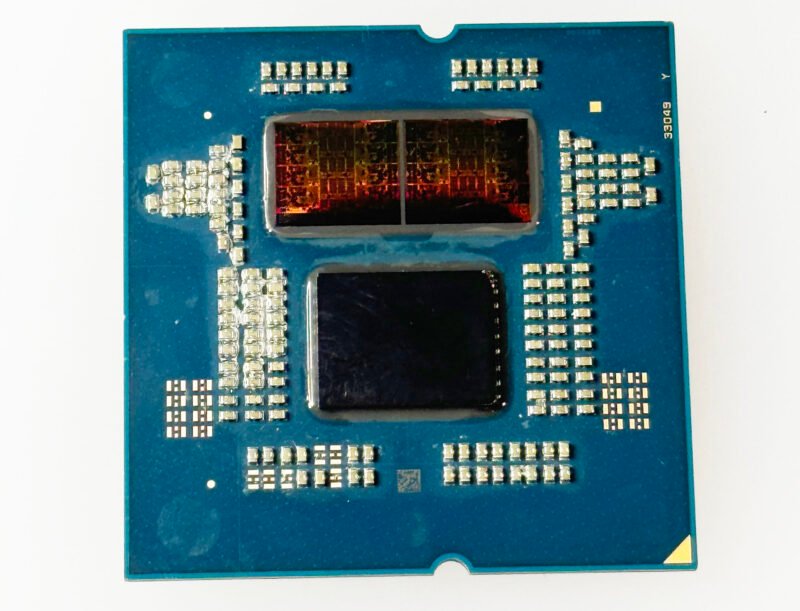
The 9950X3D2 maintains AMD's chiplet-based approach, pairing two Zen 5 CCDs with an I/O die. This design allows AMD to manufacture CPU cores on cutting-edge process nodes while keeping the I/O die on a more mature, cost-effective process.
Performance Trade-offs and Benefits
AMD's decision to implement V-Cache on both CCDs comes with specific trade-offs. The second-generation V-Cache technology reduces the clock speed penalty to just 100MHz compared to standard CCDs, making dual-cache configurations more viable than the first generation's several hundred megahertz reduction.
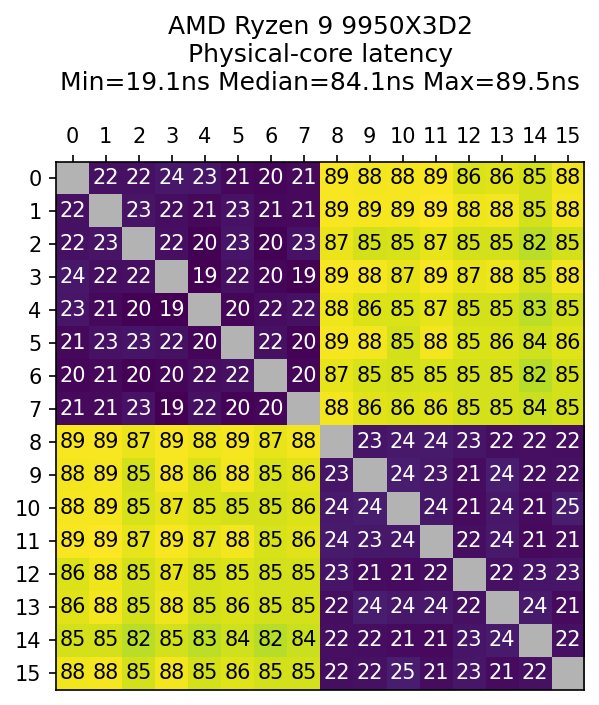
For professional workloads that benefit from large caches and can effectively utilize all 16 cores, the 9950X3D2 offers compelling advantages. Content creators, developers, and other professionals working with highly parallel tasks can leverage the additional cache to keep more data close to the CPU cores, reducing memory access latency.
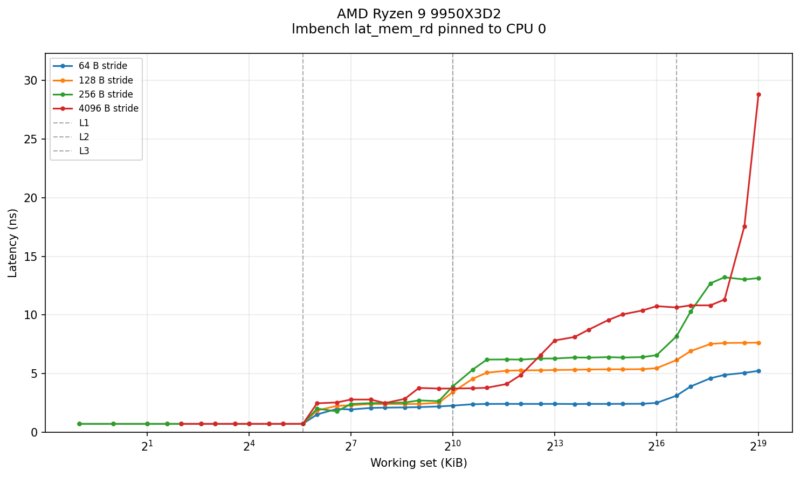
However, the chip's architecture still faces the fundamental challenge of cross-CCD communication. Workloads that frequently need to access data stored in the cache of the opposite CCD will experience performance penalties, though the expanded total cache capacity increases the likelihood that critical data remains accessible within the local CCD.
Market Positioning and Target Workloads
Unlike previous X3D processors that AMD explicitly marketed for gaming, the 9950X3D2 takes a different approach. AMD is positioning this chip squarely at the professional market, targeting developers, content creators, and other users with workloads that can benefit from the expanded cache architecture.
This strategic shift makes sense given the chip's $899 price point and the nature of workloads that benefit from dual-V-Cache configurations. Gaming performance, while still excellent, is not the primary focus since games typically don't benefit significantly from additional cache on the second CCD.
Power and Thermal Considerations
The 9950X3D2 pushes the envelope with a 200W TDP, reflecting AMD's commitment to extracting maximum performance from the Zen 5 architecture. This higher power envelope provides headroom for the chip to maintain boost clocks under heavy workloads, though it also means more robust cooling solutions will be necessary.
Final Thoughts
The Ryzen 9 9950X3D2 Dual Edition represents AMD's final flourish for the Zen 5 generation. By implementing V-Cache on both CCDs, AMD has created a unique product that fills a specific niche in the high-performance desktop market. While not a universal solution for all workloads, it offers compelling performance for professionals who can leverage its architectural advantages.
The chip goes on sale today at retail and through OEM systems, marking the end of an era for AMD's current desktop architecture while setting the stage for what comes next in the company's processor roadmap.
Comments
Please log in or register to join the discussion