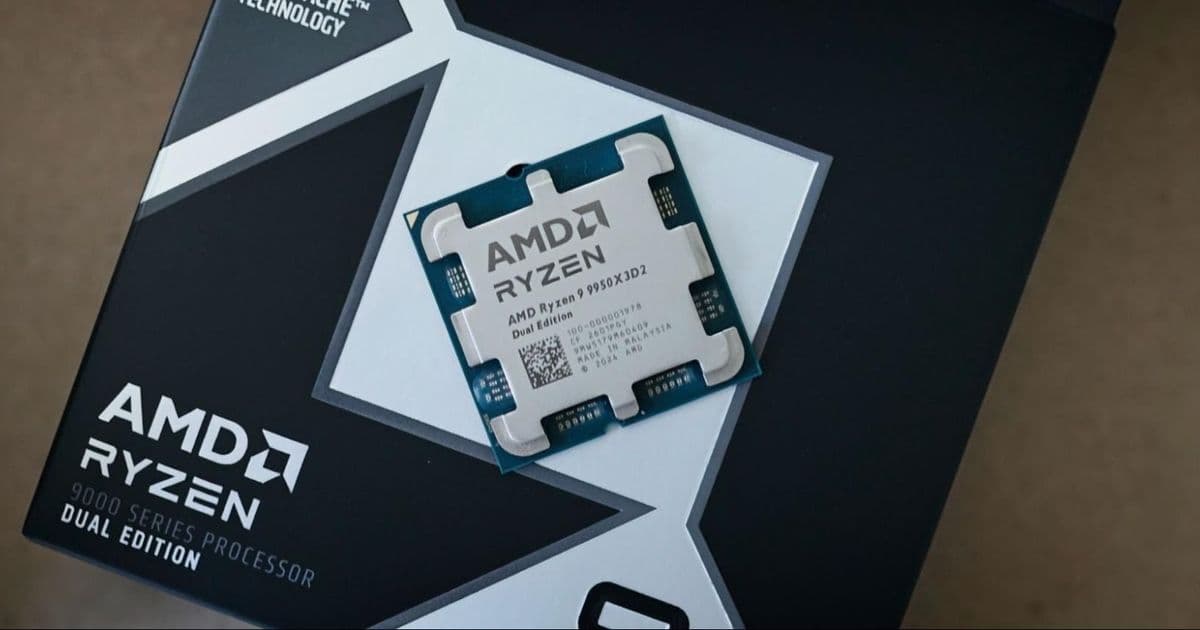
AMD's first dual-3D V-Cache CPU offers niche performance gains but struggles to justify its $900 price tag for most users.
The Ryzen 9 9950X3D2 isn't worth the money for the vast majority of people, but it was never meant to be. It's a halo product with some surprising upsides in a few niche workloads, and it stands as AMD's first-ever dual-3D V-Cache CPU.
A CPU Cranked to 11
Given the prevalence of AMD's dual-CCD 3D V-Cache-equipped X3D CPUs among the best CPUs for gaming and our CPU benchmark hierarchy, a natural question has formed in the minds of PC enthusiasts since the first model launched: What if you stacked cache on both CCDs? AMD has restricted its wildly popular (and marketable) 3D V-Cache to a single CCD on its Ryzen 9 models, leaving a natural slot for a CPU that stacked cache on both CCDs.
The Ryzen 9 9950X3D2 Dual Edition finally brings that idea to the company's long-lived AM5 platform. It's a fascinating CPU, and not just because it's the first of its kind. For starters, it's the most expensive Ryzen CPU AMD has ever released — Intel messed around with $1,000+ consumer CPUs years ago — with a recommended retail price of $899. Anything above that price goes into the Threadripper range.
It's also a halo product launching in a PC market that's plagued by inflated prices, from ongoing RAM and SSD price increases to the ever-present climb of GPU prices. Instead of just offering a binned version of the 9950X3D, similar to what we saw with the Ryzen 7 9850X3D, AMD is bridging the gap between its consumer and HEDT ranges with the 9950X3D2. It's firmly a workstation-class processor, with little to no advantage in games, and even slight regressions in some titles.
There are some minor advantages in application performance, particularly in heavily-threaded workloads like rendering and encoding, though not enough to justify the $899 price tag. The performance improvements show up mainly in specialized workloads in fields like data science, where massive instructions can show the latency benefits of having L3 access easily available on both CCDs.
Looking at overall performance, the Ryzen 7 9850X3D offers a better gaming experience while the 9950X3D delivers a greater value in applications. But for these specialized workloads, AMD is offering performance increases as large as 25%. Our full benchmarks provide a look into those advantages, spanning gaming, productivity, and power testing.
The Ryzen 9 9950X3D2 was never meant to be a mass market CPU, and our testing goes further to prove that it's a niche product for a small audience. Take 100 PC builders, and we'd recommend another chip to 99 of them. For that small market, however, the 9950X3D2 delivers.
AMD Ryzen 9 9950X3D2 Specifications and Pricing
Swipe to scroll horizontally
| CPU / (MSRP) | Street Price | Architecture | Cache (L2 + L3) | Cores/Threads (P+E) | Base/Boost Clock (GHz) | TDP / Maximum Power |
|---|---|---|---|---|---|---|
| Ryzen 9 9950X3D 2 Dual Edition ($900) | $900 | Zen 5 X3D | 208 MB | 16 / 32 | 4.3 / 5.6 | 200W / 270W |
| Ryzen 9 9950X3D ($700) | $676 | Zen 5 X3D | 144 MB | 16 / 32 | 4.3 / 5.7 | 170W / 230W |
| Ryzen 9 9950X ($650) | $520 | Zen 5 | 80 MB | 16 / 32 | 4.7 / 5.7 | 170W / 230W |
| Ryzen 9 9900X3D ($600) | $530 | Zen 5 X3D | 140 MB | 12 / 24 | 4.4 / 5.5 | 120W / 230W |
| Ryzen 9 9900X ($500) | $439 | Zen 5 | 76 MB | 12 / 24 | 4.4 / 5.6 | 120W / 162W |
| Ryzen 7 9850X3D ($500) | $499 | Zen 5 X3D | 104 MB | 8 / 16 | 4.7 / 5.6 | 120W / 162W |
| Ryzen 7 9800X3D ($480) | $464 | Zen 5 X3D | 104 MB | 8 / 16 | 4.7 / 5.2 | 120W / 162W |
| Ryzen 7 9700X ($360) | $305 | Zen 5 | 40 MB | 8 / 16 | 3.8 / 5.5 | 65W / 88W |
| Ryzen 5 9600X ($280) | $188 | Zen 5 | 38 MB | 6 / 12 | 3.9 / 5.4 | 65W / 88W |
AMD's 12- and 16-core X3D chips only use the stacked cache on one of their two CCDs, effectively giving only eight of their cores instant access to the large pool of L3. The Ryzen 9 9950X3D2 changes things up by putting the SRAM chunk on both CCDs.
The Dual-Cache Architecture
It's not double the cache of the 9950X3D, however, just double the amount of stacked cache. Each Zen 5 CCD has 32 MB of L3 cache, so the 9950X, for example, has 64 MB of L3 total. The 9950X3D boosts that to 128 MB by stacking an additional 64 MB under one CCD. Here, we have the extra 64 MB under both CCDs for a total of 192 MB of L3.
Particularly in heavily-threaded tasks, the goal it seems is to keep data close to the cores. For the other eight cores that otherwise wouldn't have access to the large, shared pool of L3, they now don't need to cross over to other CCD to get the data they need. That's the idea, at least.
Adding extra cache comes with downsides, particularly in thermal and power demands. The Ryzen 9 9950X3D2 peaks slightly lower than its single-cache counterpart at 5.6 GHz, and it demands a 200W TDP, with a peak platform power of 270W; the highest of any consumer Zen 5 CPU. You still get the same 16 Zen 5 cores and 32 threads as the Ryzen 9 9950X3D and Ryzen 9 9950X, however.
The haircut in peak clock speed is telling here, suggesting that a dual cache X3D part wouldn't have been possible with the previous Zen 4 design. AMD previously stacked the cache on top of the CCD, insulating the cores from direct access to the IHS. Now, the extra cache is under the CCD. That not only allows the Ryzen 9 9950X3D2 to maintain a high-end thermal design, but also to offer full overclocking support, alongside AMD's Precision Boost Overdrive (PBO).
Cache Latency Testing
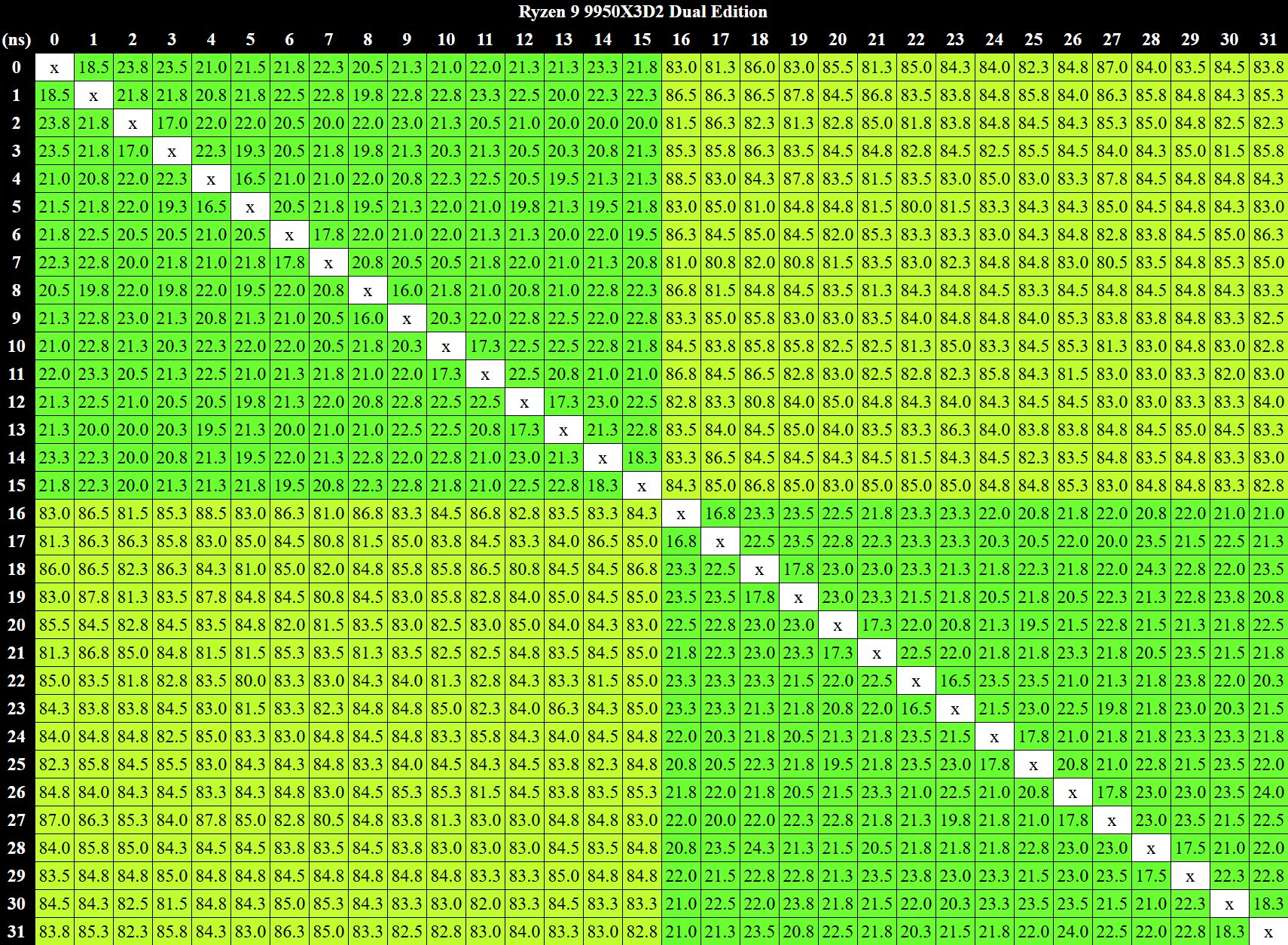
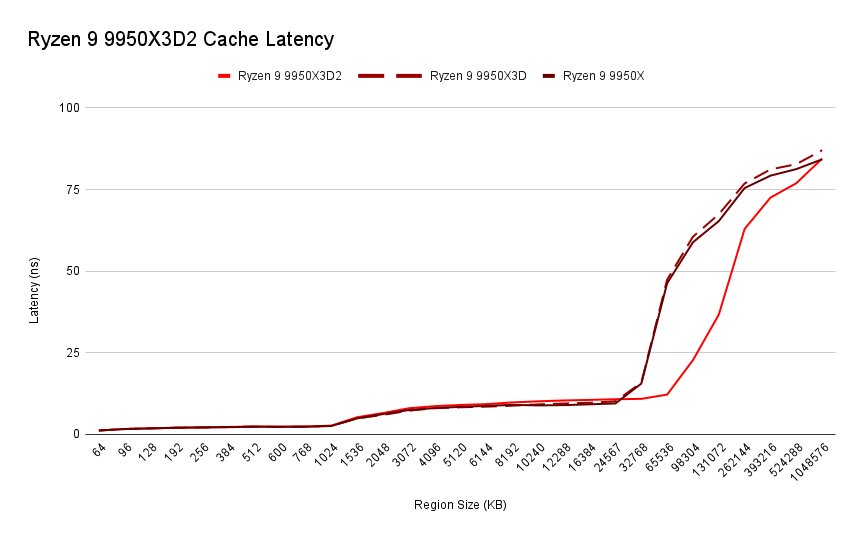
The Ryzen 9 9950X3D2 is the first 3D V-Cache CPU to have stacked L3 cache on both CCDs. The natural question: Does that actually matter? More cache is more cache, but the additional stack here seems like it has less to do with capacity and more to do with latency.
As mentioned, if you can access data from L3 on CCD 2, that means you don't need to go over to CCD 1, which creates additional latency. Now, we can look at our latency testing, which measures the time in nanoseconds when allocating different region sizes. Both the Ryzen 9 9950X3D and the non-X3D model see a big increase in latency past about 32 MB, which is the amount of L3 that's actually on the CCD (the extra 64 MB is stacked for the Ryzen 9 9950X3D).
The Ryzen 9 9950X3D2 extends that further, to around 64 MB. This doesn't translate directly into better performance, mind you. Lower latency is better performance, but we're already looking at a truncated version of this chart, starting with a 64 KB region size. The benefits show up when you're pushing past that normal 32 MB L3 chunk on a Zen 5 CCD.
For specialized workloads in data science, simulation, and other compute-intensive applications where data locality matters, the dual-cache design can provide meaningful performance advantages. In our testing, we saw improvements of up to 25% in certain workloads, though these gains were highly dependent on the specific application and workload characteristics.
Market Position and Value Proposition
The Ryzen 9 9950X3D2 occupies an interesting position in AMD's product stack. At $899, it's positioned between the standard Ryzen 9 9950X3D ($700) and AMD's Threadripper workstation CPUs. This pricing strategy suggests AMD sees this as a bridge product between high-end consumer and workstation segments.
However, the value proposition is challenging. For gaming, the Ryzen 7 9800X3D at $480 offers better performance at a significantly lower price point. For general productivity and content creation, the standard 9950X3D provides similar performance at a $200 discount. The 9950X3D2's advantages only materialize in specific, cache-sensitive workloads.
In the current market environment, with rising component prices across the board, a $900 CPU represents a significant investment. The question becomes whether the performance gains in specialized workloads justify the premium over more versatile alternatives.
Technical Innovation and Future Implications
The 9950X3D2 represents an interesting technical achievement. Moving the stacked cache underneath the CCD rather than on top represents a significant engineering challenge that AMD has overcome. This approach allows for better thermal management and enables full overclocking support — features that were limited or unavailable on previous X3D CPUs.
This design change suggests AMD is learning from the limitations of its first-generation 3D V-Cache implementation. The ability to overclock and the improved thermal characteristics could influence future CPU designs, potentially bringing 3D V-Cache benefits to a broader range of applications and use cases.
The dual-cache approach also hints at future possibilities. As manufacturing processes improve and thermal challenges are better managed, we could see even more aggressive cache stacking strategies. The question becomes how much cache is beneficial before diminishing returns set in, and what types of workloads can actually utilize such large amounts of on-chip memory.
Conclusion
The AMD Ryzen 9 9950X3D2 is a technically impressive CPU that pushes the boundaries of what's possible with 3D V-Cache technology. However, its $900 price tag and niche performance advantages make it a difficult recommendation for most users. It's a halo product that demonstrates AMD's engineering capabilities but struggles to find a broad market fit.
For the small subset of users running cache-sensitive workloads, the 9950X3D2 offers compelling performance gains. For everyone else, more balanced alternatives like the Ryzen 7 9800X3D for gaming or the standard 9950X3D for productivity provide better overall value.
The real significance of the 9950X3D2 may lie in what it represents for future CPU designs rather than its immediate market impact. The technical innovations in cache placement and thermal management could influence AMD's product roadmap for years to come, potentially bringing the benefits of large on-chip caches to a wider range of applications and users.
In a market where component prices continue to rise, the 9950X3D2 serves as a reminder that cutting-edge technology often comes at a premium. Whether that premium is worth paying depends entirely on your specific use case and performance requirements.
Comments
Please log in or register to join the discussion