
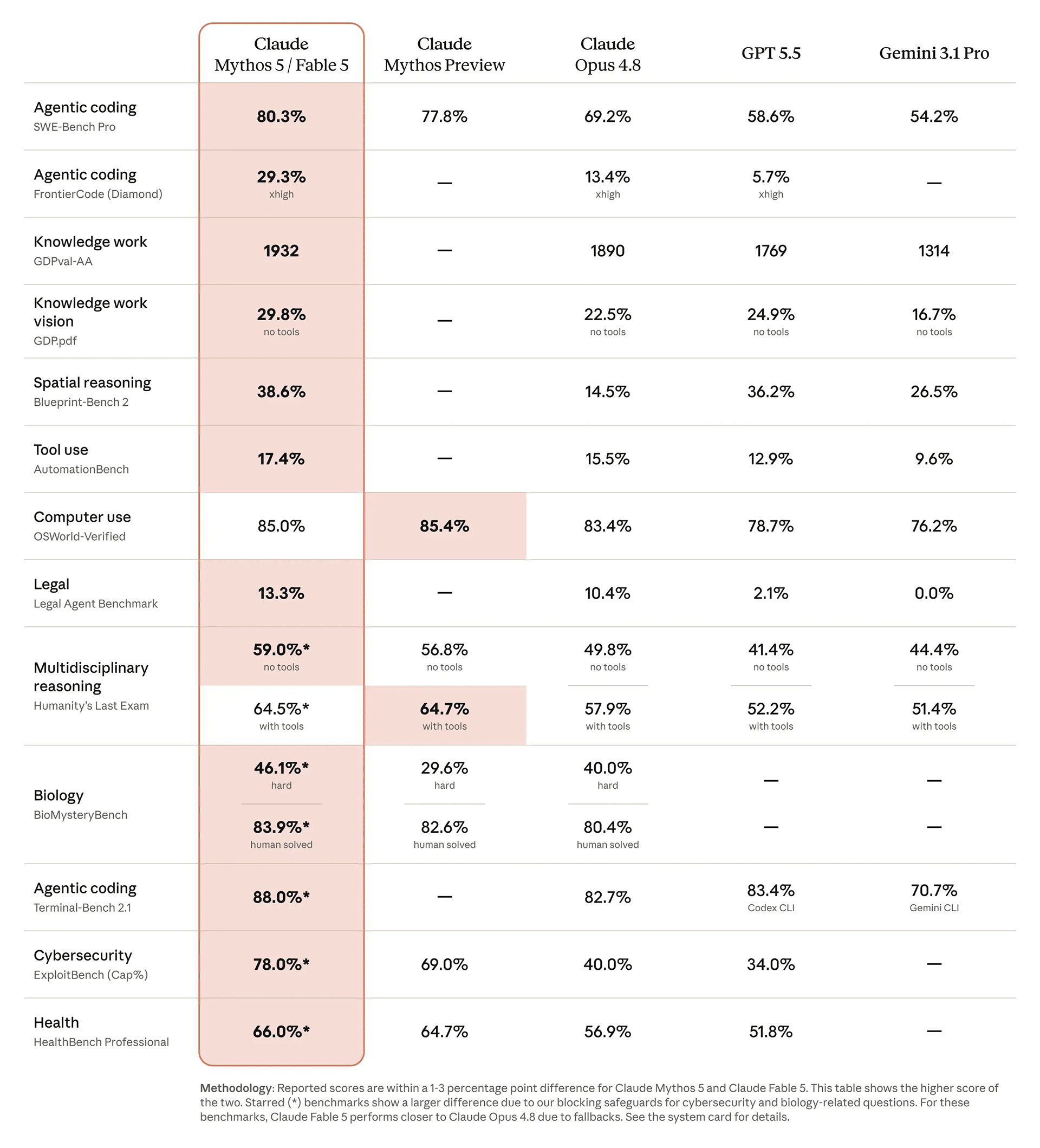
Anthropic's long-teased Mythos system reaches the public as Claude Fable 5, a frontier model the company calls state-of-the-art on nearly every benchmark it tested. The release pairs record autonomy claims, including a 50-million-line codebase migration done in a day, with hard capability limits and pricing that runs 2x to 3x the company's previous flagships.
Anthropic has released Claude Fable 5, the first publicly available model derived from the Mythos architecture it disclosed back in April. The company describes Fable 5 as "state-of-the-art on nearly all tested benchmarks" and, more notably, the first model of this class it considers "safe for general use." Alongside the public release, Anthropic is shipping an unrestricted Mythos 5 variant to members of its Project Glasswing program for sensitive cybersecurity and biology work.

The headline numbers are familiar territory for frontier launches: a sweep of widely accepted benchmarks, with vision singled out as a category where Fable 5 is "the new state-of-the-art model." But the more useful signal sits in the workload claims. Anthropic points to Stripe migrating a 50-million-line Ruby codebase in a single day, a job the company says would have taken a human team roughly two months. That is the kind of task-compression figure that matters more than a leaderboard delta, because it implies the model can hold context and stay on-task across long autonomous runs rather than just answering well in short bursts.
Autonomy is the real spec sheet
Anthropic frames Fable 5 and Mythos 5 as able to "work autonomously for longer than any previous Claude models," and the supporting examples lean hard on duration. Wharton professor Ethan Mollick handed Fable a 19-page specification for a tool to categorize and analyze unstructured survey responses. He reports the model worked for "nine and a half hours" to produce what he called an "extremely sophisticated" tool, the sort of thing "researchers have needed for years but was never profitable to create."
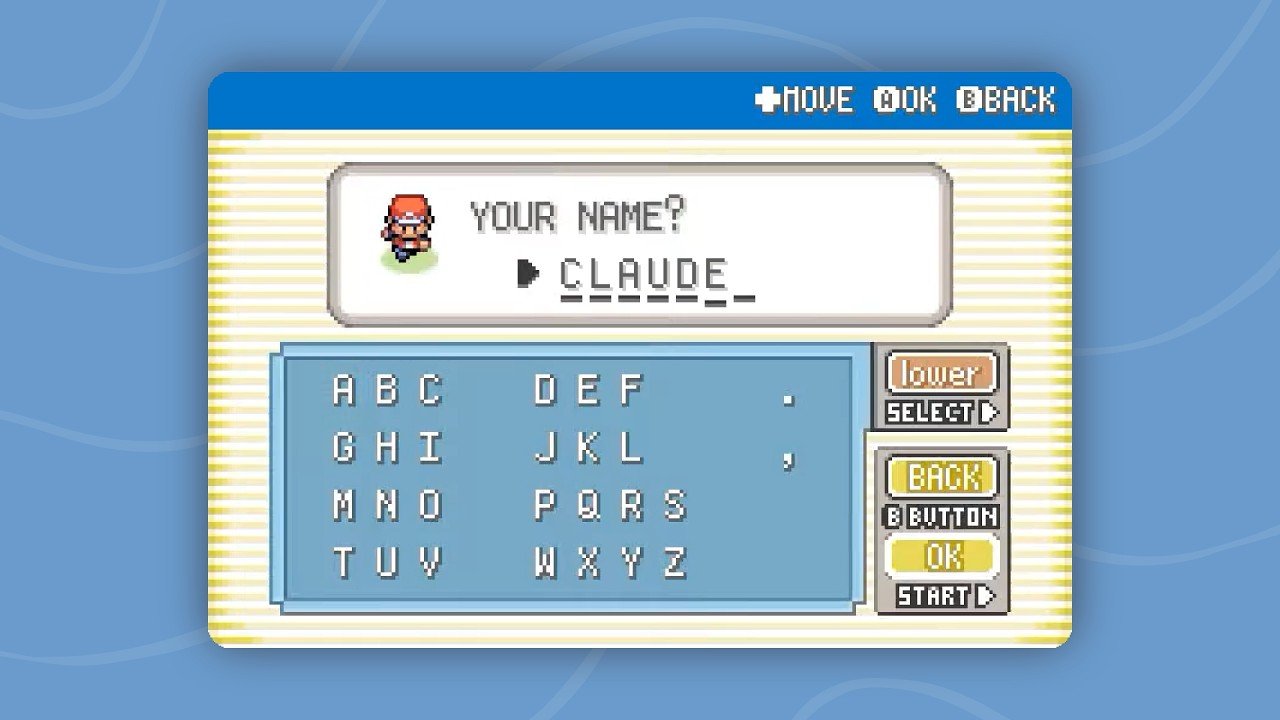
On vision specifically, the company says Fable 5 played through Pokémon FireRed start to finish using only a "minimal, vision-only harness," with no tool-calling lifeline. Earlier models reportedly stalled on the same task even when allowed to reach for outside help. It is a stunt benchmark, but a revealing one: completing a long game purely from pixels requires sustained state tracking and planning across thousands of frames, which is a closer proxy for agentic reliability than a single screenshot Q&A.
The guardrails are aggressive by design
The defining characteristic of this release is restriction. To keep Mythos-level capability away from misuse, Anthropic says it will redirect queries touching "cybersecurity, biology and chemistry, or distillation" to the previous-generation Claude Opus 4.8 instead. Users are told when redirection happens, and the company estimates it triggers in "less than 5%" of interactions.
That estimate is already contested. Mollick reports the limits trip "at the faintest hint of a security problem," which suggests defensive practitioners trying to harden their own code may find themselves bounced to the older model more often than the headline figure implies. Anthropic's model card also notes that Fable 5 is deliberately weakened when used to push frontier AI or ML research, a constraint the company ties to its concerns about AI self-improvement, and one that conveniently doubles as protection against competitive and geopolitical distillation.
Pricing and access
Fable 5 is available everywhere today through Anthropic's API at $10 per million input tokens and $50 per million output tokens. That is twice the cost of the now-previous-generation Opus 4.8 and a little over three times the cost of Sonnet 4.6. The pricing makes the positioning clear: this is a model for high-value autonomous work where a nine-hour run replaces weeks of human effort, not for high-volume routine calls where Sonnet remains the economical choice.

Subscribers on Pro, Max, Team, and Enterprise plans get a short free access window through June 22, after which using Fable 5 will require usage credits. Anthropic says it will restore plan-included access "as quickly as we can" once it has the compute capacity, a candid admission that supply, not demand, is the current bottleneck for a model this expensive to serve.
The broader takeaway is that the industry now has a publicly accessible Mythos-class system, and the interesting questions are no longer about raw capability but about where the company has chosen to draw the lines. A model that can autonomously rewrite a 50-million-line codebase, yet refuses to help audit a security flaw, is a deliberate trade between capability and control. How well that trade holds up in practice, and how often the redirection fires for legitimate users, will say more about Fable 5's real-world value than any benchmark chart. The technology is here; the constraints around it are now the story worth watching.
Comments
Please log in or register to join the discussion