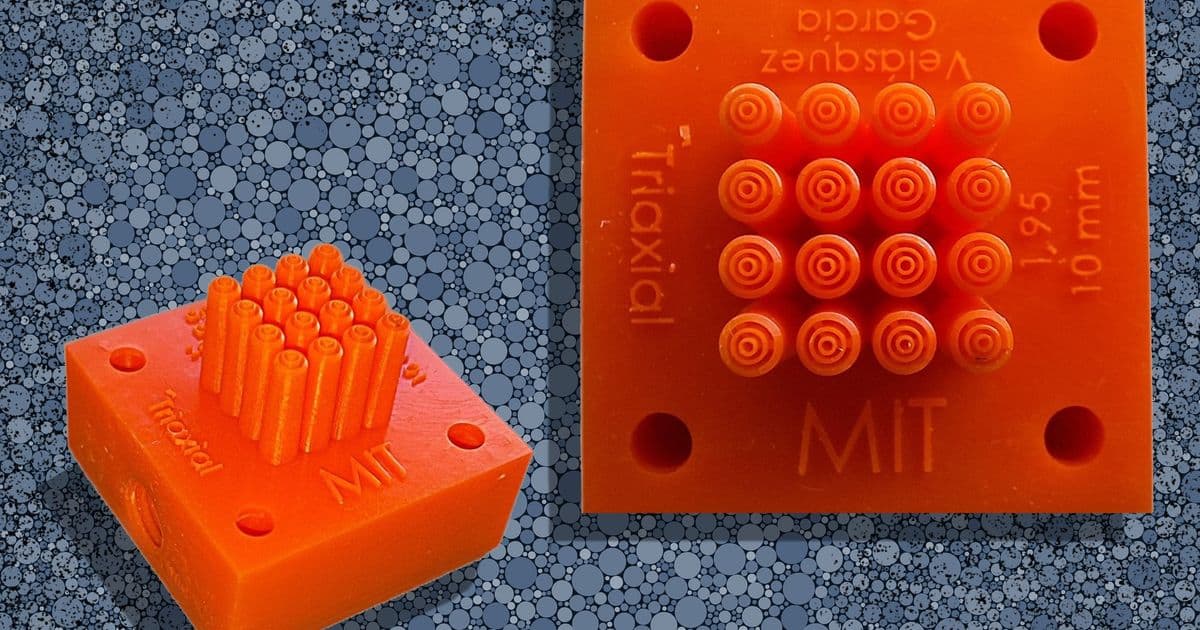
A team at MIT printed arrays of three-channel electrospray nozzles that sidestep the cleanroom, producing uniform three-layered microdroplets at scale. The work points toward cheaper, faster manufacturing of time-release drug particles and self-healing materials.
MIT researchers have built arrays of triaxial electrospray emitters using nothing more exotic than a high-resolution 3D printer, and in doing so they have removed one of the main bottlenecks that has kept layered microparticle manufacturing locked inside semiconductor fabs. The devices, described in Virtual and Physical Prototyping, dispense three immiscible liquids from concentric nozzles to form droplets with three distinct shells. Those droplets can solidify into compound microparticles useful for time-release medicine, biosensors, and self-healing composites.
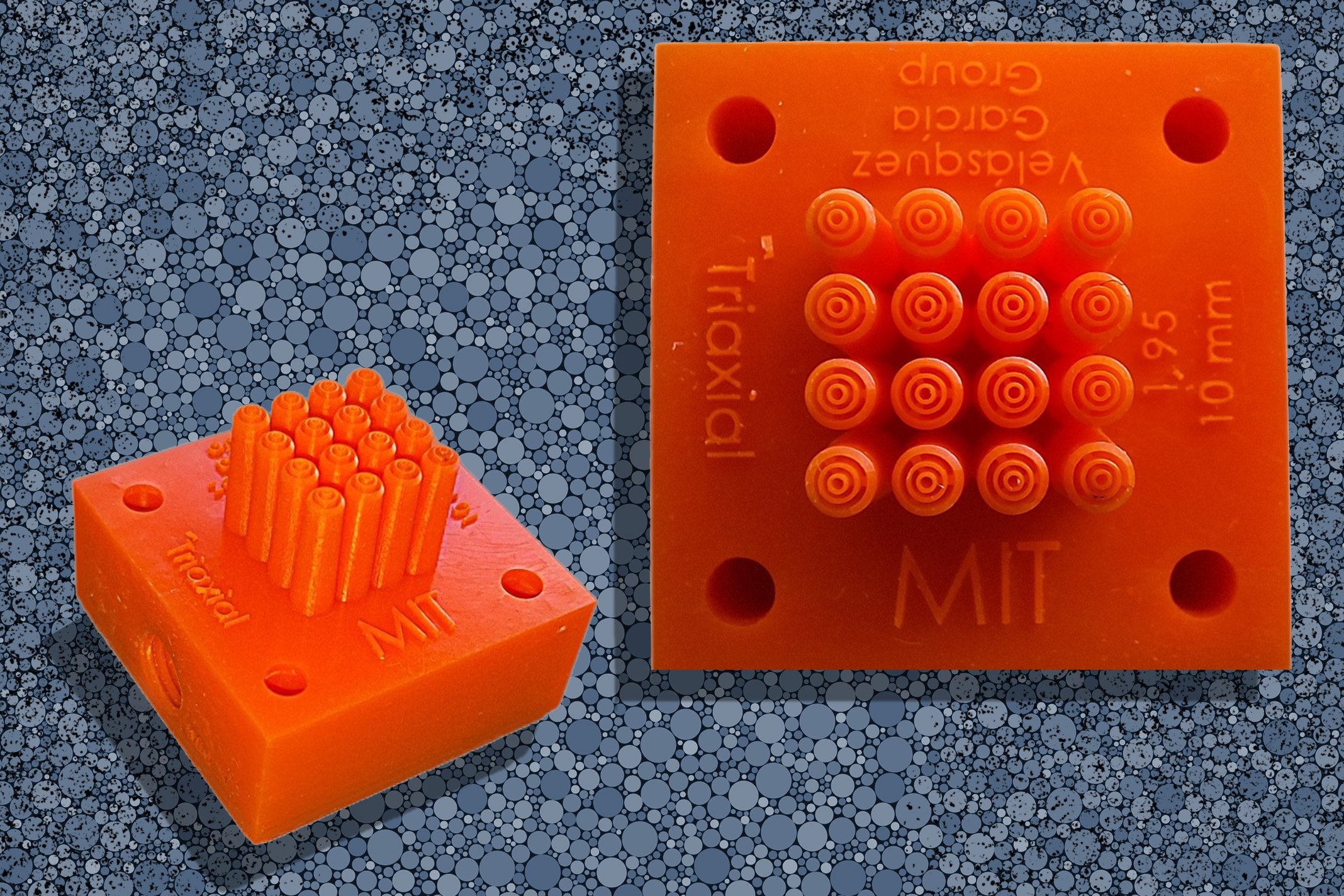
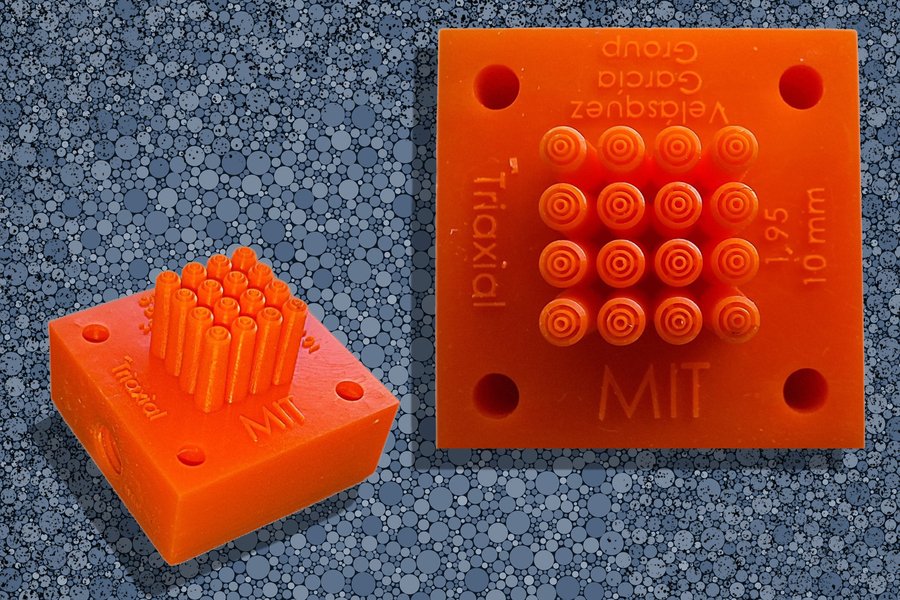
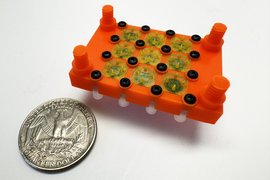
The headline result is deceptively simple: a single device, roughly the size of a U.S. penny, packs 16 nozzles into about one square centimeter and can be printed in a few hours. That production timeline matters more than it first appears, and understanding why requires looking at how these emitters actually work and why they have historically been so hard to make.
What a triaxial electrospray emitter does
Electrospray is an old idea applied at a small scale. Apply a high voltage to a conductive liquid as it exits a fine nozzle, and the liquid surface deforms into a Taylor cone that sheds a steady stream of extremely small charged droplets. The technique is already familiar from mass spectrometry ionization and electrospinning. What MIT scientist Luis Fernando Velásquez-García and lead author Bryan Ivan Quintanar-Abarca of the Tecnológico de Monterrey added is concentricity. A triaxial emitter nests three nozzles inside one another so that three non-mixing fluids leave the tip at the same time, arranged as a core wrapped in two shells.
The payoff is structural control over each particle. Consider an oral drug particle. The outer layer might erode slowly in the stomach, exposing a middle layer that meters the release rate, surrounding a core that carries the active compound to a target in the intestine. Each layer does a separate job, and the geometry is set at the moment the droplet forms rather than through later coating steps. The same core-shell-shell approach maps onto biosensing particles that carry a different chemical marker in each layer, or artificial cells designed to support tissue regeneration.
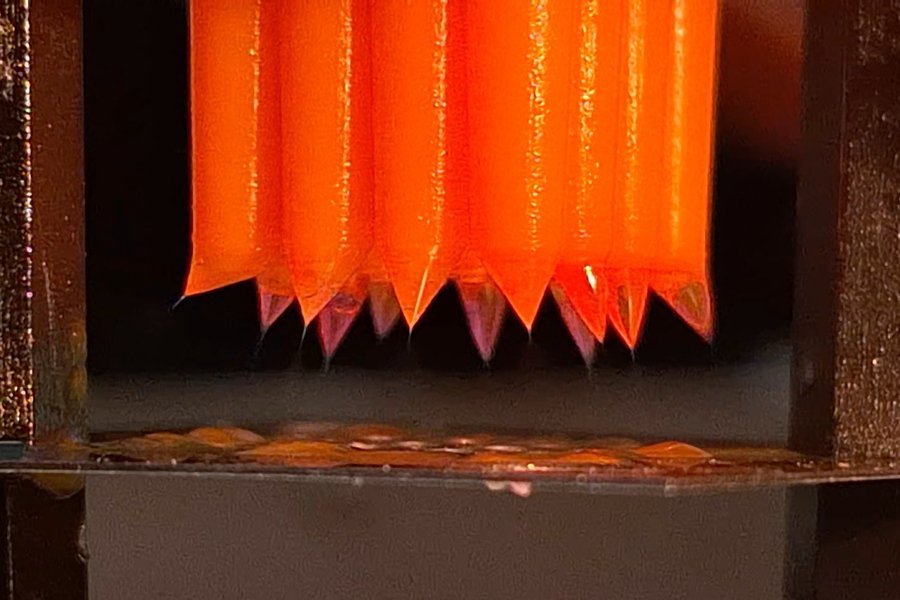
There is a physical reason these devices want to be small. The smaller the emitter, the lower the voltage needed to start the spray. But a single tiny emitter produces only a modest output, so practical throughput depends on arraying many of them together and getting every nozzle to behave identically. That tension, small features for low voltage versus many features for volume, is the central engineering problem.
Why the cleanroom was the obstacle
Multi-emitter electrospray devices have traditionally been etched and deposited in semiconductor cleanrooms. Those processes are precise, but they are fundamentally two-and-a-half-dimensional. They build up planar layers and struggle with the deep, curved, internal fluid paths a triaxial design needs. Three concentric nozzles per site, fed by separate liquid supplies, with channels that route fluid uniformly to 16 positions, is not a shape that conventional microfabrication produces easily or cheaply. The researchers note they could not find any prior report of a miniaturized triaxial electrospray array in the open literature, which says something about how awkward the geometry is for established methods.
"We couldn't make a device like this in a semiconductor cleanroom. This is only possible because they are 3D-printed," Velásquez-García says. The team used vat photopolymerization, a printing method that uses light to cure very thin layers of liquid resin one at a time. Their layers were 25 micrometers tall, a fraction of the width of a human hair, which is fine enough to render the internal channel network and the aligned concentric tips in a single build.
The design work that makes uniformity possible
Getting droplets out is the easy part. Getting 16 nozzles to emit the same droplets is where the engineering lives. Internally, the array routes liquid through coiled, helical microchannels that feed each nozzle. The helices are not decorative. They equalize the flow path to every emitter so that no nozzle is favored over another, while folding enough channel length into a compact footprint to keep the device small.
Velásquez-García frames the goal vividly: "In a sense, the emitters in the array never learn they have company, or otherwise there would be cross-talking and causing interference between them. We achieved uniformity because of the work that went into our designs." In practice that meant printing very fine channels without internal support structures, since supports would clog the fluid paths, and fully clearing uncured resin before use so nothing blocked the nozzles. The concentric tips also have to be aligned accurately, because a misaligned core or shell breaks the layered droplet.
One finding from the testing campaign is worth flagging for anyone trying to reproduce this. When the team swept liquid flow rates and architectures to maximize droplet stability, the viscosity of the middle liquid turned out to matter most. It preserves the thickness of each layer and holds the three-shell structure together. That is a useful, slightly counterintuitive design lever: stability is governed less by the core or the outer fluid than by the one in between. The researchers also showed that adjusting flow rates and applied voltage lets them tune the thickness of each shell independently, which is exactly the knob a formulation scientist would want when timing a drug's release.
Why fast iteration is the real advantage
The deeper point in this work is not any single device but the development loop. Because a new emitter array prints in hours rather than weeks of cleanroom processing, the team could test many architectures and converge on a good one quickly. "We were able to aggressively optimize the design because we could iterate in a much timelier manner," Velásquez-García says. Anyone who has waited on a multi-week fab run to discover a channel was a few micrometers too narrow will recognize the value here. Rapid iteration changes what designs are even worth attempting, because the cost of a failed revision drops to an afternoon and some resin.
That said, the practical limits deserve a clear statement. Printed resin emitters are not a drop-in replacement for silicon in every respect. The current feature floor is set by the printer's resolution and the chemistry of the cured polymer, and resin devices face their own questions around chemical compatibility with aggressive solvents, long-term durability, and operating voltage. The 16-nozzle, square-centimeter array is a strong proof of scale, but high-volume pharmaceutical manufacturing will want far larger arrays and validated, reproducible output across many devices and many runs. The work demonstrates feasibility and uniformity convincingly; it does not yet claim a finished production line.
Where it fits and where it goes next
This result sits inside a longer thread of additive-manufacturing work from Velásquez-García's group at MIT's Microsystems Technology Laboratories, which has previously printed fully 3D-printed electrospray engines, components for point-of-care mass spectrometers, and miniature electromagnets. The recurring thesis is that 3D printing can take microsystems that once required a fab and make them accessible to labs and small companies that will never own a cleanroom. "We want to democratize this technology so the benefits can touch many more people," Velásquez-García says, and the triaxial emitter is a concrete example of that argument rather than a slogan.
The team's stated next steps are to push toward smaller dimensions and to integrate conductive or dielectric materials directly into the printed devices, which would open the door to more capable emitter arrays with onboard electrodes or shielding. For researchers working on layered drug carriers, programmable-release particles, or self-healing materials, the immediate takeaway is more pragmatic. The barrier to prototyping a custom multilayer microparticle source has dropped from a cleanroom campaign to a print job, and the design space for what those particles can be is now bounded mostly by imagination and the physics of the middle layer's viscosity.
The paper, "Additively Manufactured Arrays of Triaxial Electrospray Emitters for Scalable Generation of Core-Shell-Shell Microdroplets," is available through Virtual and Physical Prototyping, and more on the group's broader microsystems work can be found through MIT's Microsystems Technology Laboratories. The research was funded in part by the Tecnológico de Monterrey – MIT Nanotechnology Program.
Comments
Please log in or register to join the discussion