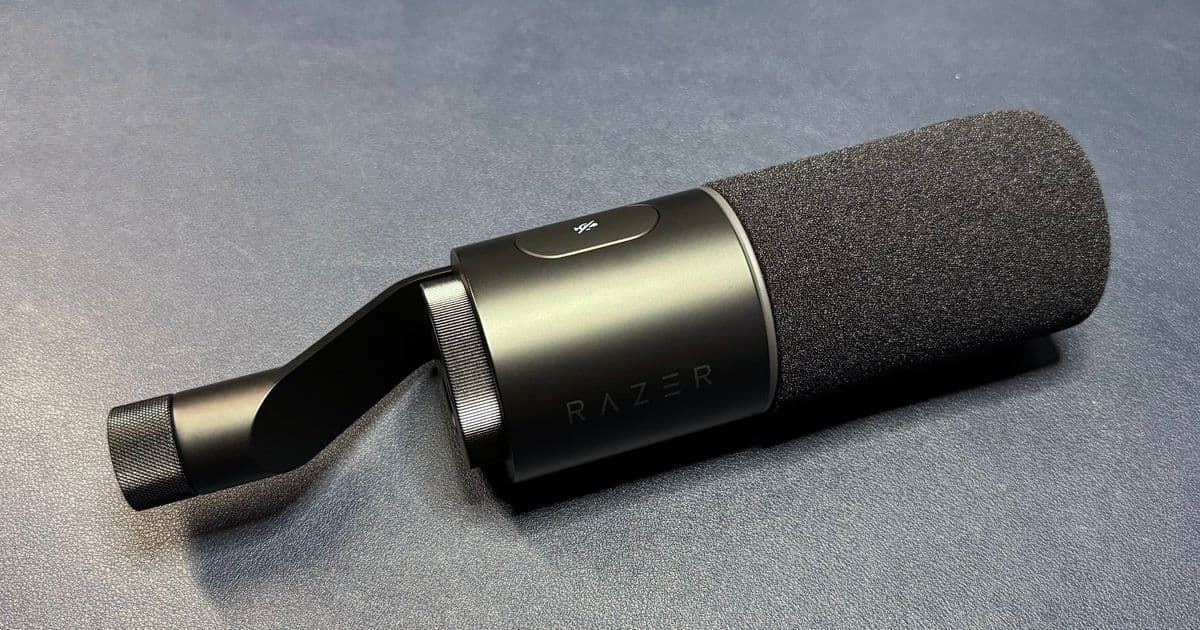
Razer's new Seiren V3 Pro pairs a 30mm dynamic capsule with both USB-C and XLR output, 32-bit float recording, and a flawless capacitive tap-to-mute button. At $250 it's competent and well-built, but cheaper rivals like the HyperX FlipCast and Rode PodMic USB match its core performance without the premium.
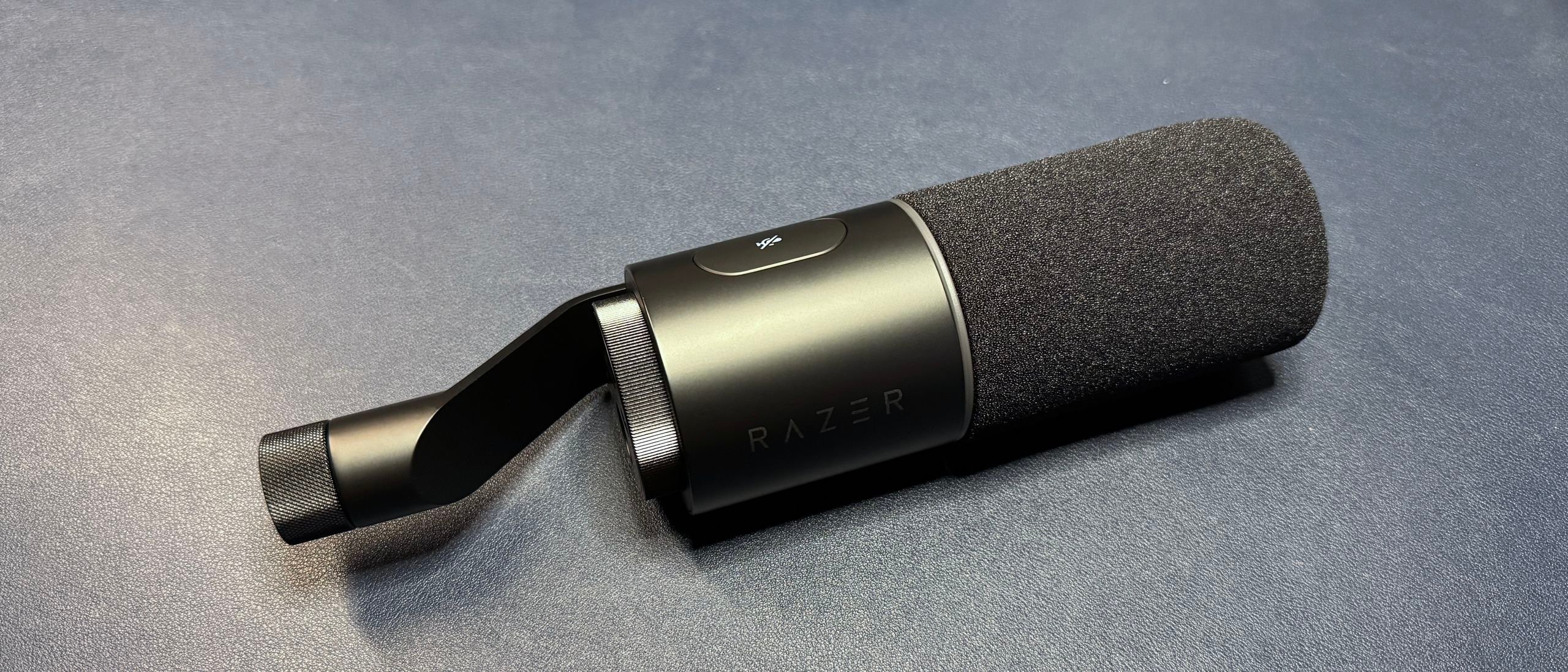
Razer launched the Seiren V3 Pro on June 9, 2026, adding another dual-connectivity dynamic microphone to an increasingly crowded category. At $249.99, it sits at the upper end of the creator-focused USB mic market, and it earns that price through a feature list rather than through any single standout in audio quality. The headline specs: a 30mm dynamic capsule, cardioid polar pattern, simultaneous USB-C and XLR output, 24/32-bit float resolution at sample rates up to 96 kHz, and 40dB of adjustable gain.
The pitch here is convergence. Most USB gaming and podcasting mics exist precisely so you can skip the audio interface that XLR requires. Razer's answer is to offer both paths in one body, plus a 3.5mm headphone jack for zero-latency monitoring and an on-mic gain wheel. That combination isn't unique, but adding 32-bit float support, available only through the Synapse app on Windows, makes the Seiren V3 Pro rare rather than common.
What 32-bit float actually buys you
The 32-bit float spec is the most technically interesting line on the sheet, and it deserves a real explanation because most buyers will never use it. Standard 24-bit recording gives you roughly 144 dB of theoretical dynamic range across a fixed scale. The catch is the fixed scale: if you set your gain too high and the signal exceeds 0 dBFS, the waveform clips and the data is gone. Set it too low and you bury your voice in the noise floor.
Floating-point recording sidesteps that trade-off. Instead of mapping amplitude to a fixed integer range, 32-bit float stores each sample as a value with an exponent, which extends usable headroom to well over 1,500 dB in practical terms. The result is a recording you effectively cannot clip. You can record a whisper and a shout in the same take, then normalize either one in post without distortion. For field recordists and one-take podcasters, that's genuine insurance. For someone streaming to a chat window, it changes nothing, and Razer's own reviewers acknowledge that very few people need it.
Build and dimensions
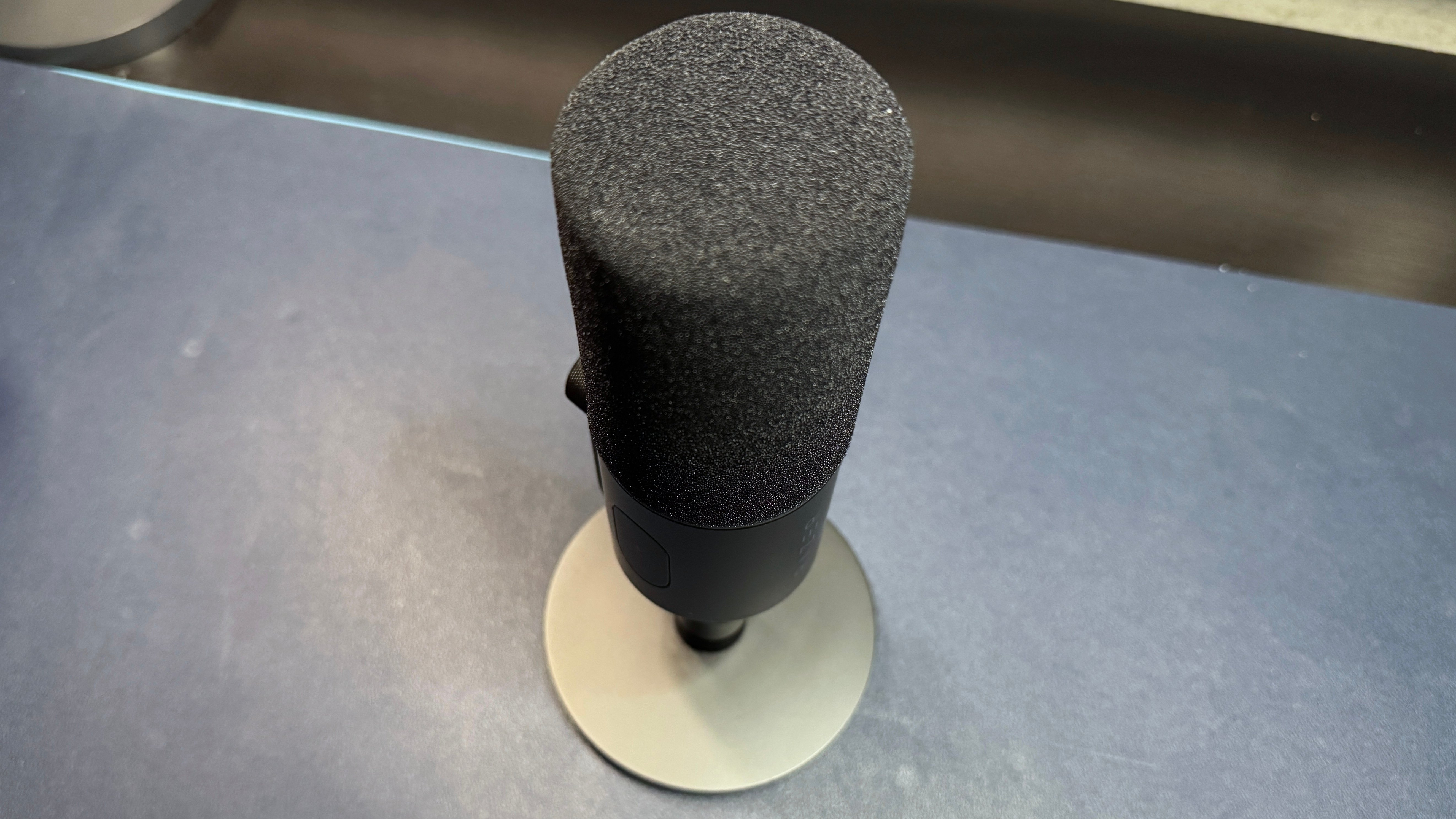
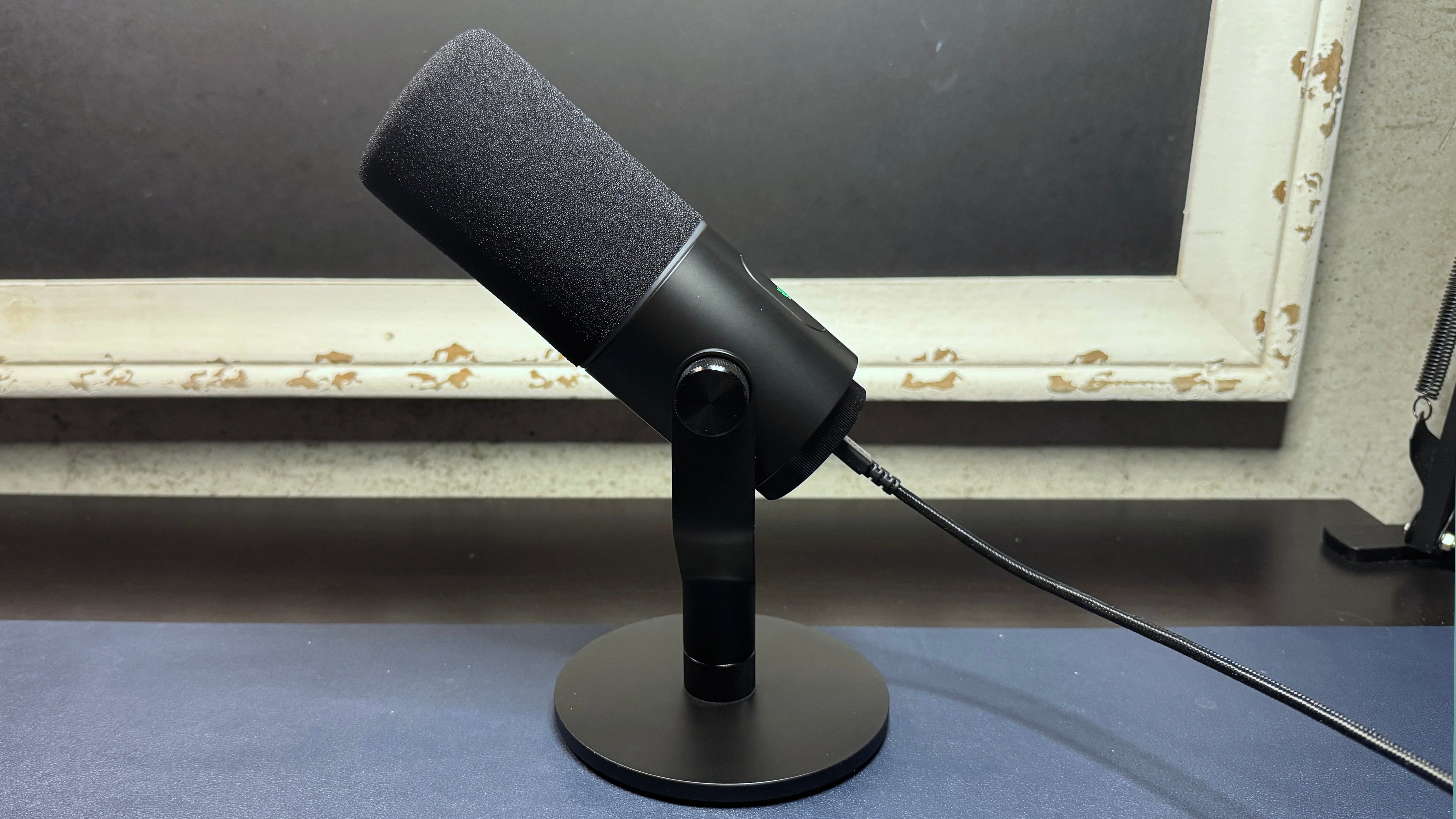
The Seiren V3 Pro is an end-address cylinder in a matte black zinc unibody, and it's physically larger than most of its peers. The mic body alone measures 8.39 inches (213mm) long and about 2.25 inches (57.15mm) in diameter. With the built-in swing mount it reaches just under 10 inches (254mm) in length and 3.55 inches (90mm) in width. Weight comes in at roughly 1.48 pounds (640g to 670g depending on the measurement).
Those numbers position it neatly between competitors. The Rode PodMic USB weighs 1.9 pounds (900g), making the Razer about half a pound lighter, while the HyperX FlipCast is lighter still at 1.26 pounds (571.5g). The mount accepts both 5/8-27 and 3/8-16 threads, so it drops onto standard boom arms without an adapter.
The included desktop stand is a round metal base about 4.75 inches (120mm) across, weighing just over 7 ounces (200.5g), with non-slip rubber and five raised feet for shock isolation. It's stable, but it sits low on a desk, and given that the mic runs quiet, a boom arm is the better deployment.
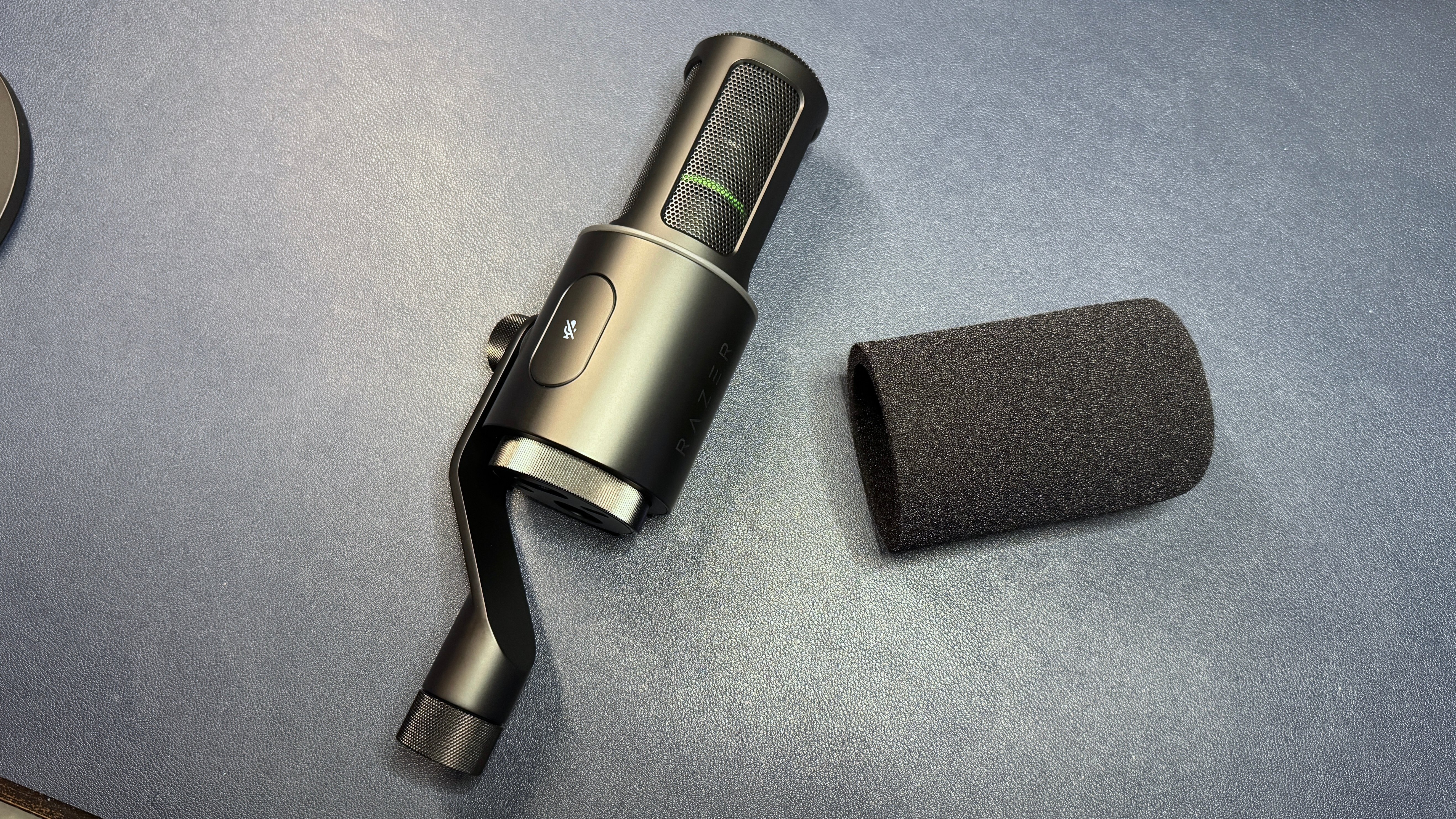
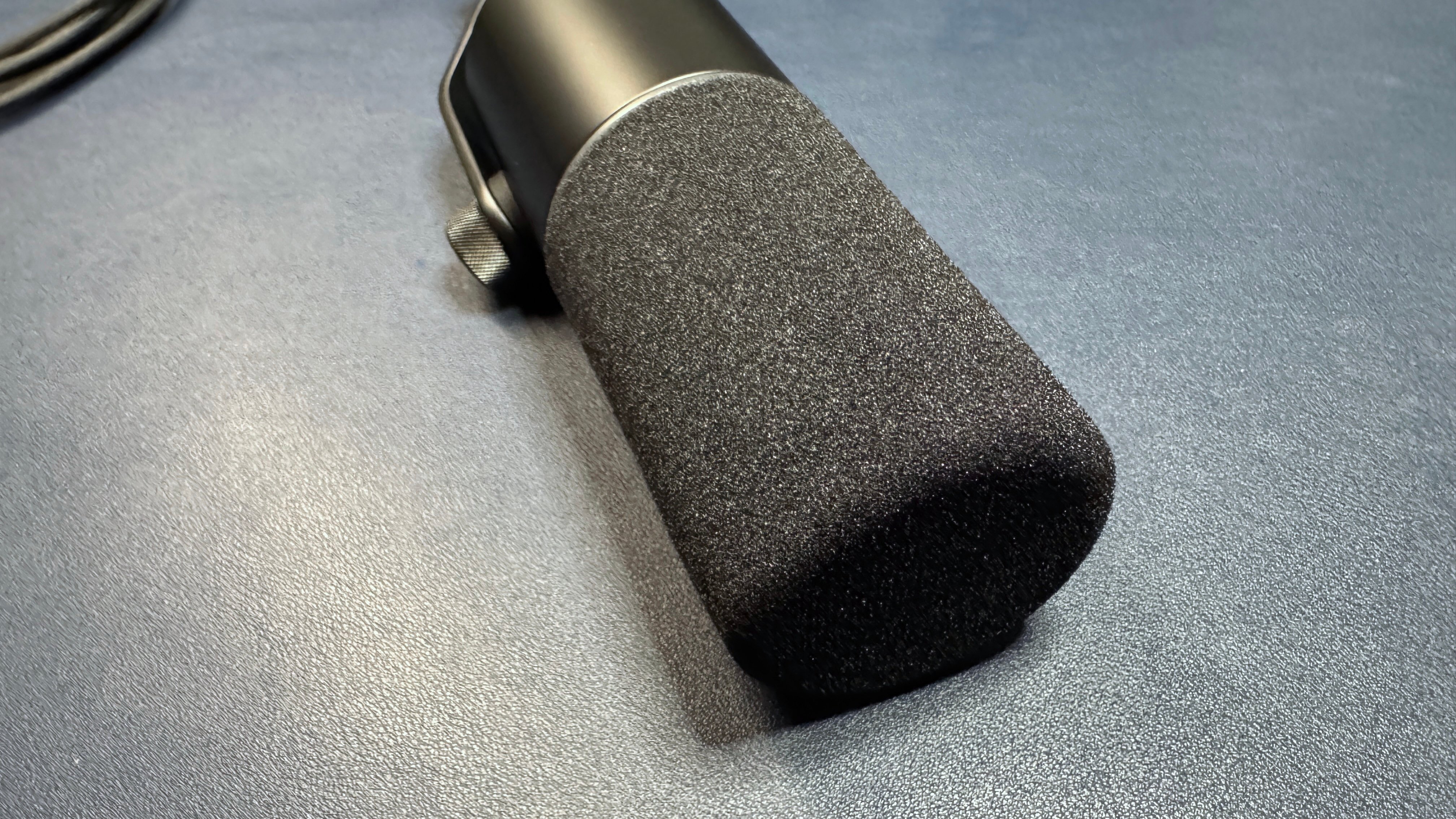
Design-wise, the Seiren V3 Pro borrows heavily from the Shure MV7+ template that nearly every mic in this segment now imitates. A removable foam pop filter slides off to expose the grille and an integrated shock absorber around the capsule. A 12-zone customizable RGB ring wraps the center, and an oval capacitive tap-to-mute button sits on the front face. The all-black finish looks clean until you touch it, at which point it collects fingerprints readily.
Performance: clean, controlled, and a little quiet
The capsule delivers a frequency response of 50 to 16,000 Hz with a sensitivity rating of -50dB (1V/Pa at 1kHz). In use, voices come through full, warm, and clear out of the box, with some audible sibilance that the bundled De-Esser can tame. The foam filter handles plosives adequately at a normal distance but struggles up close.
The recurring observation across testing is that this mic is quiet. Even with all 40dB of gain applied, you'll find yourself speaking louder than you would into competing models. Part of that traces to Razer's "enhanced" off-axis rejection, which suppresses room reflections and ambient noise without relying on DSP. The trade-off is real: ambient noise drops away impressively, even with AI noise suppression disabled, but step out of the mic's narrow on-axis zone and your level falls off faster than it would on a more forgiving capsule like the FlipCast.
The tap-to-mute button is the standout interaction. A light brush mutes and unmutes reliably, and both the button and the RGB ring glow red when muted, giving a clear visual confirmation. The single gain wheel, textured metal and smooth to turn, is the only other physical control, and it's awkwardly placed on the rear bottom alongside the USB-C, XLR, and 3.5mm ports. In Synapse it can be reassigned to control headphone volume instead, but you can't have both functions at once.
Software does the heavy lifting
Razer claims the Seiren V3 Pro works without software, and it technically does, but Synapse is where most of the value lives. The app provides a parametric EQ with presets labeled Podcast, Arena, FPS - Callout, and Studio, plus effect modules including a De-Esser, Vocal Bass, Vocal Exciter, and High Pass Filter. There's also AI noise suppression, a noise gate, a compressor, a limiter, and reverb.
Results are mixed. The AI noise suppression cleans up some background without mangling the voice, but it doesn't remove much. The noise gate cuts more noise but tends to clip the start and end of speech even on low settings. A Stream Mixer rounds out the package, acting as a virtual mixer for stream, playback, headphone, and mic channels, and RGB customization runs through Razer's Chroma integration.
The dependence on Synapse is worth weighing. The 32-bit float mode, the EQ, and the effects all live behind Windows-only software, so the mic's most differentiating capabilities are unavailable on macOS or via raw XLR into an interface. Software enhancements are a bonus on top of a good capsule, not a substitute for one.
Market implications
At $249.99, the Seiren V3 Pro competes directly with mics that match its fundamentals for less money. The HyperX FlipCast is closely comparable, down to the light ring and Shure-inspired chassis, and it offers better on-mic controls. The Rode PodMic USB skips on-mic controls entirely but delivers a superior proximity effect that broadcasters prize. Against both, Razer's differentiators come down to the dual USB-C/XLR pairing in a single body and the 32-bit float support, two features that overlap in very few buyers' needs.
That's the central tension. The mic that combines studio-grade XLR routing with consumer USB convenience and float recording is built for someone who wants all three at once, and that person is rare. For everyone else, the Seiren V3 Pro is a sturdy, well-made, slightly quiet mic carrying a price premium for capabilities they won't touch. It's a competent product that solves a problem most of its target audience doesn't have, and the cheaper alternatives perform just as well for the workflows people actually run. You can find full specifications and availability on Razer's official product page.
Comments
Please log in or register to join the discussion