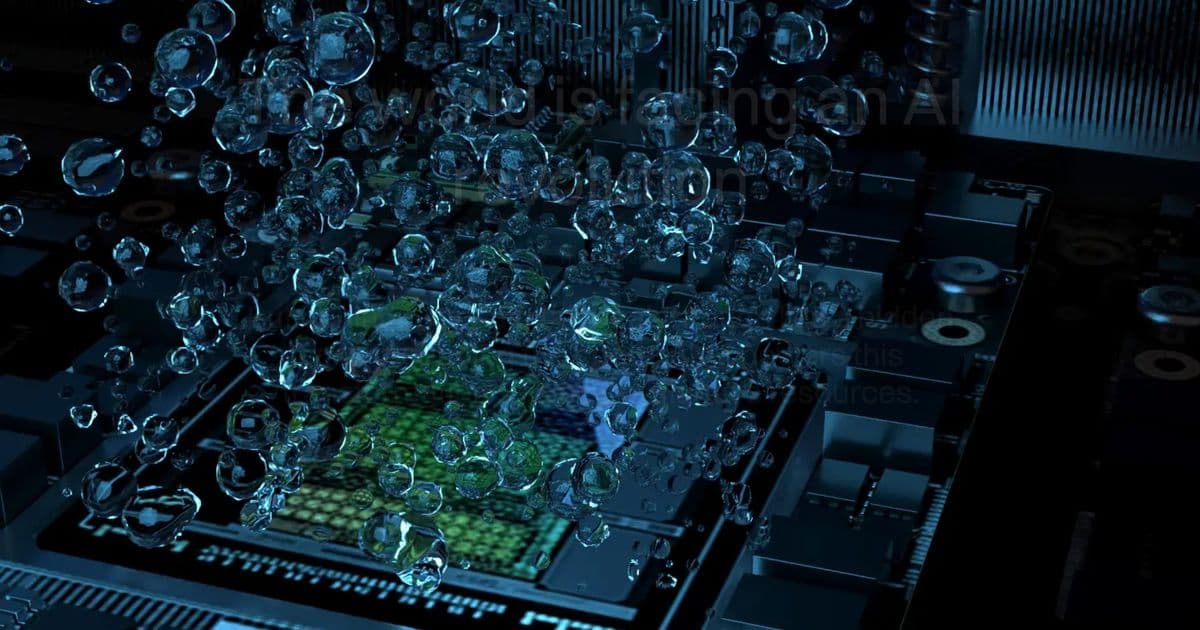
An MIT spinout is using subcooled boiling, a heat-transfer technique refined for nuclear reactors, to cool AI servers. The result is a modular immersion system that the founders say uses no water, cuts cooling power, and squeezes more useful output from the same chips.
Data centers are running into a wall that has nothing to do with algorithms and everything to do with thermodynamics. As chipmakers cram more transistors and higher power densities into each GPU, the heat they shed has climbed past what air can reasonably carry away. By the end of the decade, data centers are projected to consume somewhere between 9 and 17 percent of total U.S. electricity, and roughly a third of a typical facility's power goes not to computation but to keeping the silicon from cooking itself. Ferveret, a startup founded by two MIT researchers, is targeting exactly that overhead with a cooling method adapted from nuclear reactor physics.
The company was started in 2021 by Reza Azizian, a former MIT postdoc in nuclear engineering, and Matteo Bucci, MIT's Esther and Harold E. Edgerton Associate Professor in the Department of Nuclear Science and Engineering. Their pitch is straightforward: the cooling technology inside most data centers is decades old, and the people who study heat transfer for power reactors have spent those same decades learning how to move enormous quantities of thermal energy across small temperature differences. Ferveret is porting that knowledge over to AI hardware. You can read more about the company at its website and about Bucci's underlying research through the MIT Department of Nuclear Science and Engineering.
Why air cooling hit its ceiling
Air is a poor heat-transfer medium. That is intuitive once you compare the two: room-temperature water feels cold against your skin because it pulls heat away far faster than room-temperature air does. For most of computing history that inefficiency did not matter, because chips were not dense enough for it to hurt performance. Azizian recalls walking into his first data center in 2017, after stints working on Microsoft's HoloLens and then at Nvidia, and being struck by the rows of massive, screaming fans. Air cooling, he notes, can eat up to 40 percent of the power feeding a data center. "It was not an efficient way of doing things, but since it wasn't hurting the performance, no one cared that the cooling technology was 50 years old," he says.
The AI boom changed the calculus. With power supplies constrained and every watt at a premium, operators have moved toward liquid cooling, and increasingly toward immersion cooling, where servers are submerged directly in a thermally conductive fluid. The most aggressive version of immersion cooling lets that fluid boil. Boiling is where the physics gets interesting, and where Ferveret's reactor background becomes relevant.
The case for boiling, and its catch
A phase change, liquid turning to vapor, absorbs a large amount of energy. That energy comes directly out of the chip. "When liquid is boiling, it becomes even better at removing heat because the phase change requires a lot of energy," Bucci explains. "That lets you transfer large quantities of heat with minimal temperature differences between the chips and the liquid." Keeping the chip-to-coolant temperature gap small is exactly what lets operators push chips harder without overheating them.
The catch is that boiling is messy to manage at scale. Once you generate vapor, you have to capture it, condense it back into liquid, and hold pressure, temperature, and fluid inventory in balance. Each of those control problems adds hardware and failure modes. Many immersion systems also rely on PFAS fluids, the so-called forever chemicals now under regulatory pressure worldwide.
Subcooled boiling and the bubble problem
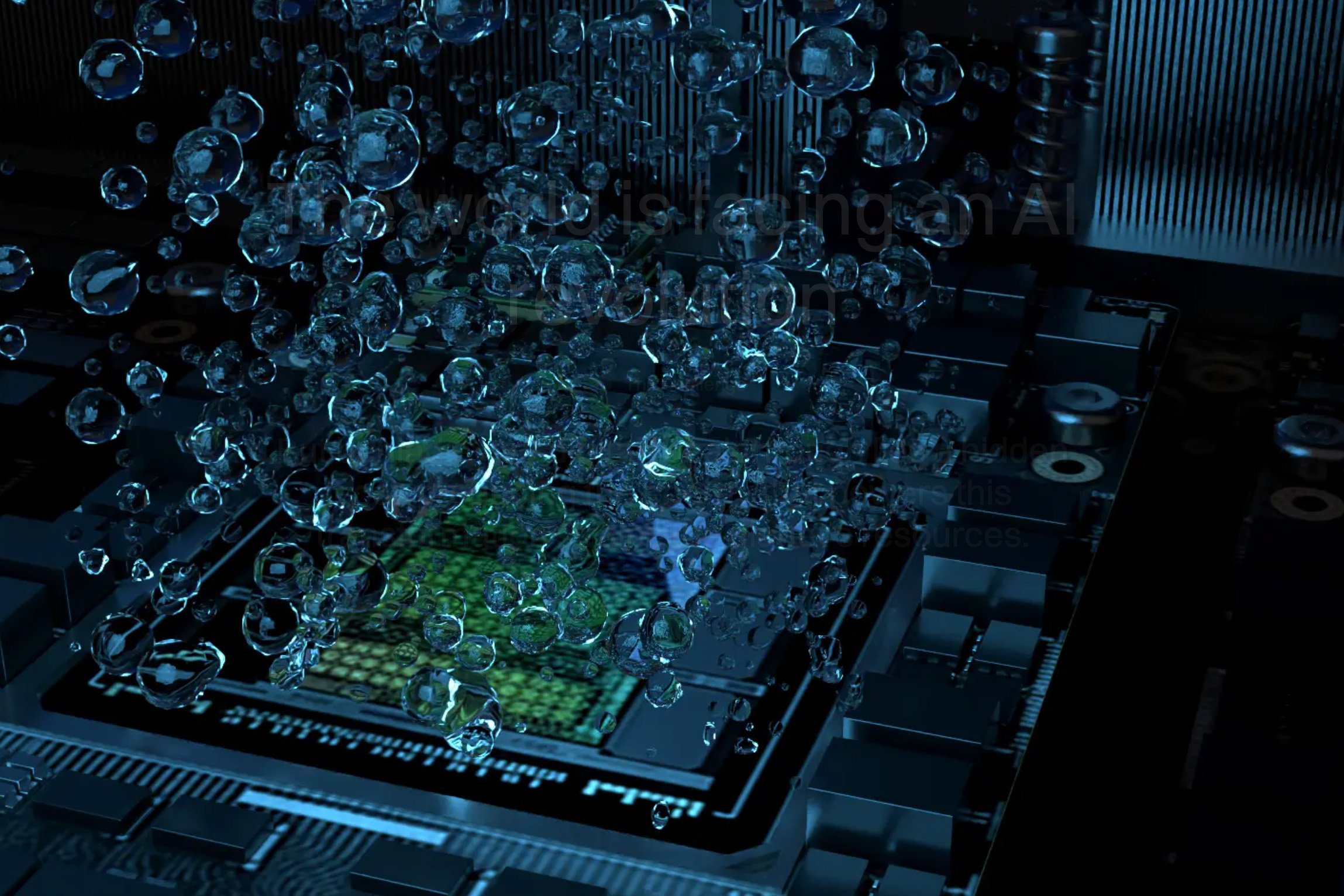
Ferveret's approach is built on a phenomenon nuclear engineers call subcooled boiling, and the company markets its implementation as Adaptive Phase Cooling. The idea is to keep the bulk of the liquid below its boiling point while boiling occurs only in a thin layer right at the hot surface. Bubbles nucleate on the chip, then detach and recondense almost immediately in the cooler surrounding fluid. Because the surrounding liquid stays sub-boiling, the system avoids most of the vapor-handling complexity of full immersion boiling while still capturing the heat-transfer benefit of the phase change.
The specific lever Ferveret pulls is bubble size and detachment frequency. Its fluid, which has a low boiling point and contains no PFAS, produces smaller bubbles than conventional immersion approaches. Smaller bubbles detach more often, and each detachment lets fresh liquid rewet the surface. That bubble-rewetting cycle is the actual engine of heat transfer here; the faster it turns over, the more heat leaves the chip per second. This is the same mechanism reactor researchers study when they try to maximize how much energy can be pulled from a core, where, as Azizian puts it, "heat transfer determines how much energy you can extract from the reactor core, which translates directly to revenue."
What the numbers look like
In a study run with the Samueli Computer Science Department at UCLA, Ferveret reported a 15 percent improvement in computational power efficiency against state-of-the-art liquid cooling. Layered on top of that, the company pairs the cooling hardware with control software that tunes the power delivered to each server in real time. Combining the two, Ferveret claims data centers can extract 35 percent more tokens, the discrete chunks of text or data an AI model emits, from the same power budget.
Those figures are worth reading carefully. A 15 percent cooling efficiency gain is a hardware result; the larger 35 percent token figure folds in software-side power optimization and so depends on workload and tuning. The framing the founders use is telling: rather than measuring success in degrees or watts, they measure it in useful output per watt. "Our goal is to make data centers as sustainable as possible and help them use every single watt of power to generate tokens, which are the most useful outputs," Azizian says.
Modular packaging instead of giant tanks
One practical consequence of subcooled boiling is geometry. Conventional immersion cooling usually means dunking servers in large open tanks, which is awkward to retrofit into existing racks and complicates servicing. Because Ferveret's process works in a thin boiling layer rather than a churning vat, the company can shrink the form factor down to a sealed box that houses a single server. "The physics enable us to get to form factors that weren't possible in the past," Azizian says. The modular, rack-mountable design is meant to slot into current infrastructure rather than demanding a purpose-built facility.
Ferveret delivers what the founders describe as a full-stack package: the cooling box, the rack, the cooling distribution units, and sensors that track temperature and pressure, all governed by software that continuously optimizes each box's operating point. "Our software monitors those sensors and optimizes the operating condition inside each box to ensure that energy consumption is minimized in the system," Bucci says.
The water angle
The zero-water claim is more than an environmental talking point. Conventional cooling at large facilities often relies on evaporative systems that consume significant volumes of water, which becomes a hard constraint in arid regions. A water-free system decouples the data center from local water availability, and that changes where you can build.

"The sun shines in places where you don't have much water, so the advantage of us being water-free is we allow you to build data centers where you have solar energy but nothing to cool the data center down," Bucci says. He points to parts of Africa, the Middle East, and the American Southwest as regions where abundant renewable power has been stranded by a lack of cooling resources. Siting compute next to cheap solar generation, without trucking in or drawing down water, is the kind of structural unlock that matters more as the industry's power and water demands keep climbing. MIT has covered the broader stakes of this problem in its reporting on the climate impact of generative AI.
Where it stands
Ferveret is already running pilots with CleanSpark, a data center developer and operator; FuriosaAI, an AI accelerator company; and Switch, one of the largest data center operators in the U.S. The startup is part of Nvidia's Inception program for early-stage companies and says it is in discussions with hyperscalers, with expanded partnerships expected to be announced later this year.
The honest read on Ferveret is that the underlying physics is well understood and the engineering bet is on packaging and control rather than on a novel scientific discovery. Subcooled boiling is not new; applying it to a modular, PFAS-free, rack-mounted server box with closed-loop power optimization is the contribution. Whether the claimed efficiency gains hold across the messy diversity of real production workloads, and whether the modular boxes prove as serviceable at fleet scale as in pilots, is what the next year of deployments will actually test. The pressure pushing operators toward solutions like this, though, is not going to ease. "The computing industry is facing a huge challenge in the form of access to power, and they have a problem with access to water in many regions," Azizian says. "That will only become more limiting as the industry grows."
Comments
Please log in or register to join the discussion