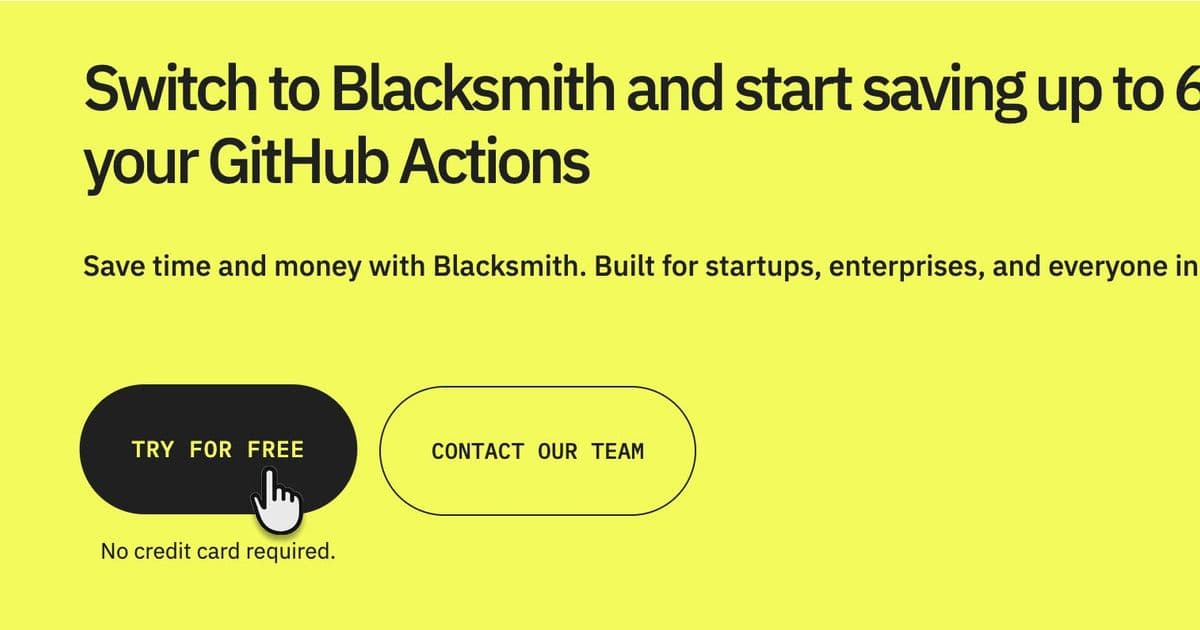
A dev team tried Blacksmith, a YC-backed drop-in replacement for GitHub Actions, on its no-credit-card free tier. Weeks later they got an invoice for $1,081.45 marked overdue on arrival. The catch: nobody ever promised the free tier was a hard cap.
A development team at Forestwalk Labs signed up for Blacksmith, a Y Combinator startup pitching itself as a faster, cheaper drop-in replacement for GitHub Actions. They ran it on the free trial, no credit card required. A few weeks later they received an invoice for $1,081.45, stamped overdue the moment it was generated. The story they published about it is worth reading not because Blacksmith did anything technically novel, but because it exposes an assumption almost every engineer carries about free tiers, and how that assumption quietly fails to match the contract.
What's claimed
Blacksmith's selling point is straightforward and, by the team's account, real. CI on GitHub Actions gets slow and expensive as pull request volume climbs, especially for teams now running automated agents that fire off large numbers of jobs. Blacksmith imports your existing GitHub Actions setup and runs the same workflows on its own machines. Forestwalk reports it was indeed faster, and possibly cheaper, though the cheaper part is hard to verify while you're on a free trial that turns out not to be free in the way most people read the word.
The practical appeal here is concrete. If your bottleneck is CI wall-clock time, swapping the runner backend without rewriting your pipelines is a low-friction win. That's why Blacksmith has grown quickly. The team admits as much: they tried switching back to GitHub Actions after the billing dispute and found it still slow enough that they expect to return to Blacksmith anyway.
What's actually new
The interesting part isn't the product. It's the billing model, and how it diverges from an industry convention that has hardened into an unwritten expectation.
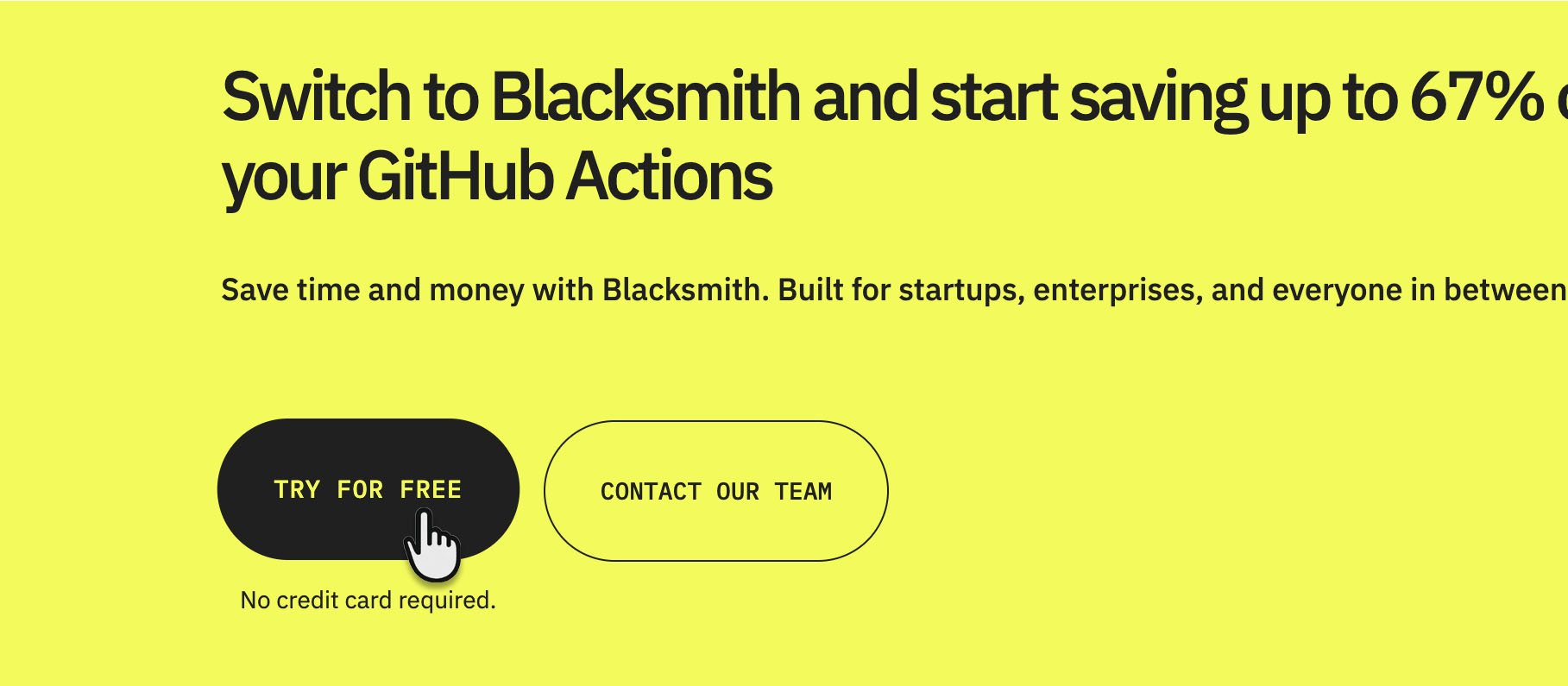
When you sign up for a SaaS product with "try for free" and "no credit card required," the near-universal mental model is that hitting the limit stops the service. You get cut off. That's the implicit deal: no payment instrument on file means no way to charge you, so the provider eats the cost of any usage past the cap or simply refuses to serve more.
Blacksmith doesn't work that way. Jobs keep running after you exhaust the free minutes, and they accrue charges at published rates. The Forestwalk team received a sequence of emails warning that they'd used 80% of their free minutes and should add a credit card "to avoid disruptions to your service." They kept coding. Later came a "You've spent $500.60" notice, then another credit card warning, then the $1,081 invoice, then an overdue reminder citing payment terms requiring payment on invoice generation.
The key exchange is with support. Forestwalk read "disruption to your service" as the conventional warning that jobs would stop. Blacksmith clarified that the word meant something else entirely:
The "disruption" wording in our reminder email refers to account flagging for review such as suspicious activity and review for suspension. There is no wording stating automatic suspension of running jobs as we know how impactful this can be to customers. We don't cut workflows when the free tier is exceeded; they continue running and accrue usage at the published rates.
And that's accurate. They never literally promised to stop your jobs at the cap. They never said the free trial meant you couldn't run up thousands of dollars in charges. The expectation that you would get cut off was, as the author puts it, just convention.
What this means for anyone running CI at scale
The convention exists for a reason, and the gap matters most for exactly the workloads Blacksmith is courting. Teams running coding agents generate CI jobs in bursts that no human is watching minute to minute. If your runner backend silently meters past a free cap instead of pausing, the failure mode is an invoice rather than a stalled pipeline. That's a different risk profile than the one most engineers price in when they click "start free trial."
The author runs through the obvious questions. Can a vendor legally do this? Probably yes, assuming the terms support it, though there's a wrinkle: as of June 8, Blacksmith's own terms reportedly implied their right to bill was contingent on you having provided payment information, which you haven't on a no-card trial. Will users be surprised? Almost certainly. The author estimates fewer than 5% of users would expect an overage invoice on a no-credit-card trial, and points out that if you ask a chatbot whether Blacksmith would cut you off or invoice you, it confidently predicts you'd get cut off. That's a decent proxy for the averaged expectation baked into the public internet, and it's wrong here, which tells you the policy is unusual.
Should vendors do this at all? The case for it is that letting free users accrue overage and then billing them captures revenue you'd otherwise forfeit. The case against is stronger. Collection on surprise invoices is poor, write-offs balloon, goodwill craters, and the main beneficiaries are abusive users who never intended to pay and now get extra free runway before anyone notices. A warning model, "your CI will be cut off in 72 hours unless you add a card," preserves the revenue opportunity without the ambush. The author's read is that this is bad practice, most likely the result of oversight or billing-system technical debt rather than deliberate growth hacking, given how fast Blacksmith has scaled amid GitHub's reliability problems in spring 2026.
Limitations and the honest part
To Forestwalk's credit, they don't claim they were cheated. They expected to hit the free limits because their agents run a lot of CI. They used the service, got value from it, and the charges reflect real compute at published rates. The complaint is about the surprise and the prickly support tone, not about being billed for nothing. Once they agreed to pay, support got friendlier, and they expect to keep using the product because it solves a real bottleneck better than the alternative.
That's the uncomfortable conclusion. The product works, the billing model is defensible on paper, and the team is pragmatic enough to stay despite the bad taste. The takeaway isn't "avoid Blacksmith." It's two narrower lessons. If you build a SaaS product, understand that most users read a no-card free tier as a hard cap, and silently metering them into overage will land badly no matter what your terms say. And if you're going to try Blacksmith right now, watch your usage and wind it down before you hit the trial limit, because the limit is a billing event, not a stop sign.
For anyone evaluating CI runners, the broader pattern is the one to internalize: "free trial" and "no credit card" describe how you sign up, not necessarily how you get charged. Read what happens at the cap before you point an automated job fleet at it.
Comments
Please log in or register to join the discussion