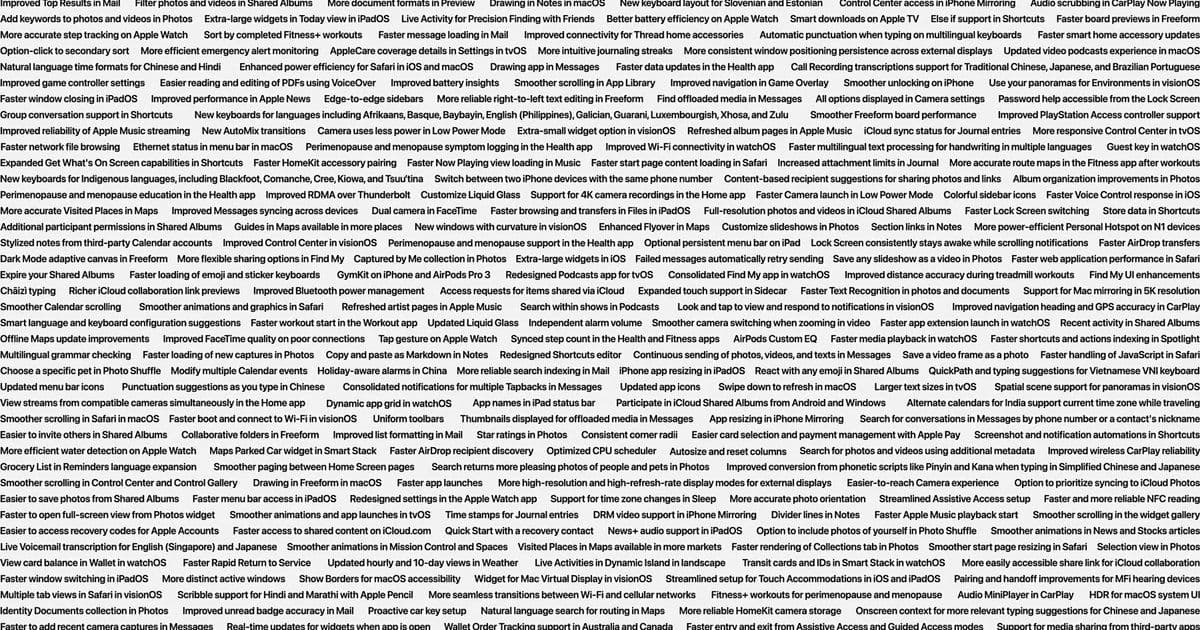
Apple's headline features get the keynote spotlight, but a sprawling screen-grab of small WWDC26 fixes is what developers are actually passing around. The list says something about where Apple's attention has shifted, and not everyone reads the signal the same way.
Every June, Apple stages its developer conference around a few tentpole features: a redesigned interface, a new on-device model, some hardware-adjacent capability meant to anchor the fall marketing. Those are the things that get the stage time and the press embargoes. But this year a different artifact has been circulating in developer channels, and it tells a more interesting story than the keynote did.
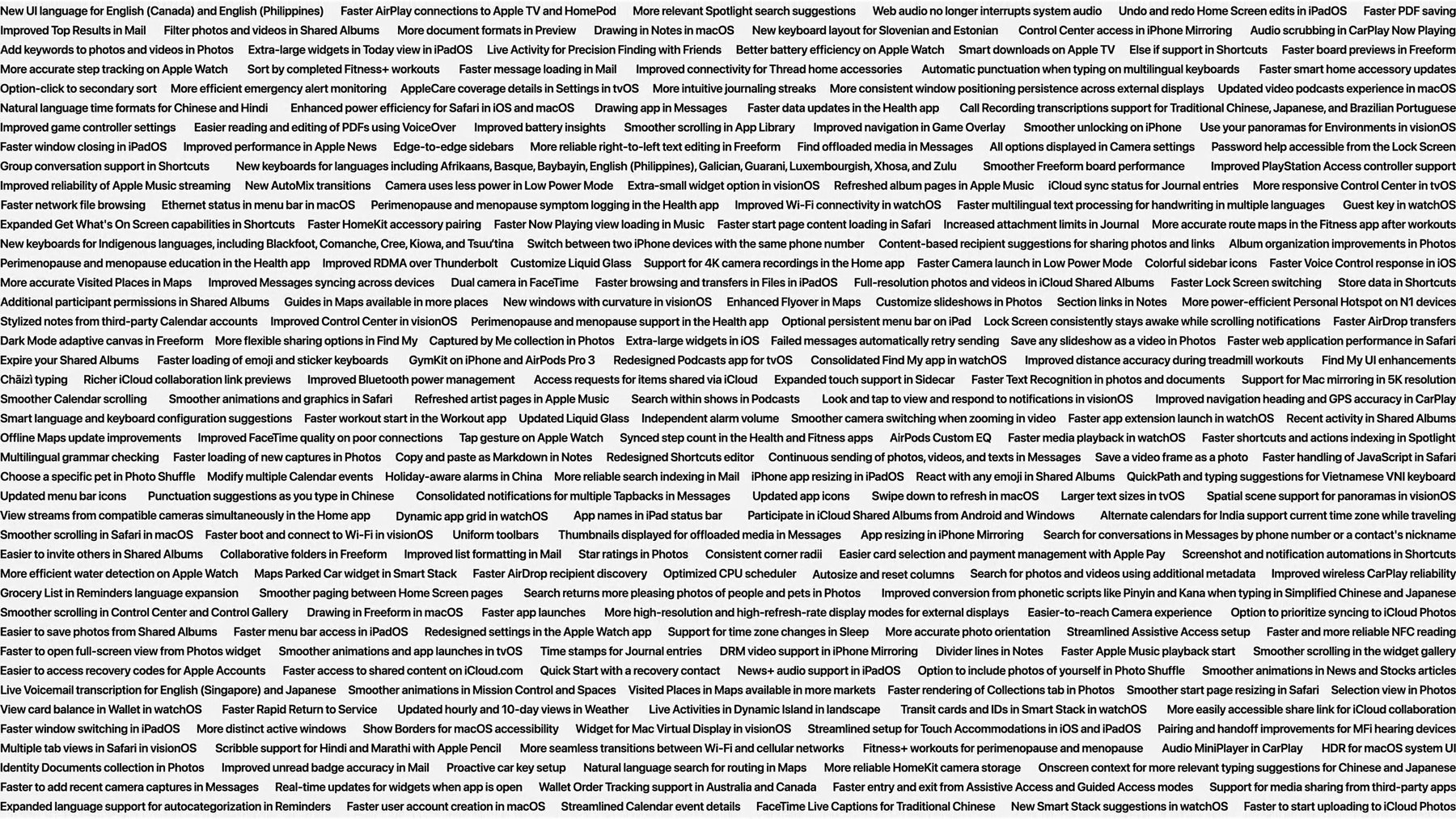
It's a single screen-grab, since transcribed and reorganized by readers, listing roughly 300 small improvements coming to Apple's platforms later in 2026. Not features in the marketing sense. Fixes. "Failed messages automatically retry sending." "More accurate photo orientation." "Improved unread badge accuracy" in Mail. "Web audio no longer interrupts system audio." The kind of thing that never makes a slide, because admitting you're fixing it means admitting it was broken.
The pattern people are noticing
What's striking about the list is how much of it reads like a backlog finally getting funded. Photos alone gets two dozen entries, and they cluster around long-standing complaints: full-resolution media in iCloud Shared Albums, the ability to participate in those albums from Android and Windows, faster loading of new captures, faster rendering of the Collections view. Messages gets "faster message loading," "improved syncing across devices," and the ability to find offloaded media, all of which describe problems users have been logging for years.
The sentiment in developer communities has been notably warmer toward this list than toward the actual announced features. The framing that keeps coming up, including from the blogger who compiled it, is that these quiet touches are "the clearest sign of a company that cares about its craft." There's a real constituency for that view. On forums like Hacker News and the Apple developer subreddits, the reliability fixes get more genuine enthusiasm than the redesign does. People who live inside these apps every day tend to value a Calendar that scrolls smoothly over a Calendar that looks new.
The performance entries reinforce the read. Safari gets "enhanced power efficiency," "faster JavaScript handling," "smoother scrolling," and faster start-page loading. The system-wide section lists an "optimized CPU scheduler," "improved app launch speed," "faster AirDrop transfers," and "faster NFC reading." Taken together it looks less like a feature roadmap and more like a quarter spent paying down technical debt.
The less flattering reading
Here's where the consensus deserves some pushback. A 300-item list of fixes can be read two ways, and the celebratory framing only captures one of them.
The other reading is that a list this long is an inventory of how much had degraded. "More accurate photo orientation" is a fix, yes, but photo orientation is a solved problem that EXIF metadata addressed two decades ago. "Failed messages automatically retry sending" is welcome, and also a quiet acknowledgment that a messaging platform with a billion-plus users has been silently dropping sends. "Improved Wi-Fi connectivity" on watchOS and "more seamless Wi-Fi/cellular transitions" on macOS describe regressions, not innovations. You don't fix connectivity that was never broken.
The critical view, which surfaces less often but is worth holding alongside the warm one, is that the volume of small fixes is itself the symptom. Apple shipped a major visual overhaul across its platforms in the 2025 cycle, and large redesigns historically introduce exactly this kind of breakage: timing bugs, sync issues, animation jank, badge counts that drift out of sync. A year later, the cleanup arrives and gets reframed as craftsmanship. Both things can be true. The work is genuinely good, and the need for so much of it points to a development process that ships first and stabilizes later.
There's also a selection-bias problem with celebrating the list. We're seeing the fixes Apple chose to enumerate. We aren't seeing the bug tracker, the issues deferred, or the items that got cut when the release branch froze. A curated list of victories is not the same as a measure of overall software health, and treating it as one lets the company set the terms of its own report card.
What's actually new in the noise
Not everything here is repair work, and a few entries are genuinely additive in ways that matter to specific users.
Shortcuts is getting real language improvements: else-if support, the ability to store data between runs, and an expanded "Get What's On Screen" action. For people who build automations, conditional branching without nested workarounds is a meaningful change, not a polish item. The Shortcuts power-user community has wanted else-if for years.
The Health app adds perimenopause symptom logging, educational content, and related Fitness+ programming, which extends a category Apple has been building out since it added cycle tracking. The language and input section is substantial too: new keyboard layouts and recognition support for Baybayin, Cree, Comanche, Blackfoot, Kiowa, Xhosa, Zulu, and others, plus multilingual handwriting and grammar improvements. Indigenous-language script support rarely makes a keynote, and for the communities involved it's more consequential than any animation change.
Notes picks up section links, dividers, and copy-paste as Markdown, the last of which developers have requested repeatedly. visionOS gets curved windows, panorama-based Environments, and Mac mirroring at 5K, which are the kind of refinements a young platform needs to mature. None of these are reliability fixes; they're the small features that didn't earn stage time but change daily use.
The signal underneath
The more interesting question isn't whether this list is good news. Most of it plainly is. The question is what it says about Apple's priorities to surface this much maintenance work as a story at all.
For most of the last decade, Apple's developer-facing narrative was about new frameworks and new capabilities. A year defined by retry logic, scheduler tuning, and sync reliability is a different posture, and it lines up with a broader industry mood. Across the software world, the appetite for stability over novelty has grown, partly as a reaction to years of features shipped faster than they could be hardened. If Apple is reading that mood and reallocating engineering toward the unglamorous middle of the stack, that's a defensible bet. The risk is that "we fixed a lot of things" becomes a marketing posture rather than a sustained practice, celebrated one year and quietly abandoned the next when the next big redesign demands the schedule.
The honest assessment sits between the two camps. The fixes are real and many of them are overdue, and a company that fixes orientation bugs and badge counts is treating its users seriously. At the same time, a list this long is evidence of how much accumulated, and the warm reception it's getting shouldn't obscure that the best version of this work is the version that never needs to be announced. The details land in beta over the summer and ship to everyone in the fall, which is when we'll find out how many of these 300 lines survived contact with shipping software. Apple's full session catalog is on the developer site for anyone who wants to track which promises hold.
Comments
Please log in or register to join the discussion