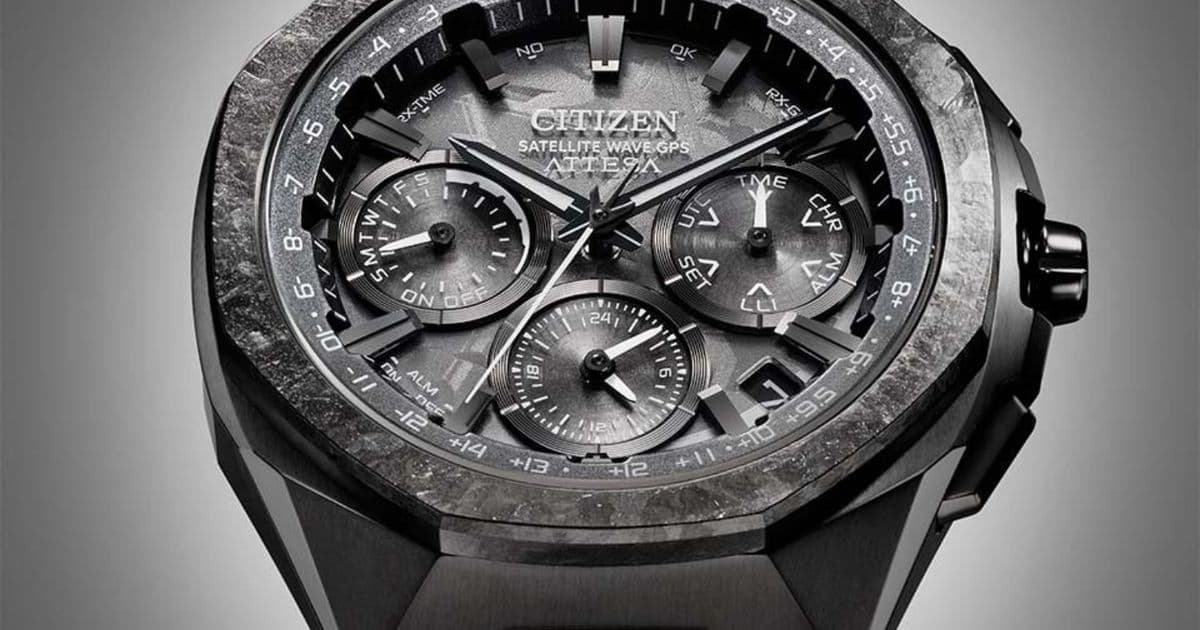
Citizen's latest Attesa is a 1,800-unit limited GPS watch that takes the brand's recrystallized titanium finish and drops it into an all-black DLC case, paired with the F950 caliber that locks satellite signals in three seconds.
Citizen Taiwan has announced the Attesa CC4107-80H, a limited-edition Eco-Drive Satellite Wave GPS watch that takes the brand's recrystallized titanium construction and pushes it into an all-black colorway. Production is capped at 1,800 units for what Citizen says is worldwide availability, though for now the listing only shows up on the Taiwan regional site at NT$84,800, roughly $2,600 at current conversion. Pricing for other markets hasn't been set.
What's new
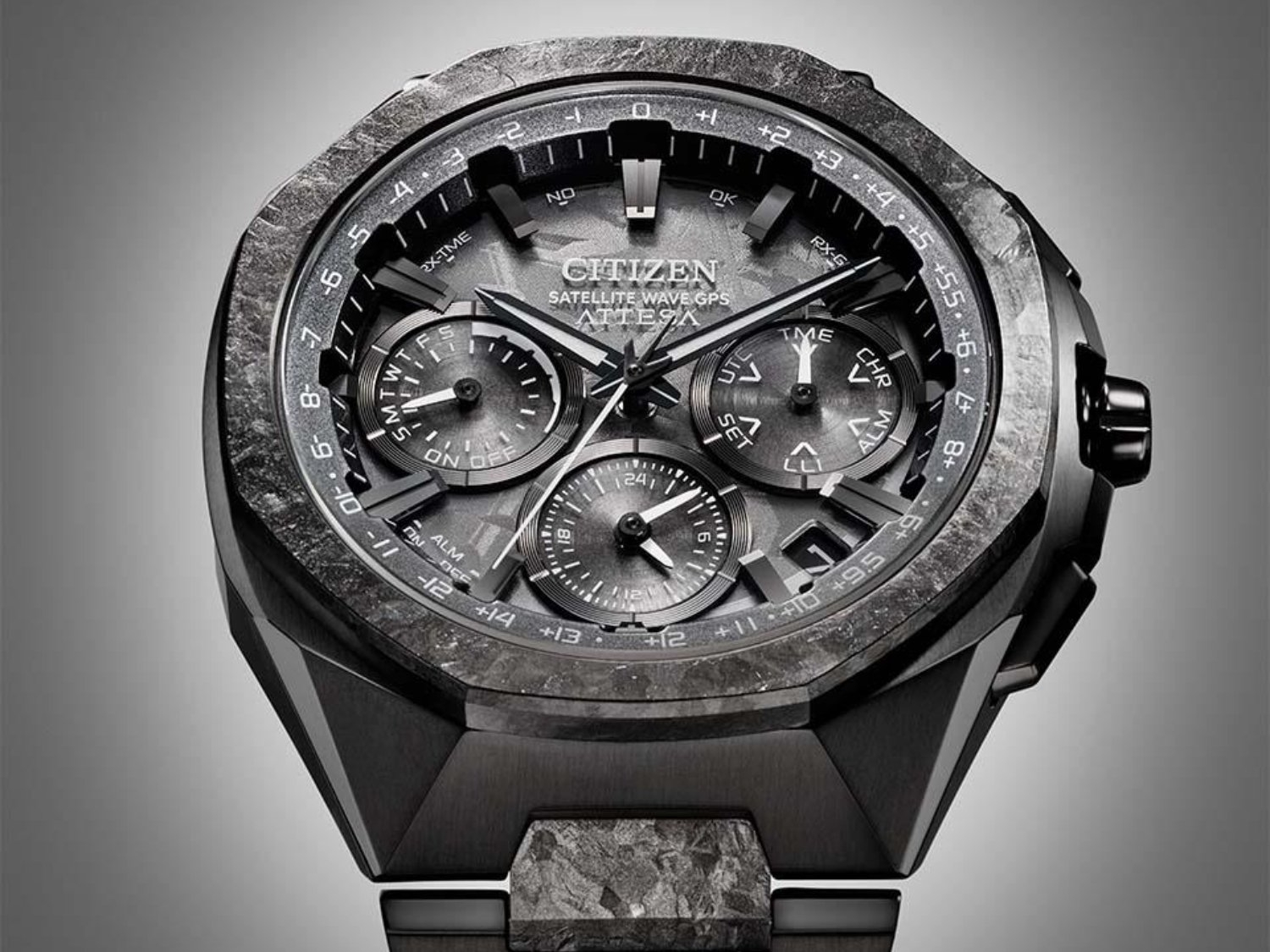
The headline change here is finish, not internals. Citizen first showed recrystallized titanium last October in its Attesa Platinum Shine Collection, where the bracelet center links and bezel carried a silvery, mineral-like crystal pattern. The CC4107-80H reuses that same process but applies it over a full Duratect DLC-black case, which changes the character of the watch considerably. Instead of the bright Platinum Shine look, you get a dark, matte body where the crystal patterning reads as texture rather than shine.
The process behind it is worth understanding because it drives the price and the exclusivity. Recrystallized titanium is made by heating titanium to a high temperature and then cooling it under controlled conditions. That heat treatment reorganizes the metal's grain structure, and as it cools the surface develops visible crystalline patterns. Because the cooling is not perfectly uniform, no two pieces come out identical, so every CC4107-80H bracelet and bezel carries its own pattern, similar to how natural minerals form. It's closer to a finishing technique than a structural one, but it's expensive to do consistently, which is part of why these stay in limited runs.
{{IMAGE:2}}
The case itself is 44 mm of Citizen's Super Titanium, 13.7 mm thick, with the Duratect DLC coating handling scratch resistance and the black tone. Super Titanium is Citizen's surface-hardened titanium, lighter than steel and considerably harder than untreated titanium, so a 44 mm case here will wear lighter than its diameter suggests. The crystal is dual-spherical sapphire with anti-reflective coating on both sides, and water resistance is rated to 10 bar, enough for swimming but not for serious diving.
{{IMAGE:3}}
How it compares
The movement is Citizen's F950 caliber, which the company positions as its most advanced Eco-Drive Satellite Wave GPS movement. The standout spec is reception speed: it can pull a time signal from GPS satellites in as little as three seconds, which Citizen claims is the fastest satellite signal reception of any watch. For a GPS-synced watch that matters in daily use, because the time you wait for a manual sync, or the time the watch needs when it grabs a signal on its own, is the practical bottleneck on this kind of technology. Three seconds is fast enough that you barely notice it.
Beyond timekeeping, the F950 covers world time across 39 time zones, a chronograph, a perpetual calendar, an alarm, and a power reserve indicator. Being Eco-Drive, it runs on light, so there's no battery to replace and no automatic rotor to wind. That combination of solar charging plus GPS correction means the watch keeps accurate time across time zones without any user input beyond exposure to light.
{{IMAGE:4}}
Against its own family, the CC4107-80H slots directly underneath the Platinum Shine models that launched in October 2025. That collection arrived with three references in limited runs of 1,400 to 2,500 pieces worldwide. At 1,800 units, this black version sits in the middle of that range on production volume while offering the more aggressive aesthetic. The internals are shared across the line, so the choice between them comes down to whether you want the bright recrystallized look or the blacked-out one.
Compared to the broader GPS watch category, Citizen's main rivals are Seiko's Astron line and Casio's Oceanus, both of which also use solar-plus-satellite timekeeping in titanium cases. Citizen's three-second reception claim is its main talking point against those, alongside the recrystallized finish, which neither competitor offers in the same form.
{{IMAGE:5}}
Who it's for
This is a collector's piece more than a daily-driver recommendation. At around $2,600 and an 1,800-unit cap, it's aimed at buyers who already understand what Eco-Drive Satellite Wave offers and want the rarer finish, not someone shopping for their first GPS watch. If you want the same movement and feature set without the recrystallized titanium premium, Citizen's standard Attesa GPS models cost considerably less and do the same timekeeping job.
For anyone who does want it, the catch is availability. Citizen says distribution is global, but right now the only confirmed listing and price are in Taiwan, and international pricing remains unannounced. Buyers outside that market will need to wait for regional rollouts or work through importers, which on a limited run of this size could mean the units sell through before wider pricing ever lands. If a blacked-out titanium GPS watch with a one-of-a-kind surface pattern is what you're after, this is the piece to watch, but plan on chasing it rather than walking into a store and picking one up.
Comments
Please log in or register to join the discussion