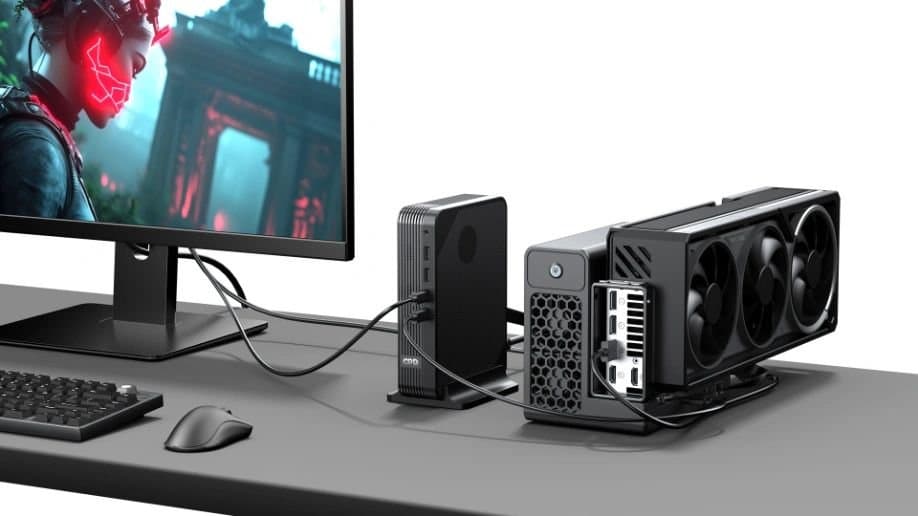
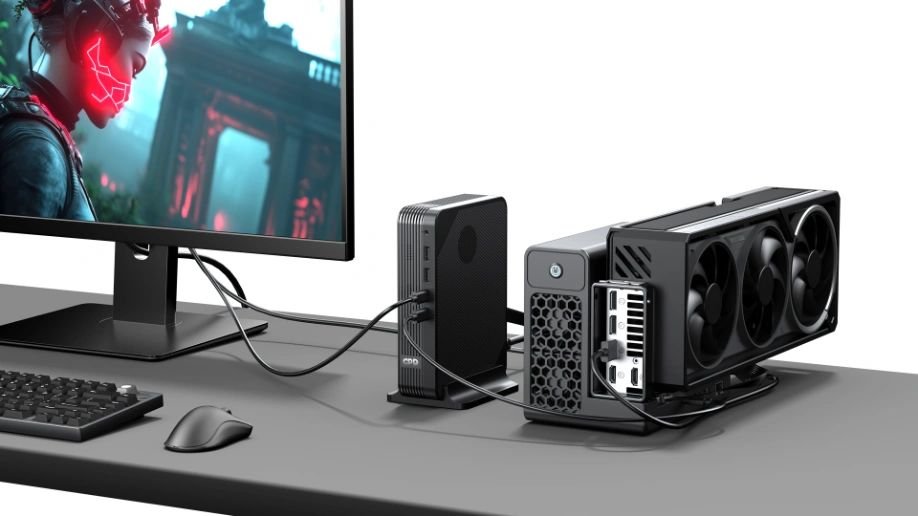
GPD is bringing its compact Panther Lake desktop to Indiegogo on June 15 with two configurations: one wired for an external GPU dock over PCIe 5.0 x8, and one that trades that port for beefier Intel Arc B390 integrated graphics. Backers save roughly 20 percent off retail.
GPD is preparing to launch its GPD Box mini PC through an Indiegogo crowdfunding campaign on June 15, and the pricing tells you almost everything you need to know about who this machine is for. This is a small desktop built around Intel's Panther Lake processors, and it splits into two configurations that solve the discrete-graphics problem in two completely different ways.
Two boxes, one decision
The entry model uses a Core Ultra 7 356H, pairs it with 32GB of RAM and a 1TB SSD, and includes an MCIO 8i port. That port matters: it carries a PCIe 5.0 x8 connection out of the chassis, which is what you'd use to drive an external graphics dock like the GPD G2. During crowdfunding it starts at $1452.
The second model swaps in a Core Ultra X7 358H with Intel Arc B390 integrated graphics and starts at $1534. That chip gives you a 12-core GPU and up to 180 TOPS of combined on-device AI performance across CPU, GPU, and NPU, versus a 4-core iGPU and roughly 100 TOPS on the 356H. The catch is that the 358H model drops the MCIO 8i connector entirely.
GPD's explanation for the missing port is the practical one: the higher-performance integrated graphics consume PCIe lanes, and there simply aren't enough left over to expose a full x8 external link. So you are choosing between strong built-in graphics with no upgrade path, or weaker built-in graphics that you can later supercharge with an external GPU. Retail prices are expected to land near $1846, with backers saving about 20 percent.
What both versions share
Whatever you pick, the core platform is the same. Both run a 16-core, 15-80 watt Panther Lake part. Both support up to 64GB of LPDDR5x-8533 soldered memory, which means you commit to your RAM ceiling at purchase time, a familiar trade-off for anyone who has bought a modern thin-and-light laptop and discovered the memory isn't socketed.
Storage is handled by two M.2 slots, one running at PCIe 5.0 x4 and a second topping out at PCIe 4.0 x4. The I/O is generous for a machine this size:
- 2 x USB4 v2 Type-C (80 Gbps)
- 4 x USB 3.2 Gen 2 Type-A (10 Gbps)
- 1 x DisplayPort 2.1
- 1 x HDMI 2.1
- 2 x 2.5 GbE LAN
- 1 x 3.5mm audio
Wireless is WiFi 6E and Bluetooth 5.3. GPD also did something unusual for a mini PC and built in 2W stereo speakers plus a microphone, so the box can function as a standalone meeting machine without peripherals. The whole thing measures 175 x 134 x 39.5mm (6.89 x 5.28 x 1.56 inches).
The GPD G2 dock changes the math
The MCIO 8i port only earns its keep if you have somewhere to plug it. That's the GPD G2 graphics dock, which gets its own crowdfunding campaign on May 15. It carries a PCIe 5.0 x16 slot that electrically runs at 8 lanes, an MCIO 8i connector, a USB4 v2 port, and an 800W integrated power supply. It's $385 during crowdfunding, down from $459 retail.
GPD is selling bundles for both directions. A BOX 356H plus G2 dock goes for $1837, and a BOX 358H plus G2 runs $1919. The second bundle is the interesting one, because the 358H lacks the MCIO 8i port. It can still talk to the dock, but only over the USB4 v2 port, which means PCIe 4.0 x4 rather than PCIe 5.0 x8. That's a meaningful bandwidth gap, and it's the kind of detail worth checking before you assume both bundles deliver the same external-GPU experience.
Why this matters for cross-platform builds
For developers shipping on both iOS and Android, a machine like this occupies an awkward but useful niche. You can't build or sign iOS apps on it, since that still requires macOS and Xcode, but a Panther Lake box with 64GB of fast memory and an optional discrete GPU is a credible Android workstation. Android emulators are memory-hungry, Gradle builds scale with cores, and the 16-core CPU plus high-bandwidth LPDDR5x helps on both fronts.
The external GPU angle is where it gets genuinely interesting. Android Emulator performance improves substantially with hardware-accelerated graphics, and on-device ML work (think testing TensorFlow Lite or LiteRT models before they ship to phones) benefits from the NPU and discrete GPU. The 180 TOPS figure on the 358H is a number you should read in context: it's combined CPU, GPU, and NPU throughput, not a single-engine rating, so treat it as a ceiling rather than a guaranteed inference rate for any one workload.
The practical question is the same one mobile teams face with every hardware purchase. Do you buy the upgradeable box and add a desktop GPU later, or pay for the stronger integrated graphics now and accept the fixed ceiling? If your work leans on emulator throughput and occasional GPU compute, the 356H plus G2 path gives you headroom. If you want a quieter, smaller, all-in-one machine and can live with integrated Arc graphics, the 358H keeps the footprint down.
Pre-orders open June 15 on Indiegogo. As with any crowdfunding hardware, the usual caution applies: shipping dates slip, and you're paying ahead of a product that doesn't exist on a shelf yet. Budget your expectations accordingly, and confirm the lane configuration on whichever bundle you choose before committing.
Comments
Please log in or register to join the discussion