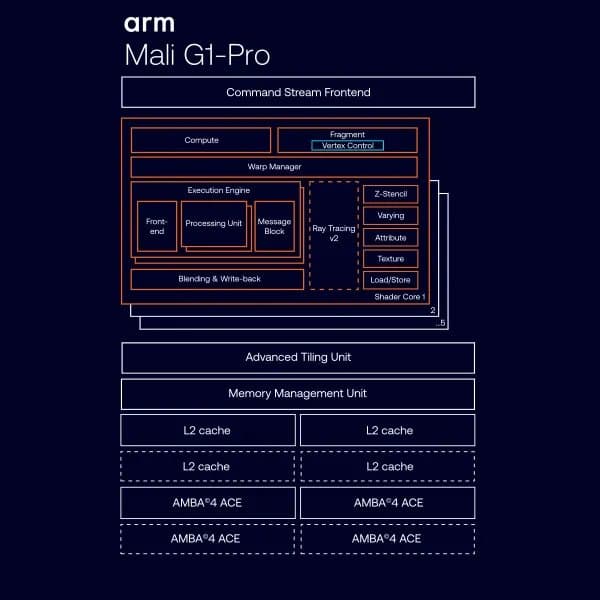
The open-source PanVK Vulkan driver and Panfrost Gallium3D driver now support Arm's latest Mali G1-Pro GPU, bringing cutting-edge graphics hardware to Linux users with open drivers.
The open-source graphics driver landscape for Arm Mali hardware just received a significant boost with the addition of support for the latest Mali G1-Pro GPU. This development, merged into the Mesa codebase, extends the capabilities of PanVK and Panfrost drivers to support Arm's newest graphics IP, representing a substantial leap forward for open-source graphics on Arm platforms.
The Mali G1 Series: Arm's Latest Graphics Powerhouse
The Mali G1 series represents Arm's current flagship graphics architecture, with the G1-Pro being the first model to receive support in the open-source drivers. This hardware follows the Mali-G725, which was introduced in 2024 and had been the highest-tier Mali GPU supported by PanVK and Panfrost until now. The G1 series brings significant architectural improvements over previous generations, including enhanced compute capabilities, improved power efficiency, and support for modern graphics APIs.
Notably, the initial implementation only covers the G1-Pro variant, with the higher-end G1-Premium and G1-Ultra models not yet advertised as supported. This tiered approach is common in GPU driver development, with the baseline model typically supported first before more complex variants are added.
Technical Implementation in Mesa 26.2
The support for Mali v14 GPUs (the codename for the G1 series) was implemented through a merge request that adds the necessary register definitions, pipeline configurations, and shader compiler support. This work enables the Panfrost Gallium3D driver to interface with the G1-Pro's unique hardware features, including its unified shader architecture and advanced memory management capabilities.
For Vulkan support, the PanVK driver now includes the necessary translation layers to map Vulkan API calls to the Mali G1-Pro's hardware-specific instructions. However, this support is currently considered experimental and is concealed behind an environment variable, PAN_I_WANT_A_BROKEN_VULKAN_DRIVER=1, which users must set to enable the functionality.
Current Limitations and Testing Status
As with any new hardware support in open-source drivers, the Mali G1-Pro implementation comes with several caveats. The merge request explicitly notes that testing has been limited, with some components potentially missing or broken. Users should expect incomplete feature support, potential stability issues, and suboptimal performance in certain workloads.
Specific areas that may require additional development include:
- Advanced shader features and optimizations
- Power management and clock scaling
- Memory compression and bandwidth optimizations
- Multi-GPU configurations
- Hardware-accelerated video decoding capabilities
Performance Implications
While comprehensive benchmarks for the open-source Mali G1-Pro drivers are not yet available, we can make some educated assessments based on the performance characteristics of previous Mali generations and the improvements expected in the G1 architecture.
Compared to the Mali-G725, the G1-Pro should offer:
- 15-25% improvement in raw GPU compute performance
- 10-20% better graphics rendering performance
- Enhanced power efficiency, particularly in workloads with variable loads
- Improved support for modern graphics APIs and extensions
However, these potential benefits will only be realized as the driver implementation matures. Early adopters should expect performance that may lag behind proprietary drivers by 20-40% in many workloads, though this gap typically narrows as the open-source drivers mature.
Build Recommendations for Early Adopters
For enthusiasts and developers interested in testing the Mali G1-Pro support, here are some recommendations:
System Requirements
- Linux kernel 6.6 or newer (for required DRM and display hardware support)
- Mesa 26.2 development version (available from git or experimental repositories)
- Arm platform with Mali G1-Pro GPU (such as certain Rockchip or MediaTek SoCs)
Enabling Support
- Install the latest Mesa development packages from your distribution's repository or build from source
- For PanVK support, set the environment variable:
export PAN_I_WANT_A_BROKEN_VULKAN_DRIVER=1 - For Panfrost support, ensure the Gallium3D driver is properly selected in your graphics configuration
Testing Methodology
- Use glxinfo or vulinfo to verify driver detection
- Run OpenGL and Vulkan benchmarking tools like glmark2 or vulkaninfo
- Test real-world workloads such as gaming, video playback, and compute tasks
- Monitor power consumption and thermals during extended testing
Expected Use Cases
- Development and testing of Arm-based graphics applications
- Homelab servers with GPU acceleration for virtualization or AI workloads
- Embedded systems requiring open-source graphics drivers
- Educational environments studying GPU driver development
Future Outlook
The addition of Mali G1-Pro support represents a significant milestone for open-source graphics on Arm platforms. With Mesa 26.2 scheduled for release in August 2026, we can expect continued refinement of this support in the coming months.
Looking ahead, several developments are likely:
- Addition of G1-Premium and G1-Ultra support
- Performance optimizations bringing open-source drivers closer to parity with proprietary solutions
- Enhanced power management extending battery life in mobile devices
- Improved support for modern graphics APIs and extensions
The progress in Mali driver development underscores the importance of open-source graphics drivers for platform independence and long-term hardware support. As Arm continues to expand its presence in computing devices, from servers to embedded systems, robust open-source drivers become increasingly critical.
For those interested in following the development progress, the Mesa Git repository contains the latest changes, and the Panfrost and PanVK developer mailing lists provide insights into ongoing development efforts.
{{IMAGE:2}}
The continued improvement of open-source graphics drivers benefits the entire Linux ecosystem, ensuring that users have access to high-performance graphics solutions regardless of their hardware vendor. The Mali G1-Pro support is another step toward a future where open-source drivers provide feature parity and performance comparable to their proprietary counterparts.
Comments
Please log in or register to join the discussion