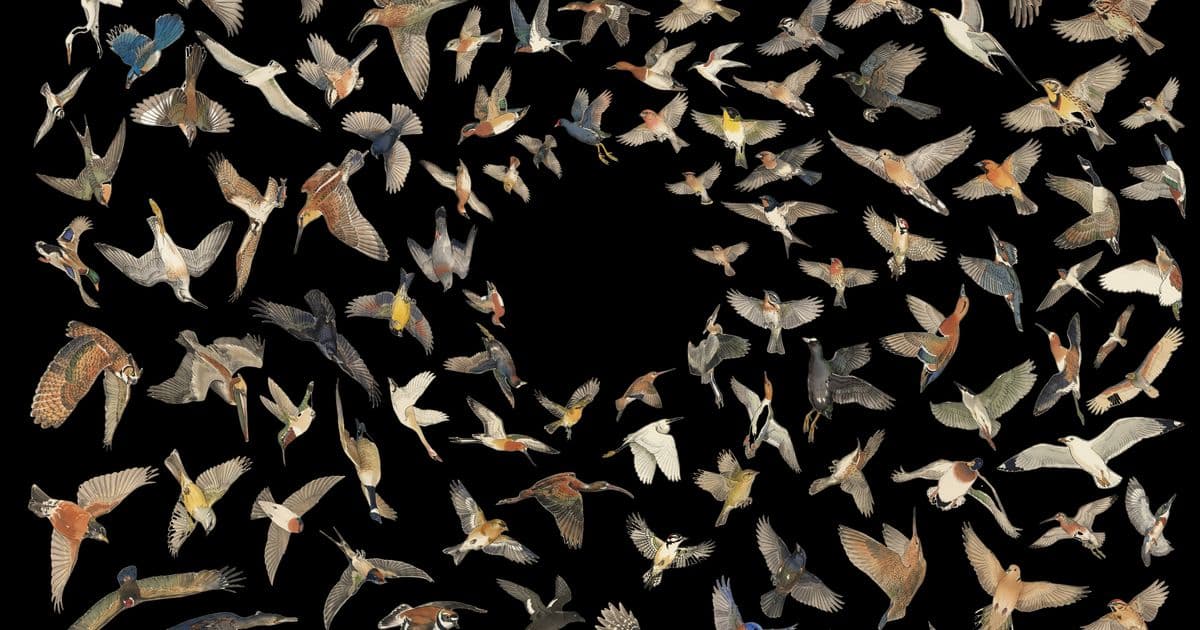
Teddy Warner's Avian Visitors project combines AI-powered bird detection with traditional Japanese woodblock aesthetics, creating an accessible and visually striking approach to ornithology monitoring.
The intersection of citizen science and artificial intelligence continues to yield fascinating projects that bridge technology with natural observation. Among the latest developments is Avian Visitors, a project by Teddy Warner that transforms the BirdNET-Pi bird monitoring system into a visually stunning kachō-e (Japanese woodblock print) collage. This fusion of modern AI analysis with traditional artistic aesthetics represents an emerging pattern in how developers are approaching environmental monitoring projects.
Avian Visitors operates by using a Raspberry Pi equipped with a USB microphone to capture ambient audio, which is then processed through Cornell's BirdNET acoustic classifier. When the system detects bird species, it doesn't simply log them as data points. Instead, it displays them as artistic illustrations in a dynamic collage format, with each bird rendered in the style of Edo-period Japanese woodblock prints.
"I was initially planning on leaving this as a 'true' personal project of sorts," Warner explains in the project documentation. "I love a good project writeup of course, but frankly I thought this was too quick an afternoon project to warrant any more documentation than a tweet. Twitter thought otherwise."
The project has quickly gained attention in the maker and birding communities, with many praising its accessibility. The complete setup costs approximately $80, making it one of the more affordable bird monitoring solutions available. The installation process is remarkably streamlined, with a single bash script handling the entire setup process, from flashing the Raspberry Pi OS to configuring the BirdNET-Pi components and installing the custom overlay.
What sets Avian Visitors apart from other bird monitoring projects is its sophisticated approach to visualization. The system generates illustrations using Google's Gemini API with carefully crafted prompts that ensure anatomical accuracy while maintaining the distinctive kachō-e aesthetic. Each species receives two poses—perched and in-flight—with specific attention to proper wing positioning and feather details.
The visualization system employs several clever technical solutions. A center-out spiral packing algorithm arranges the bird tiles based on detection frequency, with larger, more frequently detected birds positioned more prominently. The system also uses binary alpha masks to handle overlapping elements properly, ensuring that birds appear to float naturally rather than being confined to rigid grid positions.
"The packing algorithm itself is a center-out spiral: tiles get sorted by area descending, the largest is placed at the center of mass, and each subsequent tile spirals outward from the center until finding a position where its mask doesn't intersect any already-placed mask," Warner details in the technical documentation.
The project has sparked interesting discussions about the balance between scientific accuracy and artistic interpretation in environmental monitoring tools. Some birding enthusiasts have noted that while the artistic representation is beautiful, it might not provide the level of detail that serious ornithologists require for species identification. However, others argue that the artistic approach makes the data more accessible and engaging for casual observers and educational purposes.
Privacy considerations have also been raised, particularly regarding the continuous audio recording capabilities of the system. While the project is designed for outdoor monitoring, some have questioned whether similar techniques could be adapted for surveillance purposes. Warner has emphasized the project's intended use for environmental monitoring rather than surveillance.
The project's regional filtering capability, which uses the eBird API to limit species display to those actually observed in a specific area, represents an interesting approach to data relevance. This feature reduces the visual clutter by showing only species that could realistically be present, making the interface more useful for location-specific monitoring.
As climate change and habitat loss continue to impact bird populations, citizen science projects like Avian Visitors play an increasingly important role in both monitoring these changes and engaging the public in conservation efforts. The project's aesthetic approach may help bridge the gap between scientific data collection and public engagement, creating a more emotional connection to the data being collected.
The Avian Visitors project is available on GitHub, with detailed installation instructions and technical documentation. The live demonstration can be viewed at bird.onethreenine.net, where visitors can see the system in action and observe the real-time bird detection and visualization.
{{IMAGE:1}}
As the project continues to evolve, it represents an interesting case study in how artistic sensibilities can enhance scientific tools, potentially opening new avenues for public participation in environmental monitoring. The fusion of traditional Japanese art with modern AI technology creates a unique approach to data visualization that may inspire similar projects in other domains of environmental monitoring.
Comments
Please log in or register to join the discussion