AWS has launched the general availability of DevOps Agent, an AI-powered assistant that autonomously investigates incidents across AWS, Azure, and on-prem environments, promising up to 75% faster MTTR and 94% root cause accuracy.
AWS has announced the general availability of DevOps Agent, a generative AI–powered assistant designed to help developers and operators troubleshoot issues, analyze deployments, and automate operational tasks across AWS environments. Introduced in preview at re:Invent 2025 and built on Amazon Bedrock AgentCore, DevOps Agent analyzes incidents by learning application relationships and integrating with observability tools, runbooks, code repositories, and CI/CD pipelines.
The agent correlates telemetry, code, and deployment data to autonomously triage issues, speed up resolution, and identify patterns in past incidents to recommend improvements that help prevent future outages.
From Manual Triage to Autonomous Teammates
Announcing the general availability, Madhu Balaji, senior solution architect at AWS, writes: A SRE responding to a 2 AM page must manually correlate telemetry from multiple sources, trace dependencies across services, and form hypotheses — a process that routinely takes hours. As systems grow in complexity, the need for an AI-powered operational teammate — an SRE agent — has become increasingly clear.
The main improvements introduced with the general availability include:
- Cross-platform investigation: Ability to investigate applications in Azure and on-prem environments
- Custom agent skills: Support for extending capabilities through custom skills
- Custom charts and reports: Enhanced visualization and reporting capabilities
Balaji adds: DevOps Agent is not a passive Q&A tool, it is an autonomous teammate. When an incident triggers via a CloudWatch alarm, PagerDuty alert, Dynatrace Problem, ServiceNow ticket, or any other event source you configure through the webhook, the agent begins investigating immediately without human prompting.
Real-World Implementation Example
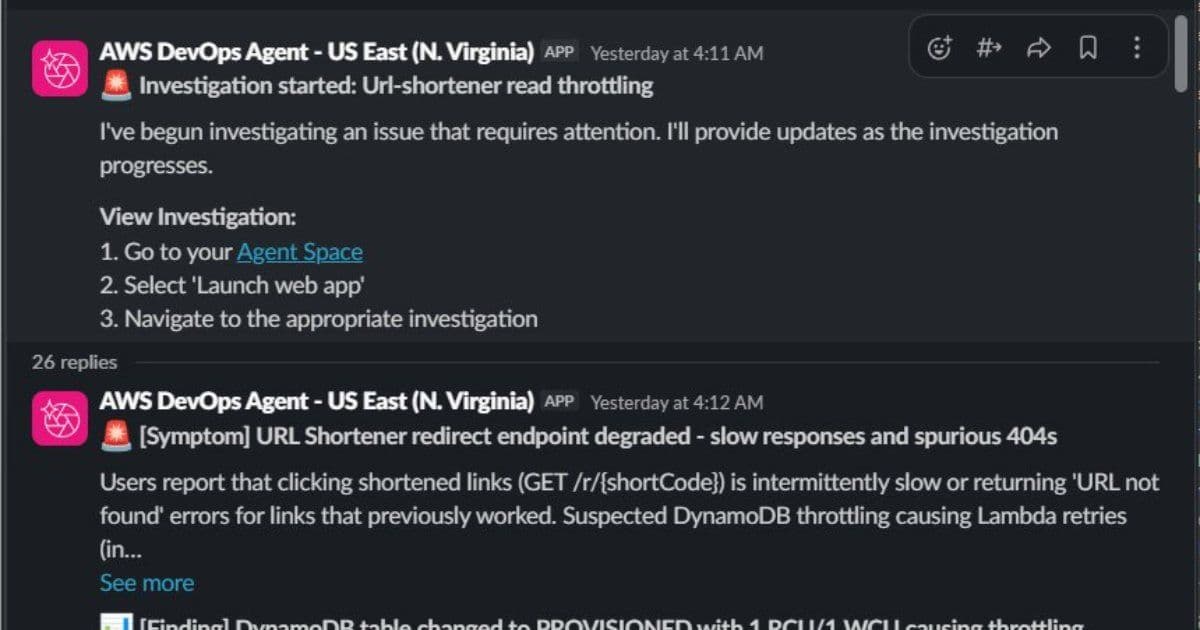
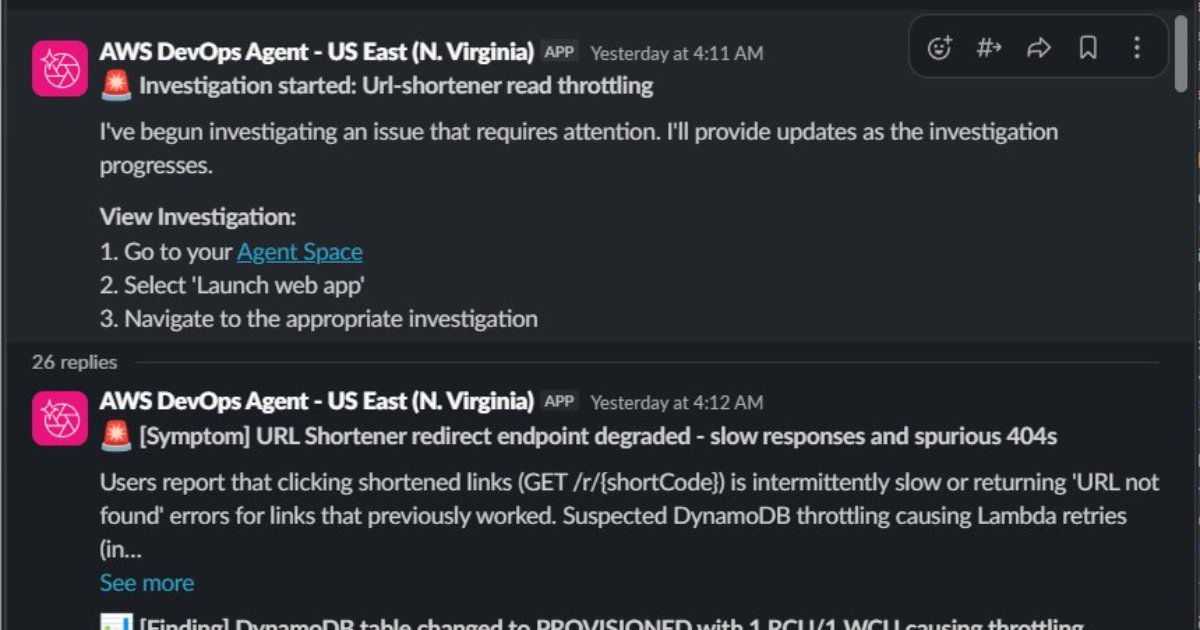
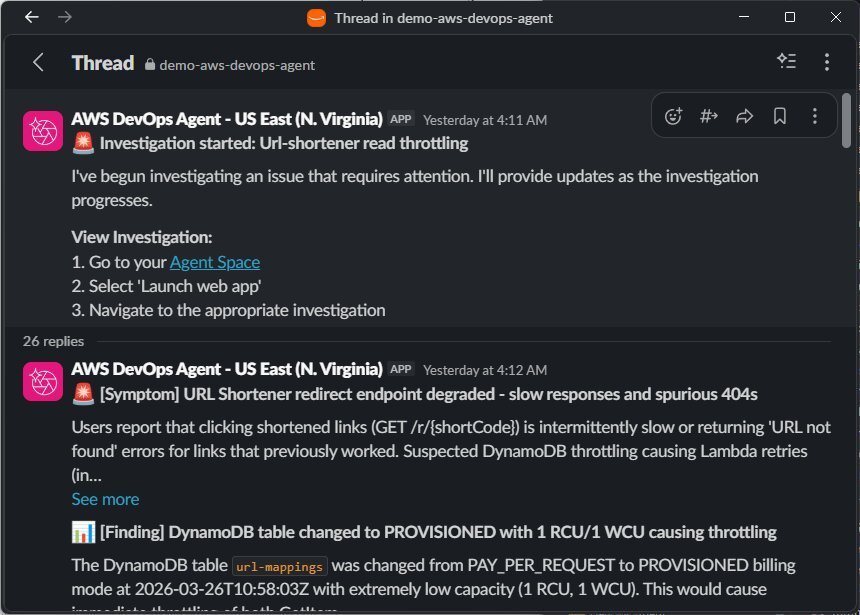
In a separate article, using a serverless URL shortener application as an example, Janardhan Molumuri, Bill Fine, Joe Alioto, and Tipu Qureshi explain how to leverage agentic AI for autonomous incident response with DevOps Agent. They write: Extensibility through the MCP and built-in integrations with CloudWatch, Datadog, Dynatrace, New Relic, Splunk, Grafana, GitHub, GitLab, and Azure DevOps ensures the agent can pull signals from wherever the team's operational data lives.
The Problem DevOps Agent Solves
According to the cloud provider, DevOps teams often start incident investigations using AI coding tools connected to logs and monitoring systems, but these tools lack the broader context and operational controls needed to manage complex production environments at scale.
Sebastian Korfmann, co-creator of Agentic Hamburg, writes: The early numbers are compelling: up to 75% lower MTTR and 94% root cause accuracy in preview. Integrates with Datadog, Grafana, Splunk, PagerDuty, ServiceNow, and more.
The Cost of Autonomous Operations
Corey Quinn, chief cloud economist at The Duckbill Group, comments: You're paying for the privilege of having AI do what your 2 AM on-call engineer does, except it won't passive-aggressively Slack the team about it afterward. MTTR drops from hours to minutes; invoices go from minutes to hours.
With general availability, the service is no longer free, with the pricing based on the cumulative time the agent spends on operational tasks, billed per second. AWS Support customers receive monthly DevOps Agent credits based on their previous month's support spending, with the percentage of the credits available based on the support level.
Community Response and Concerns
In a popular Reddit thread, many developers question the lack of an accountability model, with user The_Flexing_Dude asking: Is that the same one that dropped a production environment last month?
This question highlights a critical concern in the industry: as AI agents take on more operational responsibilities, who is accountable when things go wrong?
Availability and Regional Support
The service is currently available across six regions, including Northern Virginia, Ireland, and Frankfurt, with plans for additional region expansion.
Security Agent: Complementary AI-Powered Security
In a separate announcement, AWS made Security Agent on-demand penetration testing generally available. The AI-powered agent continuously analyzes application design, code, and runtime behavior to automatically perform on-demand penetration testing and identify exploitable security vulnerabilities.
This dual announcement of DevOps Agent and Security Agent represents AWS's broader strategy to embed AI-powered autonomous capabilities across the operational and security spectrum of cloud management.
Technical Architecture and Integration
DevOps Agent is built on Amazon Bedrock AgentCore, AWS's foundation for enterprise AI agents. The architecture allows for:
- Multi-source data correlation: Pulling from logs, metrics, traces, and code repositories simultaneously
- Contextual learning: Building knowledge of application relationships and dependencies over time
- Autonomous action: Taking predefined remediation steps without human intervention
- Extensible skill framework: Custom skills can be added to handle domain-specific scenarios
The agent supports integration with major observability and incident management platforms:
- Monitoring: CloudWatch, Datadog, Dynatrace, New Relic, Splunk, Grafana
- Incident Management: PagerDuty, ServiceNow
- Source Control: GitHub, GitLab, Azure DevOps
- CI/CD: Integration with pipeline systems for deployment context
Performance Metrics and ROI
The claimed performance improvements are significant:
- 75% reduction in Mean Time to Resolution (MTTR): From hours to minutes
- 94% root cause accuracy: High confidence in identifying the actual source of incidents
- Autonomous investigation: No human prompting required for initial triage
These metrics suggest a substantial return on investment for organizations dealing with frequent incidents or complex microservices architectures where manual investigation is time-consuming and error-prone.
Pricing Model and Cost Considerations
The shift from free preview to paid general availability introduces a consumption-based pricing model. Organizations need to consider:
- Per-second billing: Granular cost control based on actual agent usage
- Support tier credits: AWS Support customers receive credits proportional to their support level
- ROI calculation: Balancing the cost of the service against reduced MTTR and improved operational efficiency
For organizations with high incident volumes or complex environments, the cost may be justified by the operational savings and improved reliability.
The Future of AI in DevOps
DevOps Agent represents a significant step toward autonomous operations in cloud environments. As systems become increasingly complex and distributed, the ability to quickly and accurately diagnose issues becomes critical.
The agent's capabilities suggest a future where:
- AI teammates become standard: Autonomous agents work alongside human operators
- Proactive incident prevention: Pattern recognition helps prevent issues before they occur
- Cross-platform operations: Unified incident response across hybrid and multi-cloud environments
- Continuous learning: Agents improve their effectiveness over time through experience
Conclusion
AWS's DevOps Agent marks a significant milestone in the evolution of AI-powered operations. By combining autonomous investigation capabilities with deep integration into existing tools and platforms, it addresses a critical pain point in modern DevOps: the time-consuming and error-prone process of incident investigation.
The general availability brings both opportunities and challenges. Organizations can now leverage sophisticated AI capabilities for incident response, but must also grapple with questions of accountability, cost, and the changing role of human operators in an increasingly automated operational landscape.
As the service matures and expands to additional regions, it will be interesting to see how the DevOps community adopts this technology and what new patterns of autonomous operations emerge from its use.
Comments
Please log in or register to join the discussion