AWS has announced the general availability of AWS Interconnect, a managed private connectivity service that simplifies establishing secure, high-speed connections between AWS and other cloud providers, as well as between AWS and on-premises networks.
AWS Interconnect General Availability: Simplifying Multicloud and Last-Mile Connectivity
The cloud landscape continues to evolve with enterprises increasingly adopting multicloud strategies to leverage specialized services, meet data residency requirements, or support teams using different providers. Historically, connecting these environments reliably and securely has required significant coordination—managing VPN tunnels, working with colocation facilities, and configuring third-party network fabrics. Today, AWS addresses these challenges with the general availability of AWS Interconnect, a managed connectivity service that simplifies private connections across hybrid and multicloud environments.
Understanding AWS Interconnect
AWS Interconnect is a fully managed service that provides private, high-speed network connections with dedicated bandwidth to and from AWS. It removes the infrastructure complexity from networking teams, allowing them to focus on applications rather than undifferentiated heavy lifting. The service consists of two main capabilities:
- AWS Interconnect – multicloud: Connects Amazon Virtual Private Cloud (Amazon VPC) directly to VPCs on other cloud providers
- AWS Interconnect – last mile: Simplifies establishing high-speed, private connections to AWS from branch offices, data centers, and remote locations
Both capabilities are built on the same principle: a fully managed, turnkey experience that eliminates the need to discover partners and manually configure network components.
AWS Interconnect – Multicloud
The multicloud component provides a private, managed Layer 3 connection between AWS environments and other cloud providers, starting with Google Cloud, with Microsoft Azure support planned for later in 2026. This service addresses the growing need for enterprises to run workloads across multiple cloud platforms while maintaining consistent performance and security.
Key Features
- Private connectivity: Traffic flows entirely over the AWS global backbone and the partner cloud's private network, never traversing the public internet
- Predictable performance: Provides consistent latency and throughput, isolated from internet congestion
- Built-in security: Uses IEEE 802.1AE MACsec encryption on physical links between AWS routers and partner cloud routers
- Resilient architecture: Each connection spans multiple logical links distributed across at least two physical facilities
- Integrated monitoring: Works with Amazon CloudWatch, providing Network Synthetic Monitor for tracking round-trip latency, packet loss, and bandwidth utilization
How It Works
Provisioning a connection is straightforward and can be completed in minutes through the AWS Management Console:
- Navigate to AWS Direct Connect, select AWS Interconnect, and choose the cloud provider (currently Google Cloud)
- Select the source and destination regions
- Specify bandwidth requirements and provide the cloud provider project ID
- AWS generates an activation key to complete the connection on the provider side
- Routes propagate automatically in both directions
The underlying specification has been published on GitHub under the Apache 2.0 license, allowing any cloud service provider to collaborate with AWS Interconnect – multicloud. To become an AWS Interconnect partner, cloud providers must implement the technical specification and meet AWS operational requirements, including resiliency standards, support commitments, and service level agreements.
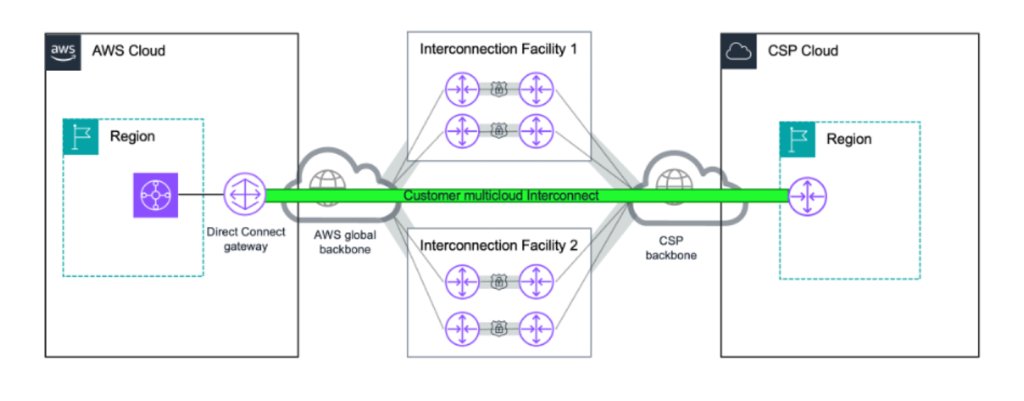 Figure: AWS Interconnect multicloud architecture
Practical Implementation Example
For a practical example, connecting an AWS VPC to a Google Cloud VPC involves these steps:
- Request an interconnect in AWS Console: Select Google Cloud as the provider, choose regions, specify bandwidth, and provide the Google Cloud project ID
- Create transport and VPC peering on Google Cloud: Use the activation key from AWS to create a transport resource, then establish peering between the Google Cloud VPC and the transport
- Associate the gateway on AWS: Attach the Virtual Private Gateway to the Direct Connect Gateway
- Configure routing: Add route entries in VPC route tables to direct traffic appropriately
Important Configuration Considerations
When implementing AWS Interconnect – multicloud, several technical details require attention:
- IP address ranges: The VPC CIDR ranges on both AWS and the partner cloud cannot overlap
- IP version consistency: You must configure IPv4, IPv6, or both consistently on both sides
- MTU alignment: The Maximum Transmission Unit must match between both VPCs, as mismatched MTU sizes can cause packet drops, fragmentation, and degraded performance
Scaling with AWS Networking Services
For more complex deployments, AWS Interconnect integrates with other networking services:
- AWS Transit Gateway: Provides a centralized routing hub for connecting multiple VPCs in a single region through a single Interconnect attachment
- AWS Cloud WAN: Extends the centralized routing model globally, allowing any region in your network to reach any Interconnect attachment with consistent policy management
Reference architectures for these deployments are documented in the AWS blog post on building resilient and scalable multicloud connectivity architectures.
AWS Interconnect – Last Mile
Building on the same architecture as the multicloud offering, AWS Interconnect – last mile simplifies establishing private connections from on-premises or remote locations to AWS through participating network providers' last-mile infrastructure.
Key Features
- Simplified provisioning: Complete setup through the AWS Management Console by selecting a provider, authenticating, and specifying endpoints and bandwidth
- Automatic configuration: Provisions four redundant connections across two physical locations, configures BGP routing, and activates MACsec encryption and Jumbo Frames by default
- Flexible bandwidth: Supports bandwidths from 1 Gbps to 100 Gbps, with the ability to adjust capacity without reprovisioning
- High availability: Includes a 99.99% availability SLA up to the Direct Connect port
- Integrated monitoring: Bundles CloudWatch Network Synthetic Monitor for connection health monitoring
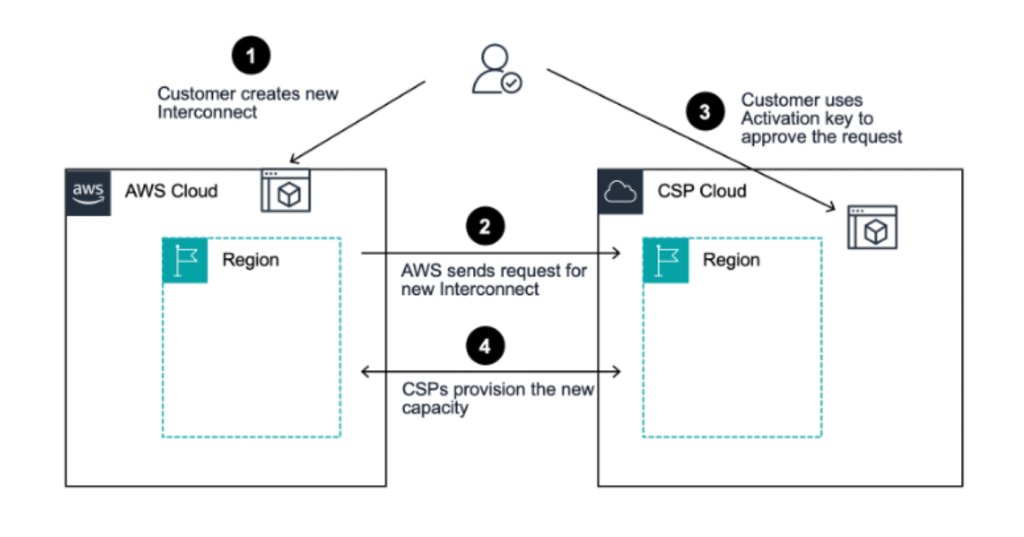 Figure: AWS Interconnect last mile provisioning process
Initial Availability
AWS Interconnect – last mile is launching in US East (N. Virginia) with Lumen Technologies as the initial partner. Additional partners, including AT&T and Megaport, are in progress, with plans to expand to additional regions.
Lumen Technologies' Scott Yow, SVP Product, commented: "By combining AWS Interconnect – last mile with Lumen fiber network and Cloud Interconnect, we simplify the last-mile complexity that often slows cloud adoption and enable a faster, and more resilient path to AWS for customers."
Use Cases and Benefits
AWS Interconnect addresses several common enterprise scenarios:
Hybrid and Multicloud Workloads
Enterprises running workloads across AWS and other cloud platforms can establish secure, high-performance connections without managing the underlying infrastructure. This is particularly valuable for:
- Applications requiring low latency between cloud environments
- Workloads subject to data residency regulations
- Organizations with standardized on different cloud providers
Branch Office Connectivity
For distributed organizations, AWS Interconnect – last mile provides a simplified alternative to traditional MPLS connections or complex VPN setups, offering:
- Higher performance than internet-based VPNs
- Simplified management through the AWS Console
- Consistent experience across multiple locations
Disaster Recovery and Business Continuity
The service's redundant architecture and built-in resiliency make it suitable for disaster recovery scenarios, ensuring reliable connectivity between primary and secondary sites.
Trade-offs and Considerations
While AWS Interconnect offers significant benefits, organizations should consider several factors:
Vendor Lock-in
As a managed AWS service, organizations become more dependent on AWS for connectivity. While the multicloud specification is open-sourced, the implementation and management remain AWS-specific.
Limited Initial Partner Ecosystem
The multicloud offering currently supports only Google Cloud, with Azure planned for later in 2026. The last-mile service is launching with a single partner (Lumen), with others in progress.
Cost Structure
Pricing is based on a flat hourly rate for the requested capacity, billed prorated by the hour. The multicloud pricing varies by region pair, which can affect total costs, especially when using AWS Cloud WAN's global routing model.
Technical Complexity
While simplified compared to traditional implementations, the service still requires networking expertise to properly configure and troubleshoot issues, particularly around IP addressing, routing, and MTU alignment.
Pricing and Availability
AWS Interconnect – multicloud is available today in five region pairs:
- US East (N. Virginia) to Google Cloud N. Virginia
- US West (N. California) to Google Cloud Los Angeles
- US West (Oregon) to Google Cloud Oregon
- Europe (London) to Google Cloud London
- Europe (Frankfurt) to Google Cloud Frankfurt
AWS Interconnect – last mile is launching in US East (N. Virginia) with Lumen as the initial partner.
For detailed pricing information, organizations should review the AWS Interconnect pricing page before sizing their connections.
Conclusion
AWS Interconnect represents a significant step forward in simplifying connectivity across hybrid and multicloud environments. By providing a fully managed service that eliminates the need for coordinating with multiple providers and manually configuring network components, AWS enables organizations to focus on their applications rather than infrastructure management.
The service's integration with existing AWS networking services like Transit Gateway and Cloud WAN further enhances its value for organizations of all sizes. As the partner ecosystem expands and additional cloud providers are supported, AWS Interconnect is positioned to become a cornerstone of enterprise multicloud strategies.
For organizations looking to get started, the service can be accessed through the AWS Direct Connect console by selecting AWS Interconnect from the navigation menu. The simplified provisioning process and comprehensive documentation should help accelerate adoption for enterprises looking to streamline their hybrid and multicloud connectivity.
Comments
Please log in or register to join the discussion