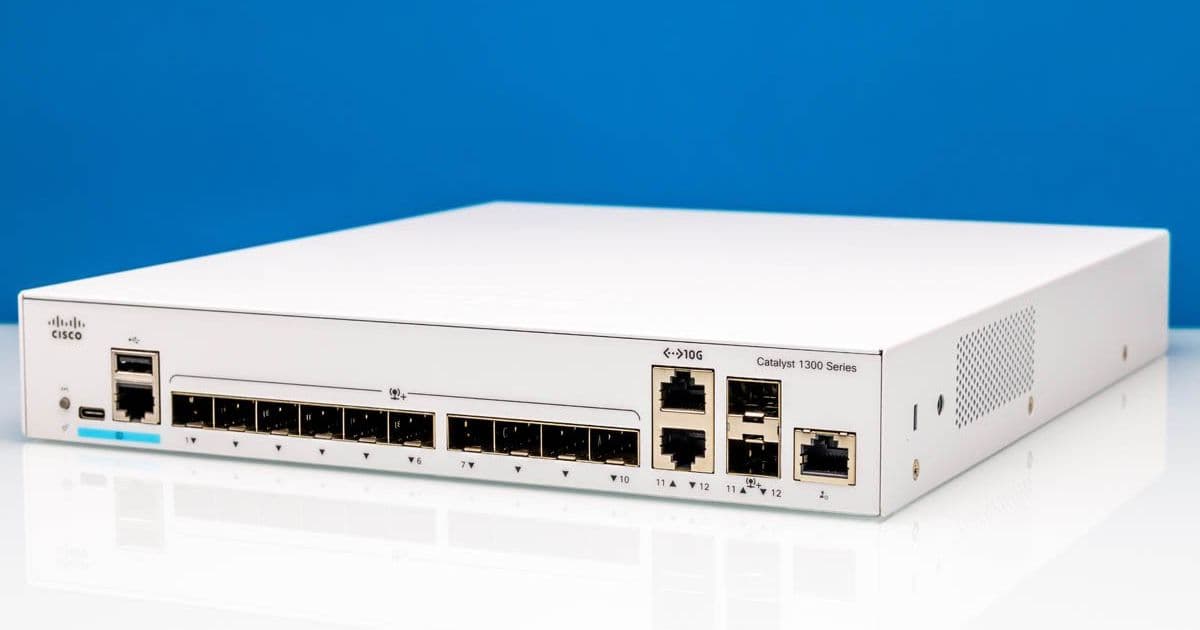
The Cisco Catalyst C1300-12XS delivers twelve 10Gbps ports in a compact 1U form factor, combining SFP+ and 10GBase-T flexibility with enterprise-grade management features.
The Cisco Catalyst C1300-12XS represents a significant step forward in accessible enterprise networking hardware. As networks increasingly demand 10GbE connectivity for both servers and client devices, this switch offers a compelling balance of port density, flexibility, and management capabilities. Let me walk you through what makes this switch noteworthy.
Hardware Design and Build Quality
The C1300-12XS comes in a standard 1U rackmount form factor that's immediately recognizable as Cisco enterprise gear. The front panel houses twelve 10Gbps ports - ten dedicated SFP+ ports and two combo ports that can accept either SFP+ modules or 10GBase-T RJ45 connections. This dual-interface approach provides valuable flexibility as network environments evolve.
One notable feature that sets this model apart from its smaller sibling, the C1300-8FP-2G, is the dedicated out-of-band management port. While some networks may never use this feature, it's becoming increasingly important in data center environments where management traffic needs to be isolated from production data flows.
Port Configuration and Flexibility
The ten SFP+ ports (1-10) provide pure optical connectivity for high-performance links, while the combo ports (11-12) offer the flexibility to use either SFP+ or 10GBase-T. This is particularly relevant as we move through 2026, with more client devices supporting 10Gbase-T natively. The combo port design means you can adapt to whatever connectivity your devices require without being locked into one interface type.
Internal Architecture
Opening the switch reveals a more sophisticated internal design than initially apparent. Rather than using a standard 40mm 1U fan, Cisco employs a blower-style fan that provides more efficient cooling for the densely packed components. This design choice suggests the switch is built to handle sustained high-throughput scenarios without thermal throttling.
The internal power supply is a single AC input, which means if you need A+B power redundancy, you'll need to pair it with an Automatic Transfer Switching (ATS) PDU. This is a common configuration in enterprise environments but worth noting for planning purposes.
Component Analysis
The switch's brains appear to be based on Marvell Prestera switching silicon, though Cisco uses different SKUs across the C1300 series. Supporting components include:
- Lattice MachXO2 FPGA for hardware acceleration and control logic
- Marvell 88E1512 PHY for physical layer interfacing
- Marvell 88X3310 10Gbase-T transceiver for the combo port functionality
- Micron NAND for storage
- Nanya DRAM for memory
The heatsink is glued to the main switching chip, which is typical for production hardware but makes component-level repairs challenging.
Management and Configuration
As expected from Cisco, the switch provides multiple methods to access the command-line interface (CLI). The "Cisco-like" CLI will be immediately familiar to network administrators who have worked with other Cisco devices. This consistency across the product line reduces the learning curve and enables more efficient network management.
Market Position and Value Proposition
Cisco's gear isn't the cheapest option in the 10GbE managed switch market, but it offers several advantages that justify the premium:
- Brand recognition and support: Cisco's reputation means better third-party support and easier troubleshooting
- Feature completeness: The out-of-band management port and enterprise-grade CLI are features you won't find on budget switches
- Reliability: Cisco's quality control and component selection typically result in longer operational lifespans
- Compatibility: Seamless integration with existing Cisco infrastructure and management tools
Use Cases
This switch is ideally suited for:
- Small to medium data centers needing 10GbE connectivity without breaking the bank
- Network edge aggregation where multiple 10GbE links need to be consolidated
- Workgroup environments with high-performance computing or storage requirements
- Homelab enthusiasts who want enterprise-grade features without enterprise pricing
Final Thoughts
The Cisco Catalyst C1300-12XS fills an important niche in the networking market. It provides twelve 10Gbps ports in a compact form factor, with the flexibility of both SFP+ and 10GBase-T interfaces. While not the cheapest option available, the combination of Cisco's reliability, feature set, and management capabilities makes it a strong contender for environments where downtime is costly and network performance is critical.
For organizations already invested in Cisco infrastructure, this switch represents a logical upgrade path that maintains consistency while providing the port density and speed needed for modern workloads. The inclusion of features like out-of-band management and the familiar CLI make it particularly attractive for enterprise deployments where these capabilities are expected rather than optional.
If you're looking for a 10GbE managed switch that balances performance, flexibility, and enterprise features, the Cisco Catalyst C1300-12XS deserves serious consideration. Its combination of port options, management capabilities, and Cisco's backing makes it a reliable choice for networks that need to scale without compromising on features or support.
[Purchase options: Available on Amazon and B&H]
Comments
Please log in or register to join the discussion