
Lawmakers are moving to insert themselves into a fight that has so far played out in zoning boards and statehouses. As data center construction surges to meet AI demand, the cost spilling onto electricity bills and water supplies is turning into a federal issue.
Congressional interest in data centers has shifted from cheerleading to scrutiny, and the timing tracks a measurable economic strain. A wave of local opposition to hyperscale facilities, the campus-sized buildings that house the servers training and running AI models, has bubbled up across states from Virginia to Georgia to Arizona. Now members of Congress are signaling they want a seat at a table that until recently belonged to county commissioners and utility regulators.
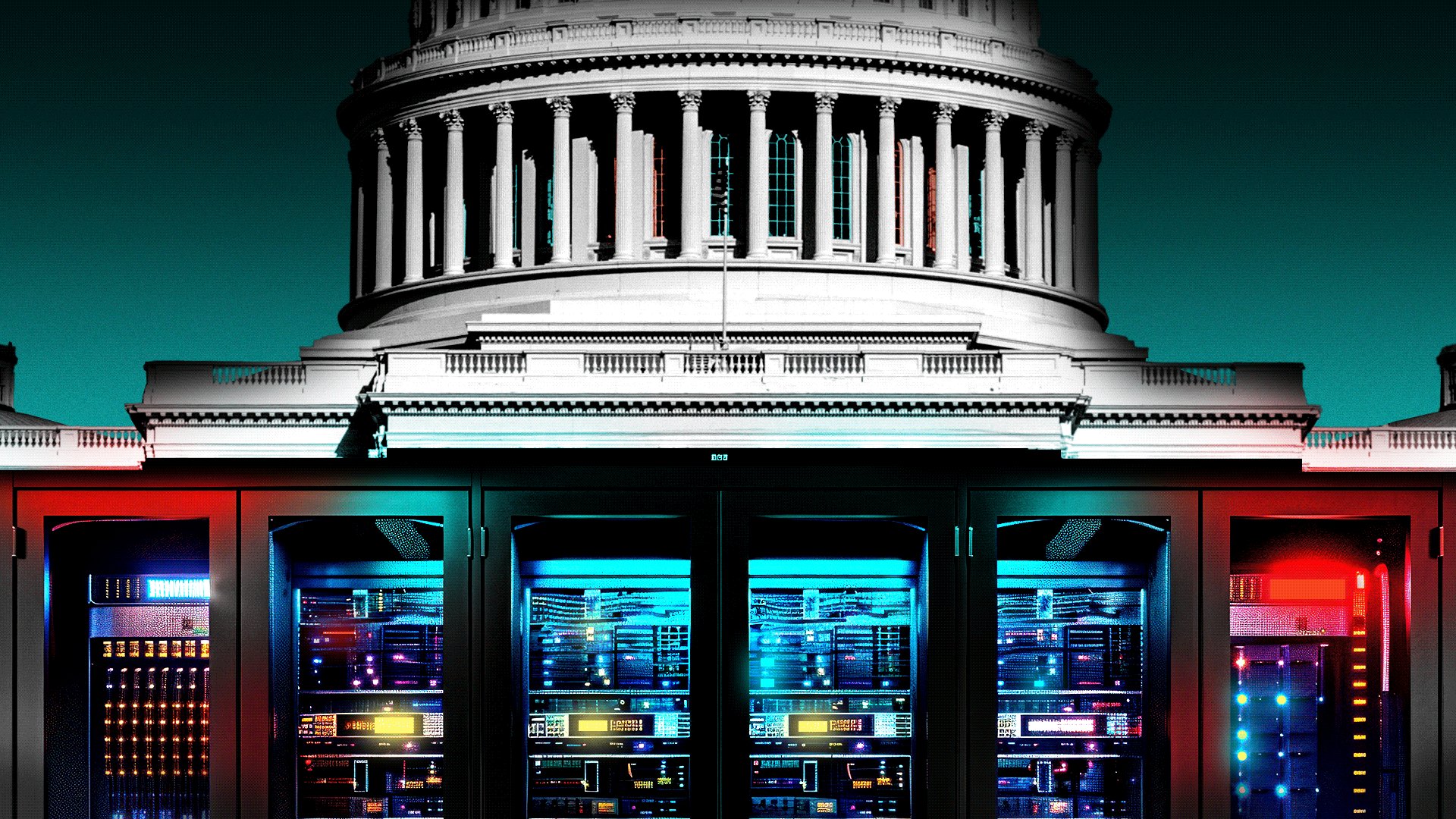
The backlash is fundamentally about money and resources, which is why it has legs. Data centers are the physical backbone of the AI buildout, and the spending behind them is staggering. The largest cloud and AI operators, Amazon, Microsoft, Google, and Meta, are collectively on pace to spend well over $300 billion in capital expenditures in 2025, the bulk of it pointed at AI infrastructure. That capital has to land somewhere, and where it lands, it draws power and water on a scale that reshapes local grids.
The numbers driving the friction
Electricity is the pressure point. Data centers consumed roughly 4% of total US electricity a few years ago, and projections from the Department of Energy and independent analysts now put that share on a path toward 9% to 12% by 2028. In concentrated markets the load is far more lopsided. Northern Virginia's Loudoun County, the densest data center cluster on the planet, already routes a majority of its grid capacity to these facilities. When demand of that magnitude shows up faster than utilities can build generation, the cost of new transmission and capacity gets socialized across ratepayers.
That is the part voters notice. Residential electricity bills in several data center heavy regions have climbed at rates well above inflation, and utilities have been candid in regulatory filings that surging commercial demand is part of the equation. When a homeowner's monthly bill rises and the explanation traces back to a windowless building running AI workloads for a trillion-dollar company, the politics write themselves.

Why Congress is stepping in now
Land use and utility rates are traditionally state and local matters, so federal involvement is not automatic. Several forces are pulling Washington in anyway.
The first is the grid itself. Interstate transmission, wholesale power markets, and the regional grid operators that manage them fall partly under federal jurisdiction through the Federal Energy Regulatory Commission. As data center load strains those systems, questions about who pays for new transmission and how large customers are charged become federal questions whether lawmakers want them to be or not.
The second is the national security and competitiveness framing that has surrounded AI. The same officials who argue the US must out-build China on compute capacity now face constituents who do not want the build to happen in their backyard. Reconciling an industrial policy that favors rapid data center expansion with local opposition to that expansion is exactly the kind of tension that lands on congressional desks.
The third is straightforward political opportunity. Opposition to data centers has become one of the rare issues with bipartisan grassroots energy. Conservative rural communities object to land use and water draws, while progressive groups focus on emissions and corporate subsidies. A backlash that crosses the usual partisan lines is attractive to lawmakers looking for an issue that resonates at home.
What it means for the industry
For the hyperscalers and the AI labs renting their capacity, federal attention introduces a variable they have largely avoided. The current expansion has depended on speed, the ability to site, permit, and energize a facility quickly, often sweetened by state and local tax incentives. Studies of those incentive packages have repeatedly found the per-job cost runs high because finished data centers employ relatively few people. That math, generous subsidies for modest local employment, is precisely what invites legislative review.
The strategic implication is that the cost of capacity may rise in ways that do not show up in a chip price. If Congress or federal regulators push for rate structures that make large customers bear more of their own grid costs, or if disclosure requirements force operators to reveal water and power consumption they currently keep confidential, the economics of where and how fast to build shift. Operators are already responding by pursuing dedicated generation, including deals for nuclear output and on-site gas, partly to sidestep the public grid and the politics attached to it.
None of this stops the buildout. Demand for AI compute is real, and the capital committed to meeting it is enormous. What changes is the friction. The era in which a data center could be sited as a quiet economic development win is closing, and the companies that planned around cheap power and light oversight now have to plan around a public, and increasingly federal, fight over who pays for the infrastructure underneath the AI boom.
For a sense of the scale involved, the Department of Energy's analysis of data center energy use offers the baseline figures lawmakers are working from, available through the Lawrence Berkeley National Laboratory report, while the grid market questions sit with FERC. The fight ahead will be decided as much in rate cases and committee hearings as in any single piece of legislation.
Comments
Please log in or register to join the discussion