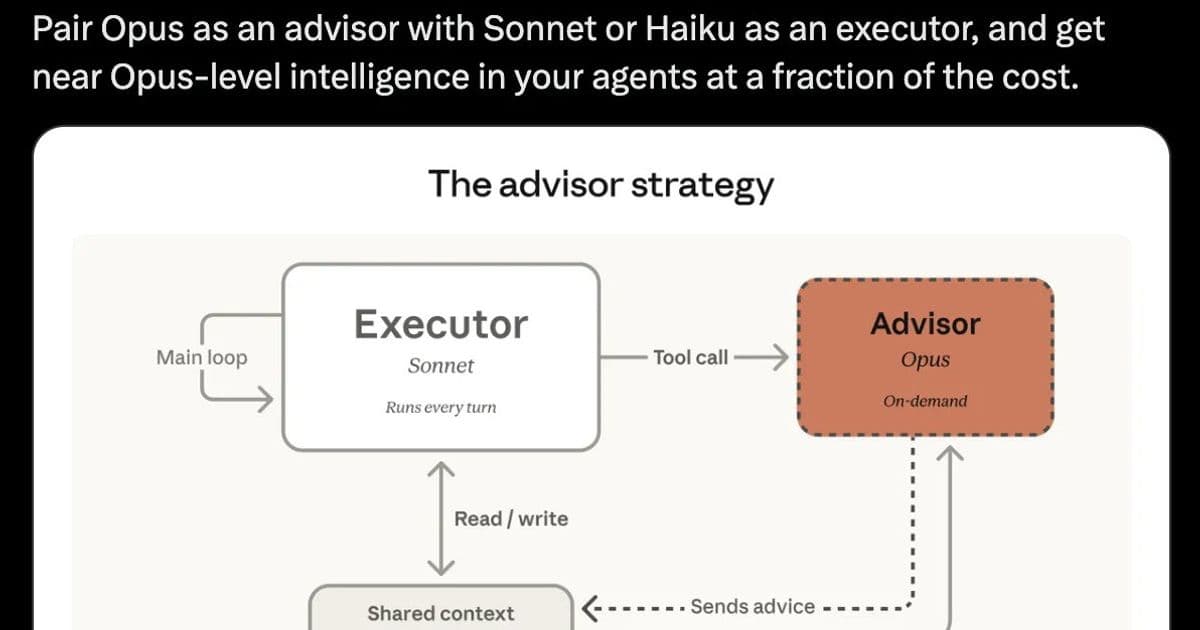
A novel approach to AI agent architecture allows larger models to actively modify the context windows of smaller models, potentially improving efficiency but raising questions about cost-effectiveness and implementation challenges.
In the rapidly evolving landscape of AI agent development, a new concept called 'context sculpting' has emerged that challenges our fundamental assumptions about how AI systems manage their context windows. This approach, developed by Perception Theory, allows a more capable 'outer agent' to actively modify the context window of a smaller 'inner agent' during task execution, potentially creating more efficient and effective AI systems.
The concept originated from a simple yet profound question: what if we treat the context window not as an immutable, append-only conversation log, but as a mutable space that the model itself can inspect and modify? This represents a significant departure from the dominant paradigm that has existed since ChatGPT's release, where context is typically viewed as an ever-growing list of messages, tool calls, and results.
"I was reading 'The Anatomy of an Agent Harness' by Viv when this vision popped into my head," explained the researcher behind Perception Theory. "What if we dropped that append-only assumption? What if we made the context window mutable, by the model itself?"
The implementation approach centers on a two-layer architecture where an inner agent works on the actual task while an outer agent observes and potentially intervenes in the inner context after every turn. The outer agent can choose from four actions: pass_through, rewrite_context, rollback, or terminate. This creates a dynamic system where the context is actively shaped rather than passively accumulated.
The researchers conducted two distinct demos to test this concept. The first demo used GPT-5.4-mini as the inner agent and GPT-5.4 as the outer agent for both coding repair and local-corpus synthesis tasks. While technically successful, the results were underwhelming from an engineering perspective:
- The full harness cost 14x more than the inner-agent-only baseline
- The outer agent never actually edited the inner agent's context window
- The outer agent behaved like a "conservative supervisor," mostly passing through or terminating
"From an engineering perspective, the full 'context sculpting' harness was clearly worse, at least from this small sample size," the researcher noted. "It increased the cost by 14x, without actually doing anything to improve the results."
For the second demo, the researchers made key adjustments: they modified the outer prompt to explicitly encourage intervention when a rewrite could reduce wasted work or simplify the next turn, and they created more challenging tasks with conflicting information and deliberate noise. The results were dramatically different:
- The outer model performed 14 rewrites across 2 harnessed runs
- The system successfully "sculpted" context to reduce clutter and focus the inner agent
- The synthesis task demonstrated the cleanest illustration of the concept, with the outer model simplifying the transcript and focusing the inquiry
However, the coding repair task revealed significant challenges, with what the researchers called an "oversteering disaster": the system took 12 turns instead of 7, cost 70x more, and triggered guardrails despite eventually completing the task successfully.
"The interesting question is no longer: Can an outer agent intervene? The answer is obviously yes," the researcher reflected. "The interesting question is: What is the intervention policy that makes rewriting useful more often than harmful? That is a much harder problem, and much more interesting than the original naive version of the idea."
The research highlights a crucial insight: "the prompt is the policy." The simple change in how the outer agent was instructed to behave transformed it from a "polite supervisor" to an "active context editor." This suggests that control in agent systems isn't just about infrastructure—it's fundamentally about behavior and policy.
The implications for AI development are significant. As more inference moves from the "chat" paradigm to the "agent" paradigm, approaches that rethink what gets passed into models as input could become increasingly valuable. However, the cost implications and the challenge of developing effective intervention policies suggest that context sculpting, while promising, requires further refinement before it becomes a practical engineering solution.
The complete research, including code, demo reports, and analysis, has been published to a public GitHub repository, offering the AI research community an opportunity to build upon these findings. As the researcher noted, "the key insight: the inner agent's context window is not a log. It is a design space that the outer agent actively sculpts."
Comments
Please log in or register to join the discussion