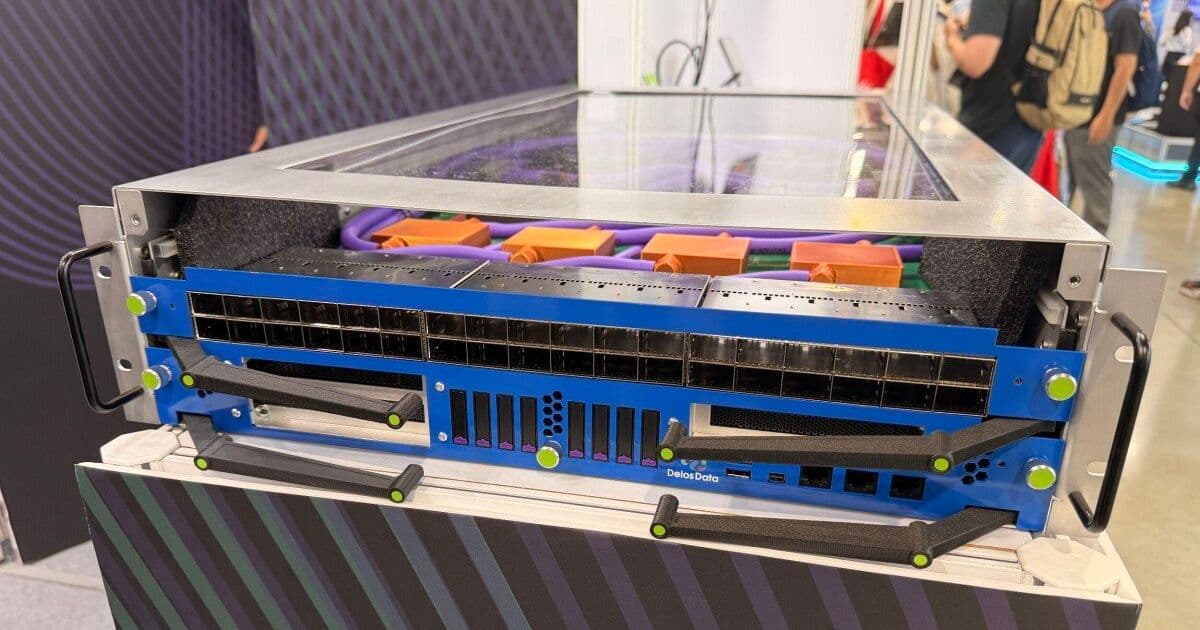
Building a competitive AI accelerator is hard. Wrapping it in a rack that behaves like one giant GPU is arguably harder. Delos Data, founded by former Intel and Barefoot Networks engineers, wants to sell startups a modular chassis that handles the networking, power, and thermal problems so they can focus on silicon.
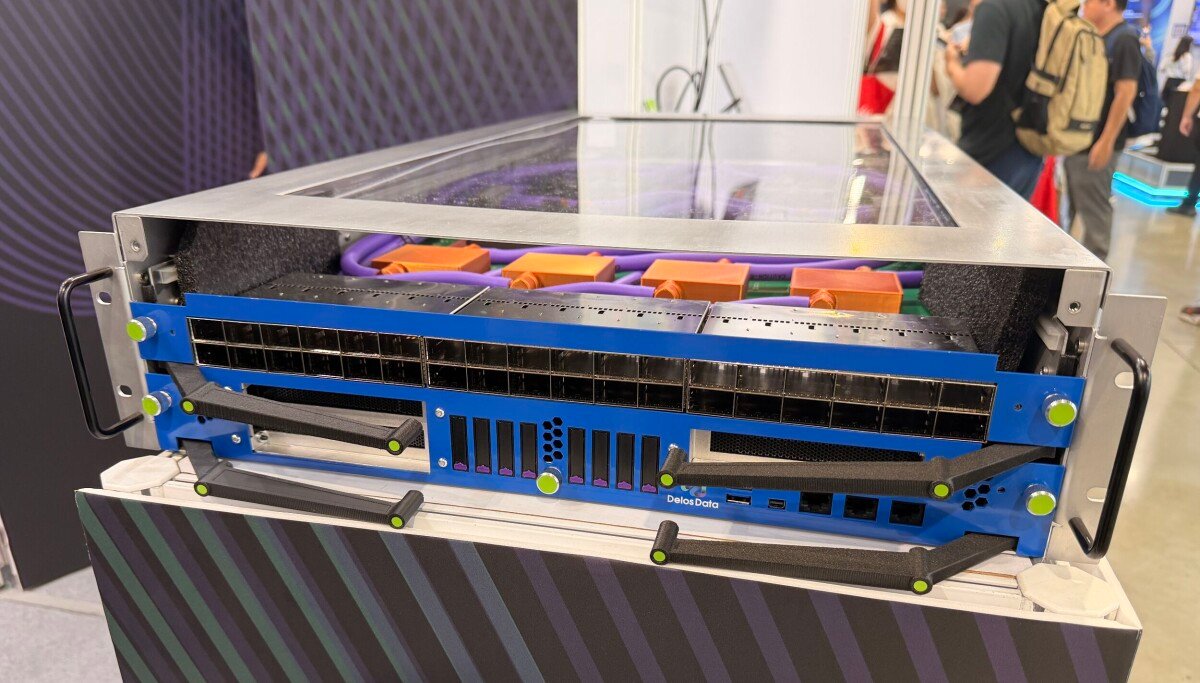
Designing an AI accelerator that can stand up to Nvidia or AMD is already a brutal undertaking. The shift toward rack-scale architectures, where dozens of accelerators are stitched together to act as a single enormous GPU, has raised the bar even further. A startup now needs to solve not just chip design but the mechanical, thermal, and power engineering required to pack six dozen or more accelerators into one rack and keep them fed with data.
At Computex 2026, Delos Data, a company funded by former Intel and Barefoot Networks executives, showed a modular server platform built to hand chip startups a shortcut to that rack-scale problem. The pitch is straightforward: let Delos handle the box, the cabling, and the fabric, and let the customer concentrate on the accelerator itself.
The networking problem nobody warns you about
The headline challenge in moving to rack scale is the sheer volume of networking that has to terminate at the box. A conventional eight-GPU HGX node gets by with one or two ports per GPU. A GB300 NVL72, by contrast, demands 18 ports of 400 Gbps connectivity per GPU. That is an order-of-magnitude jump in the amount of wiring, transceivers, and fabric a system has to support.
Nvidia and AMD have answered this with custom racks that integrate backplanes, power delivery, and cooling into a single tightly engineered unit. Those designs work, but they are difficult for an outside chip vendor to replicate. Delos took a different route by designing a chassis that, viewed from the front, looks more like a network switch than a GPU server.
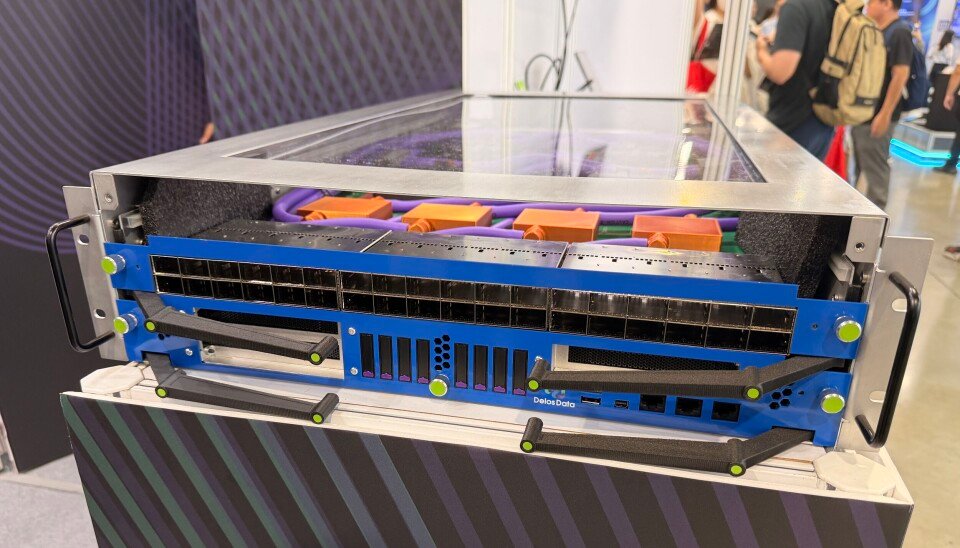
The reference design carries 36 OSFP cages, each rated for 1.6 Tbps of bandwidth. Those 36 ports are split nine per OAM socket across the four sockets at the center of the system. OAM, the Open Accelerator Module socket, is an open standard used by high-performance accelerators that need more interconnect bandwidth and power than a standard PCIe card can deliver. Assuming 200 Gbps SerDes, the layout works out to 3.6 TB/s of interconnect per chip, matching the figure Nvidia quotes for its new Rubin GPUs.
Why OSFP matters here
The choice of OSFP is the clever part. Because the ports accept standard direct-attach copper cables or pluggable transceivers, customers can decide for themselves how large a scale-up domain they want and what switches to feed it into. OSFP is usually associated with Ethernet, but the physical interface is protocol agnostic. You can run UALink, Ultra Ethernet, PCIe, or something else entirely across the same cages.
That flexibility is the core of the sales argument. Delos isn't the only reference design available to chip startups. AWS appears to be repurposing Nvidia's MGX form factor for its Trainium 3 rack systems, and AMD's Helios rack has become an OCP standard. Both of those are arguably easier to service. Delos counters that its modular approach buys configurability that integrated racks can't match.
"It makes it a little bit more flexible in terms of, maybe you want a scale up domain of 100 or maybe you want it a scale up domain of one," CTO Dan Daly told The Register. "It just depends on how many cables you want to plug in. This also allows you to go plug into different types of switches. It could be simpler switches, maybe even optical circuit switches."
Using existing packet switches from Broadcom or Marvell, the design can reach 512 to 1,024 accelerators in a single-layer fabric, depending on whether the customer runs 200 Gbps or 100 Gbps SerDes. Pull in multi-layer fabrics, optical circuit switches, or 2D and 3D torus topologies, and the compute domain can scale further still, all using off-the-shelf parts rather than bespoke silicon.

The power tradeoff
Keeping everything on OSFP and pluggable optics is simple, but it carries a cost. For larger compute domains that depend on pluggable optics, power consumption becomes a real constraint. This is precisely why Nvidia has been slow to adopt optical scale-up interconnects. Copper lacks the reach of optics, but it draws a fraction of the power, and at rack scale every watt spent on the network is a watt not spent on compute.
Delos is aware of the ceiling. CEO Ed Doe said the company is already exploring versions of the system that swap OSFP for near-package or co-packaged optics terminating in MPO-style connectors. That would push more of the optical conversion closer to the silicon and cut the power overhead of driving long copper or pluggable links.
Not just hardware
The company's ambitions extend past the chassis. Anyone who has run large-scale networking knows that the physical topology and the logical topology, the way devices actually communicate across the fabric, can diverge sharply depending on the workload. Delos has built a software orchestration platform to configure and monitor these switched fabrics and meshes, and to dynamically reroute traffic when a link fails.
That platform, branded Nonstop AI, was running on the show floor at Computex. Attendees could pull links at random and watch the network detect the failure and reconverge around it on its own. For operators of dense accelerator fabrics, where a single dropped link can stall an entire training run, automatic rerouting is more than a demo trick.
Delos hints that more products are coming. Nothing is confirmed, but a high-radix switch built on merchant silicon would slot neatly alongside the Nonstop AI systems and give the company a fuller stack to sell. For a startup whose entire pitch is removing infrastructure friction for other startups, owning the switch as well as the chassis and the orchestration layer would close an obvious gap.
Comments
Please log in or register to join the discussion