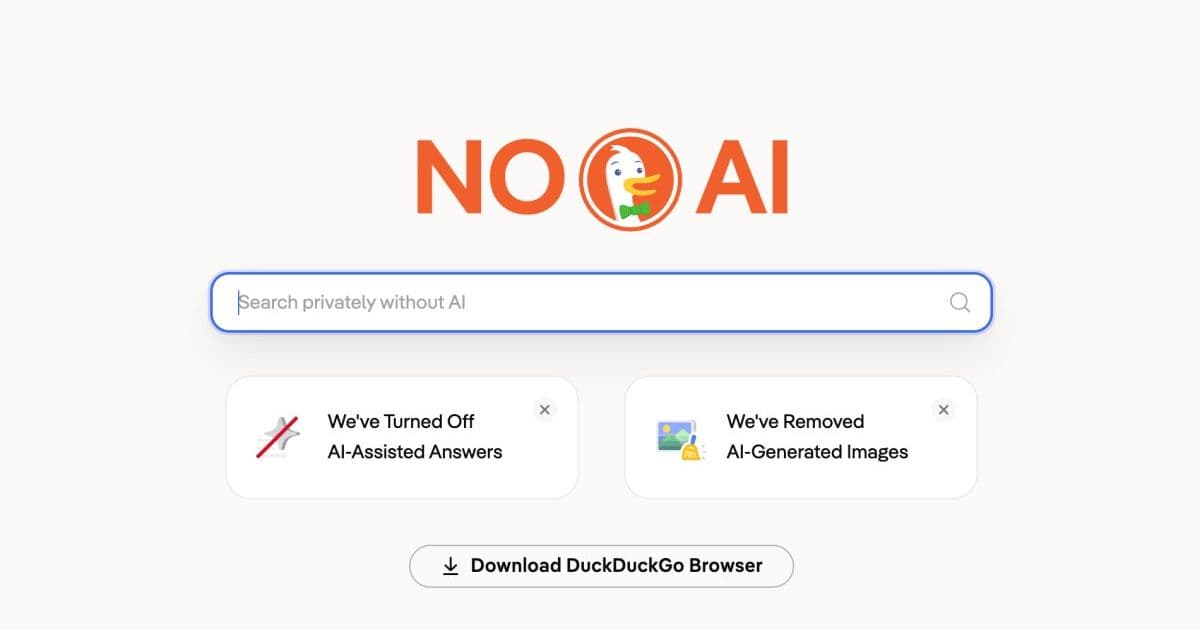
DuckDuckGo released Chrome and Firefox extensions that force searches to the company’s no‑AI endpoint (noai.duckduckgo.com). The move follows a 30% week‑over‑week rise in visits to that page after Google’s AI‑first search rollout, but the extensions have practical limits and the broader shift away from AI‑augmented results remains modest.
DuckDuckGo adds browser extensions to lock in its AI‑free search mode as traffic spikes
What DuckDuckGo is claiming
DuckDuckGo announced two new browser extensions – one for Chrome, one for Firefox – that let users set the no‑AI search endpoint (https://noai.duckduckgo.com) as their default. According to the company, the extensions guarantee that every query lands on a results page without ChatGPT‑style answers, AI‑generated snippets, or AI‑curated image results. The same behavior is already baked into the DuckDuckGo desktop browser, and the extensions are meant to extend that experience to users who prefer the classic “ten blue links” style.
The press release highlights three data points:
- Visits to the no‑AI page were up ≈30 % week‑over‑week after Google’s May 2026 AI‑first search announcement.
- U.S. app installs for DuckDuckGo’s mobile client rose 18 % week‑over‑week, with iOS growth peaking at ≈70 %.
- Traffic to the no‑AI page has been consistently ~84 % above baseline for several weeks.
What’s actually new
A thin wrapper around an existing URL
The extensions do not introduce a new search algorithm or a separate index. They simply rewrite the browser’s search‑engine URL to point at noai.duckduckgo.com. The underlying DuckDuckGo crawler, ranking signals, and ad model remain unchanged. In practice, the only difference is the presentation layer – the UI that normally displays “Instant Answers” and a handful of AI‑generated result cards is suppressed.
Compatibility with existing DuckDuckGo tools
- The DuckDuckGo Privacy Essentials extensions (Chrome, Firefox, Edge, Opera) are being updated to expose a toggle for “AI‑enhanced results”. This means users who already have the privacy suite installed can switch between the standard and no‑AI endpoints without installing a second extension.
- The DuckDuckGo desktop browser already preserves the AI‑free setting across profile wipes, which the company cites as a convenience feature.
A response to Google’s UI shift, not a technical breakthrough
Google’s May 2026 overhaul replaces the traditional link list with an AI‑generated overview that can spawn charts, code snippets, or mini‑apps. DuckDuckGo’s response is to give users a way to opt out of that experience. The extensions are essentially a defensive product decision rather than a novel search technology.
Limitations and practical concerns
| Issue | Why it matters |
|---|---|
| No new ranking signals | The no‑AI endpoint still relies on DuckDuckGo’s existing ranking pipeline. Users who dislike AI‑generated answers do not gain any improvement in relevance; they only lose the supplemental context that some AI answers provide. |
| Extension adoption friction | Users must manually install the extension and set it as the default search engine. For non‑technical users, this extra step can be a barrier, especially when browsers already ship with Google as the default. |
| Limited cross‑browser coverage | Only Chrome and Firefox are supported at launch. Edge, Safari, and mobile browsers (iOS/Android) still require manual URL entry or the DuckDuckGo app to achieve the same effect. |
| Potential for broken queries | Some query types (e.g., “weather in Paris tomorrow”) trigger DuckDuckGo’s Instant Answers, which are disabled on the no‑AI page. Users may see a plain list of links and miss concise, high‑quality answers they previously relied on. |
| No guarantee of “AI‑free” downstream | While the front‑end UI strips AI snippets, DuckDuckGo still indexes pages that contain AI‑generated content. The search results themselves may still point to AI‑written articles or tools, which the extension does not filter. |
Context: Is the shift larger than the headline suggests?
The traffic numbers are impressive in isolation, but they need to be calibrated against DuckDuckGo’s overall market share. As of Q2 2026, DuckDuckGo holds roughly 2–3 % of global search traffic. A 30 % week‑over‑week increase on a small base translates to a modest absolute gain – on the order of a few hundred thousand additional queries per day.
Moreover, the surge coincides with a media‑driven reaction to Google’s AI‑first UI. Historically, DuckDuckGo’s traffic spikes after high‑profile privacy or antitrust news, then settle back to a slower growth curve. The reported 84 % sustained lift is measured against a baseline that already includes a recent upward trend, so the net effect may be less dramatic than the raw percentage implies.
What this means for users and the market
- For privacy‑oriented users – the extensions provide a low‑effort way to keep search results free of DuckDuckGo’s own AI overlays. If you already trust DuckDuckGo’s ranking and want to avoid the extra visual noise of AI cards, the extensions are a practical tool.
- For developers and researchers – the move underscores a niche demand for “classic” SERP output. It may encourage other privacy‑focused browsers (e.g., Brave) to expose similar toggles, but it is unlikely to spur a broader industry shift away from AI‑augmented search.
- For the competitive landscape – Google’s AI overhaul remains the dominant narrative. DuckDuckGo’s response is a defensive posture that protects its existing user base rather than a strategic attempt to capture market share from Google.
Bottom line
DuckDuckGo’s new Chrome and Firefox extensions are a user‑experience tweak that makes its existing AI‑free endpoint easier to reach. The underlying search technology has not changed, and the extensions add only modest friction for adoption. Traffic growth suggests genuine interest, but the absolute numbers remain small relative to the overall search market. For users who are uncomfortable with AI‑generated answer boxes, the extensions are a handy shortcut; for everyone else, they are unlikely to alter the broader trajectory toward AI‑first search experiences.
Comments
Please log in or register to join the discussion