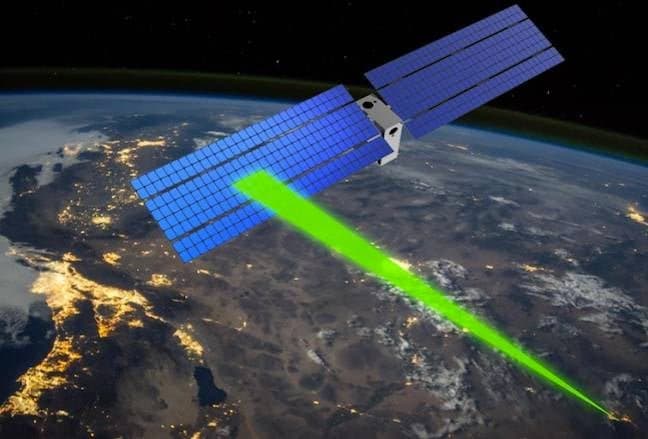
European Space Agency and Chinese researchers independently achieve gigabit-speed laser communications with satellites 36,000-40,000km away, overcoming extreme technical challenges and enabling new possibilities for satellite reprogramming and intelligent processing.
The European Space Agency and China's Institute of Optoelectronics have independently achieved breakthrough gigabit-speed laser communications with satellites in geostationary orbit, marking a significant advance in space networking technology that could transform how we interact with distant spacecraft.
ESA's 2.6 Gbps milestone
The European Space Agency announced on February 26th that an Airbus-built terminal successfully established a 2.6 gigabit per second error-free connection with the Alphasat TDP 1 satellite, located 36,000 kilometers above Earth. The test maintained this high-speed link for several minutes, demonstrating the viability of laser communications over extreme distances.
"Establishing laser links between moving targets at this distance is technically very challenging," said François Lombard, Head of Connected Intelligence at Airbus Defence and Space. "Continuous movements, platform vibrations and atmospheric disturbances require extreme precision."
This achievement builds on Airbus's long history in laser satellite communications and opens what the company describes as "a new era of laser satellite communications to meet defence and commercial needs in the next decades."
China's 1 Gbps achievement
China's Institute of Optoelectronics claimed its technology achieved a 1 gigabit per second link to a satellite 40,000 kilometers away using a newly developed 1.8-meter laser ground station. The system required just four seconds to establish the connection and maintained it for three hours with symmetrical 1 Gbps data flow.
According to machine-translated announcements, the uplink technology relies on "high-precision pointing closed-loop control, achieved through micro-radius-level dynamic tracking and real-time compensation using beacon light." This ensures the continuous and accurate projection of the 1 Gbps signal light onto the satellite.
The downlink integrates "a high-order adaptive optics system and mode diversity coherent reception technology." The adaptive optics system corrects for signal distortion caused by atmospheric turbulence in real time, while the mode diversity technology "intelligently synthesizes multiple signals to suppress fading, jointly ensuring clear, stable, and high-speed transmission of the downlink data stream."
Technical challenges overcome
Laser communications to geostationary satellites present extraordinary technical challenges. At 36,000-40,000 kilometers away, these satellites are nearly 100 times farther than low-Earth orbit satellites. The extreme distance introduces significant latency and requires unprecedented precision in tracking and signal alignment.
The systems must compensate for platform vibrations, atmospheric disturbances, and the continuous movement of both the ground station and satellite. Achieving error-free connections at gigabit speeds over these distances represents a major engineering accomplishment.
Implications for satellite operations
The Institute of Optoelectronics is particularly enthusiastic about the potential to reprogram satellites in high orbit. Their technology could transform satellites "from 'data relay stations' to 'intelligent processing hubs,'" creating "infinite possibilities for us to reach a smart earth, a three-dimensional network, and even deeper space."
This capability has significant implications for both scientific and military applications. Satellites in geostationary orbit could receive complex software updates, new mission parameters, or artificial intelligence models without requiring physical intervention or lower-orbit intermediary satellites.
Context in space networking evolution
These achievements come amid rapid advancement in space communications. China claimed in January to have achieved 120 Gbps laser networks to low-Earth orbit satellites, surpassing the 60 Gbps achieved last year. SpaceX's Starlink service claims its third-generation satellites will offer terabit-per-second downlink capacity and more than 200 Gbps of uplink capacity.
While low-Earth orbit satellites orbit less than 1,000 kilometers from Earth and don't face the same latency challenges, geostationary satellites present more complex problems that require innovative solutions like these laser communication systems.
Future of interplanetary networking
The space networking community is already adapting existing protocols for the unique challenges of space communications, where network nodes can disappear behind planets for extended periods or travel so far from Earth that latency stretches into many minutes. The ability to maintain high-speed, reliable connections over such vast distances is crucial for future interplanetary internet development.
These laser communication breakthroughs represent a significant step toward more capable, flexible satellite networks that can support increasingly sophisticated space operations, from Earth observation to deep space exploration.
Comments
Please log in or register to join the discussion