Healthily CTO Andre Ribeiro explains how Bayesian inference and RAG models bridge the gap between medical insights and confident patient action.
At 2 a.m., a 7-year-old boy wakes with a headache and fever. His parents search online, spiral into worst-case scenarios, and rush to A&E—only to discover it's a simple sinus infection. Meanwhile, a 68-year-old man experiences slurred speech and confusion, dismisses it as stress, and waits until morning, missing the critical window to treat a transient ischemic attack that could have prevented a full stroke.
These aren't isolated incidents. In the UK alone, there are 50 million health-related searches annually, with numbers rising across all age groups. The core problem isn't finding information—it's knowing what to do with it.
The Challenge: From Insights to Action
When people experience symptoms, they typically follow this path:
- Symptom recognition - Either self-reported or observed in others
- Information gathering - Searching online, finding potential conditions
- Decision paralysis - Knowing what could be wrong but not what to do
What users truly want is the ability to act with confidence. This requires more than just medical knowledge—it demands understanding what healthcare access they have available and what they're eligible for, which varies significantly between countries like the UK and US.
Healthily's Solution: A Smart Symptom Checker
Healthily built a ground-up tool developed by clinicians using an in-house medical database. The system employs Bayesian inference models—mathematically rigorous approaches that calculate probabilities and minimize uncertainty through multiple rounds of questioning.
System Architecture
The architecture routes user input through three main systems:
- Clinical reasoning engine - Handles the core assessment logic using Bayesian inference, safety rules, and red flags
- Semantic retrieval engine - Uses BM25 and dense encoding to understand relationships between user queries and medical data
- Flow-driven clinical logic - Manages edge cases and dangerous scenarios that symptom checkers shouldn't handle normally
The system integrates with healthcare insurers to provide personalized guidance: "Go to your MSK pathway," "See your 24-hour nurse," or "Call 999"—not just generic "see a doctor" advice.
Natural Language Processing Engine
The NLP engine consists of three microservices:
- Intent detection model - Determines whether users want information, assessment, or are unclear
- Workaround classifier - Identifies dangerous topics like suicidal thoughts that require special handling
- Symptom entity extraction - Uses the Mediterm model (based on Stanford CoreNLP) enhanced with proprietary medical concepts and synonyms
Each model undergoes rigorous validation and governance processes, as this is a Class I medical device. The symptom extraction uses hierarchical propagation—if you have pain in the bottom of your foot, the system also recognizes you have pain in your foot, increasing reliability.
Clinical Reasoning Engine
The engine starts with red flags. For chest pain, it immediately asks about recent injury to rule out dangerous conditions. Then it employs Bayesian inference to minimize entropy—asking questions that reduce uncertainty about potential conditions.
The system requires 90% confidence across at least 12 rounds before providing outcomes. It ranks conditions by relevance and provides actionable triage recommendations integrated with insurer pathways.
Demo: From Symptom to Action
A user reporting slurred speech and confusion is guided through targeted questions. The system identifies potential TIA and ischemic disorders, recommending 999 for ambulance services. It explains what was ruled out, what's most likely, and provides educational context about symptoms and conditions.
Evolution: Conversational Chatbots
For users who start with questions rather than symptoms, Healthily developed a RAG (Retrieval-Augmented Generation) model. The system:
- Uses a question-aware transformer to contextualize queries
- Retrieves relevant information from Healthily's extensive UK medical database
- Employs a reader model to extract and re-rank the most relevant snippets
- Generates answers using a commercially available LLM with planned migration to a fine-tuned model
The chatbot includes guardrails for safety: restrictive knowledge bases, factual checking, uncertainty estimation, and contextual awareness (e.g., medication safety during pregnancy).
Future Directions
Healthily is pursuing Class II medical device certification for enhanced reliability and clinical trust. The roadmap includes:
- Improving data quality and symptom checker utilization
- Enhancing model retrieval with conversation awareness
- Integrating symptom checker outcomes into chatbot conversations
- Increasing transparency through detailed documentation
- Improving rationale explanations for symptom questions
- Reducing hallucination and improving source attribution
Key Technical Insights
Bayesian Inference for Medical Triage: The system calculates P(condition|symptoms) and minimizes entropy to determine the most informative next question, achieving 90% confidence thresholds before concluding assessments.
Hierarchical Symptom Propagation: Medical concepts are organized hierarchically, allowing the system to recognize that "pain in bottom of foot" implies "pain in foot," improving coverage and reliability.
Microservice Architecture for Safety: Each component (intent detection, workaround classification, symptom extraction) operates as an independent microservice, enabling granular validation and governance essential for medical devices.
RAG with Healthcare-Specific Fine-Tuning: The chatbot uses proprietary medical data for fine-tuning, ensuring responses are grounded in clinical knowledge rather than general web content.
Safety-First Design Philosophy: The system intentionally over-triages to ensure safety, even at the cost of accuracy—preferring to recommend emergency care when uncertain rather than missing critical cases.
The Human Impact
Healthily's systems aim to give users confidence to act appropriately—whether that means self-care for minor issues or emergency response for critical conditions. By bridging the gap between medical insights and actionable guidance, these AI systems help people make better healthcare decisions, reduce unnecessary A&E visits, and potentially save lives by identifying emergencies that might otherwise be missed.
As Andre Ribeiro notes, the goal is building systems "for people"—helping users act with confidence when they should act, and providing the reassurance that their actions are the right ones.
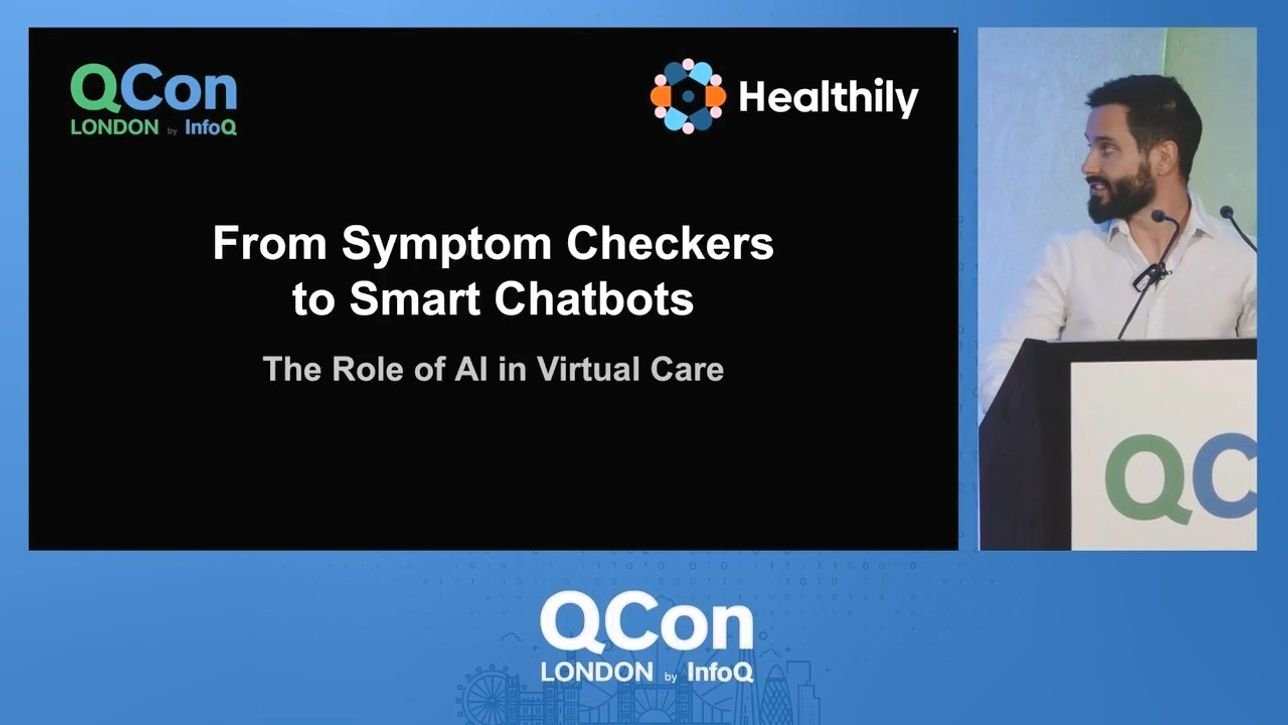
The evolution from clickable symptom checkers to conversational AI represents a fundamental shift in how people interact with healthcare technology. While challenges remain—particularly around multimodal assessment and regulatory compliance—the trajectory is clear: AI will increasingly serve as a trusted guide from symptom to action, helping people navigate the complex landscape of modern healthcare with greater confidence and better outcomes.
Comments
Please log in or register to join the discussion