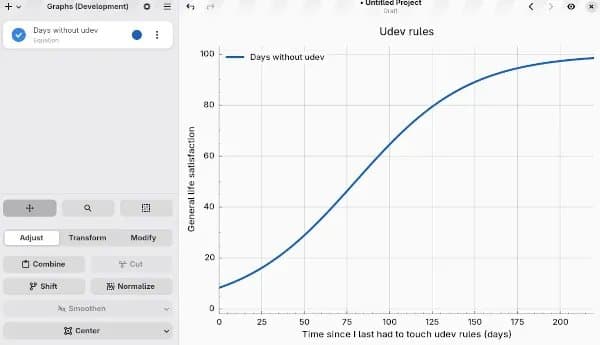
The GNOME ecosystem is seeing significant app improvements alongside the GNOME 50 desktop release, with Maps getting transit station tracking, Graphs 2.0 nearing release with infinite equation ranges, and RustConn polishing its network management interface.
The GNOME desktop environment continues to evolve beyond its core shell, with a wave of improvements hitting associated applications in recent weeks. Following the GNOME 50 desktop release last month, developers have been refining and expanding the capabilities of various GNOME apps, creating a more cohesive and powerful ecosystem for users.
Transit Tracking Comes to GNOME Maps
One of the most practical improvements arriving in GNOME Maps is enhanced public transit support. The application will now display track and stop locations for boarding and disembarking stations, assuming the upstream transit data provides this information. This feature addresses a common pain point for public transit users who often struggle to locate the exact platform or stop for their journey.
The implementation leverages existing transit data feeds to provide real-time location information, making it easier for users to navigate complex transit systems. Whether you're catching a train from a multi-platform station or finding the correct bus stop in a busy terminal, this enhancement should reduce the uncertainty and stress associated with public transportation.
Graphs 2.0 Nears Release with Major Mathematical Capabilities
For users who rely on GNOME for scientific or educational purposes, the Graphs 2.0 application represents a significant leap forward. As a GNOME Circle app, Graphs has been rebuilt from the ground up, and version 2.0 is now approaching its official release.
The most notable mathematical enhancement is the ability to handle equations that span an infinite range. This capability opens up new possibilities for visualizing mathematical concepts that were previously difficult or impossible to represent accurately. Students and researchers working with calculus, physics, or advanced mathematics will find this particularly valuable.
Beyond the core mathematical improvements, the style editor has undergone a complete redesign. The new version includes a live preview feature, allowing users to see changes in real-time as they adjust colors, line styles, and other visual elements. This immediate feedback loop makes the application more intuitive and reduces the trial-and-error typically associated with graph customization.
RustConn Advances Network Management
Network management in Linux environments has traditionally been handled by tools written in C, but the GNOME ecosystem is embracing modern programming languages. RustConn, a Rust-based network connection manager supporting multiple protocols, has been polishing its user interface and making various enhancements. The choice of Rust for network management brings several advantages, including memory safety guarantees and improved performance characteristics. As network security becomes increasingly critical, the memory safety features of Rust provide an additional layer of protection against common vulnerabilities.
While specific details about the UI improvements weren't provided, the focus on polishing suggests that RustConn is moving toward a more polished and user-friendly experience. This could make it an attractive alternative to traditional network management tools for users who prioritize both security and usability.
Goblin Brings Static Analysis to C Codebases
In the realm of development tools, Goblin emerges as a new open-source project providing a GObject linter for C codebases. Static analysis tools have become essential in modern software development, helping catch potential bugs and style violations before code reaches production.
Goblin's focus on GObject, the object system used extensively in GNOME development, makes it particularly relevant for the GNOME community. By providing automated code quality checks, Goblin can help maintain consistency across the growing ecosystem of GNOME applications and libraries.
Pods 3.0 Enhances Container Management
Container technology continues to gain traction in development and deployment workflows, and GNOME is keeping pace with Pods 3.0. This application for managing Podman containers introduces a new container engine abstraction layer that offers greater flexibility.
The abstraction layer is particularly noteworthy as it suggests Pods is preparing to support multiple container runtimes beyond just Podman. This architectural decision future-proofs the application and provides users with more options for their containerization needs.
The Broader GNOME Ecosystem
These improvements reflect GNOME's commitment to creating a comprehensive desktop experience that extends beyond the core shell. By investing in associated applications, the project ensures that users have access to high-quality tools for various tasks, from scientific visualization to network management.
The diversity of improvements—spanning transit navigation, mathematical visualization, network management, code quality, and container orchestration—demonstrates the breadth of GNOME's ambitions. Each enhancement addresses specific user needs while maintaining the project's focus on usability and accessibility.
For users of the GNOME desktop, these improvements should start appearing in their distributions soon, particularly in rolling release distributions or those that quickly adopt new GNOME versions. The transit improvements in Maps and the mathematical capabilities in Graphs 2.0 are likely to be the most immediately noticeable changes for everyday users.
As the GNOME ecosystem continues to mature, the focus on both core desktop improvements and associated applications suggests a holistic approach to desktop computing. Whether you're a student plotting mathematical functions, a developer managing containers, or simply someone trying to navigate public transit, the GNOME project is working to provide tools that make these tasks easier and more intuitive.
Comments
Please log in or register to join the discussion