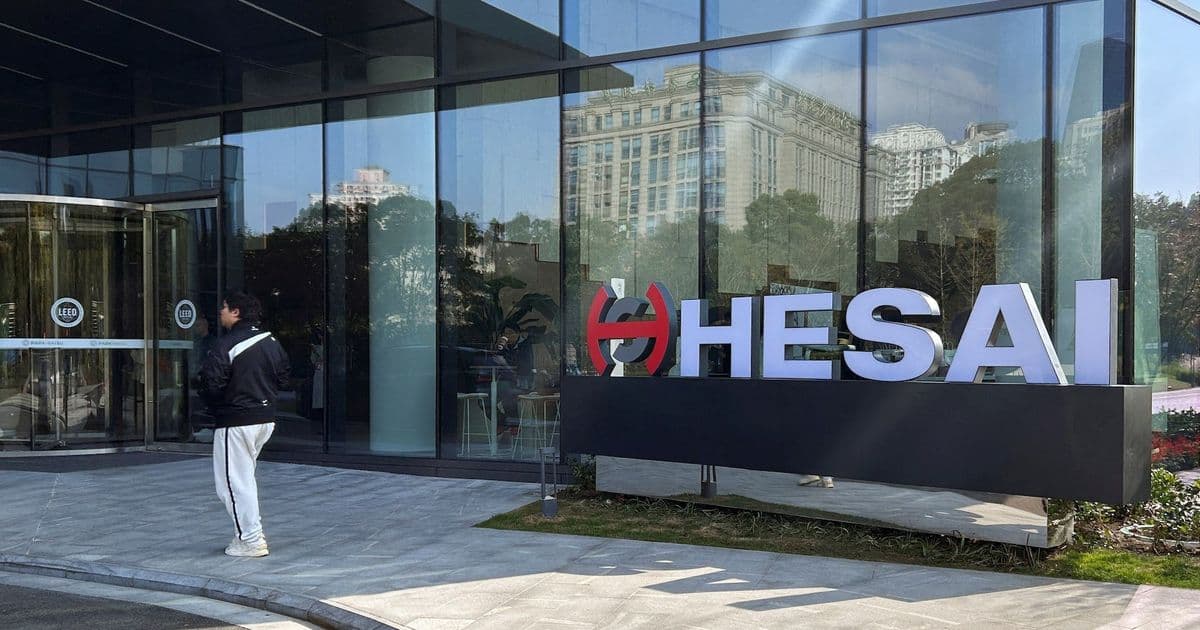
Chinese lidar manufacturer Hesai, a key supplier for Nvidia's ADAS systems, has announced its EXT lidar technology, claiming it as the first in the industry to integrate both spatial and color detection capabilities.
Chinese lidar manufacturer Hesai has announced a significant technological breakthrough with its new EXT lidar system, positioning it as the industry's first to integrate both spatial and color detection capabilities. This development comes from one of Nvidia's primary suppliers for Advanced Driver Assistance Systems (ADAS), marking a notable advancement in autonomous vehicle sensor technology.
The EXT lidar represents a convergence of traditional lidar's precise distance measurement with color detection capabilities typically found in cameras. This hybrid approach could potentially address one of the persistent challenges in autonomous driving: the need for both accurate depth perception and rich visual information about the environment.
Technical Innovation and Industry Impact
Lidar technology has been fundamental to autonomous vehicle development, providing precise 3D mapping of surroundings through laser pulses. However, traditional lidar systems lack color information, which can be crucial for identifying traffic signals, road signs, and other visual cues. By integrating color detection, Hesai's EXT lidar could provide a more comprehensive environmental understanding in a single sensor package.
The timing of this announcement is particularly interesting given the current state of the autonomous vehicle industry. While companies like Tesla have pursued vision-only approaches, most other major players continue to rely on lidar as a core sensor technology. Hesai's innovation could potentially reduce the sensor suite complexity and cost for autonomous vehicles by combining multiple sensing capabilities into one device.
Market Context and Competitive Landscape
Hesai has established itself as a significant player in the lidar market, particularly in China where it has benefited from strong domestic demand and government support for autonomous vehicle development. The company's relationship with Nvidia, a major force in AI and autonomous driving technology, provides additional credibility and market reach.
This announcement comes amid increasing competition in the lidar space, with companies like Velodyne, Luminar, and various startups all vying for market share. The integration of color detection could provide Hesai with a competitive edge, particularly for applications where visual information is as important as spatial data.
Technical Considerations and Challenges
While the integration of spatial and color detection is innovative, it raises several technical questions. Combining these capabilities in a single sensor package likely involves significant engineering challenges, including managing the different data processing requirements and ensuring that the addition of color detection doesn't compromise the lidar's primary distance-measuring function.
The performance specifications, power consumption, and cost implications of this integrated approach will be crucial factors in determining its market adoption. If Hesai can deliver this technology at a competitive price point while maintaining or improving upon existing lidar performance metrics, it could see rapid adoption across the autonomous vehicle industry.
Implications for Autonomous Vehicle Development
This technology could have far-reaching implications for how autonomous vehicles process and understand their environment. By providing both depth and color information from a single sensor, developers could potentially simplify their sensor fusion algorithms and reduce the computational overhead required to integrate data from multiple sensor types.
The EXT lidar could be particularly valuable for applications beyond passenger vehicles, including industrial automation, robotics, and smart city infrastructure. Any scenario where understanding both the spatial layout and visual characteristics of the environment is important could benefit from this integrated approach.
Industry Reception and Future Outlook
The autonomous vehicle industry has been waiting for technological breakthroughs that can address the remaining challenges in achieving full autonomy. While sensor technology has advanced significantly, the integration of spatial and color detection in a single lidar unit represents a meaningful step forward.
However, as with any new technology announcement, the real test will be in practical implementation and performance validation. The industry will be watching closely to see how this technology performs in real-world conditions and whether it can deliver on its promised benefits.
Broader Technology Trends
This development reflects broader trends in sensor technology toward integration and multi-functionality. As autonomous systems become more sophisticated, there's increasing pressure to reduce complexity while improving performance. Hesai's approach aligns with this trend by combining traditionally separate sensing capabilities into a unified solution.
The announcement also highlights China's growing technological capabilities in areas critical to future mobility and automation. As Chinese companies like Hesai continue to innovate in these spaces, they're increasingly competing with established Western technology leaders on the global stage.
Conclusion
Hesai's EXT lidar represents an interesting technological development that could potentially influence the future direction of autonomous vehicle sensor technology. By integrating spatial and color detection capabilities, the company is addressing a real need in the industry for more comprehensive environmental sensing solutions.
The success of this technology will ultimately depend on its performance, reliability, and cost-effectiveness in real-world applications. If it delivers on its promises, the EXT lidar could become a significant tool in advancing autonomous vehicle capabilities and potentially accelerating the timeline for widespread deployment of self-driving technology.
As the autonomous vehicle industry continues to evolve, innovations like this demonstrate the ongoing technological progress and the diverse approaches being pursued to solve the complex challenges of autonomous navigation. The coming months and years will reveal whether Hesai's integrated approach represents a meaningful advancement or simply another incremental step in the ongoing evolution of autonomous vehicle technology.
Comments
Please log in or register to join the discussion