
Before smartphones put the web in every pocket, game consoles were the cheap on-ramp to the internet for households without a computer. The story of console browsers, from the CD-i to the Wii U, is a long experiment in making the web work on a television.
For roughly two decades, the most accessible web browser in a lot of homes wasn't running on a PC. It was running on a game console hooked up to the family television. Long before the iPhone normalized mobile browsing, companies like Philips, Sega, Apple, Sony, Nintendo, and Microsoft treated the console as a potential gateway to the internet for people who didn't own a computer and weren't inclined to buy one. The pitch was simple: you already have a box under the TV, so why not let it get you online?
That history, documented in depth in Web Browsers on Video Game Consoles, reads less like a series of product launches and more like a running experiment in solving the same hard problems over and over. How do you render readable text on a low-resolution television? How do you type a URL without a keyboard? How do you fit a browser into a few megabytes of RAM? Each generation answered differently, and the answers track the maturation of the web itself.

The internet-lite era
The first attempts were modest to the point of being fragile. Philips and Sony's CD-i, a multimedia machine that pivoted toward being marketed as a game console late in its life, shipped a service called CD-Online (sold as Web-i in the United States) in late 1995. It worked, technically. It connected to web portals. But the machine was so memory-constrained that browsing would overwrite other values in memory, including your game saves and preferences. The web was burgeoning and so was the hardware's inability to keep up with it.
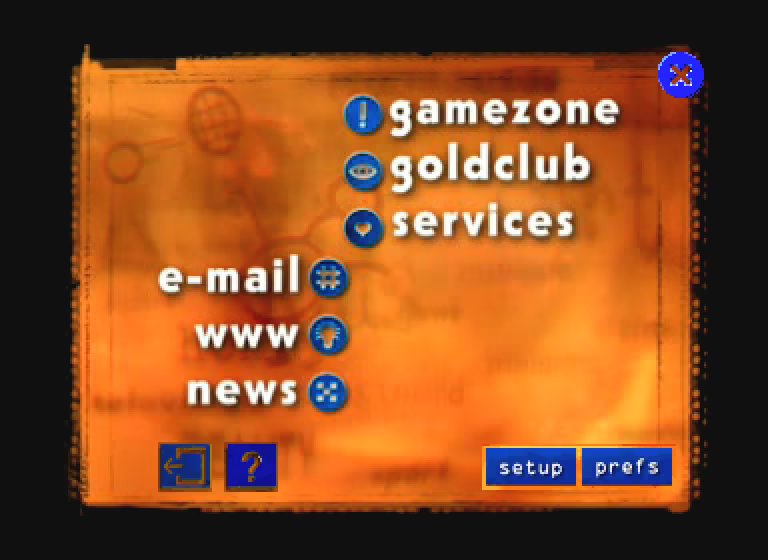
The business idea underneath the CD-i is the one that recurs throughout this entire story. Build a cheaper, TV-based computing device, price it below a home computer, and capture the audience that found PCs intimidating. New discs would arrive periodically with more games, software, and eventually the ability to publish your own homepage. Six discs shipped in total before the service wound down by the late 1990s and faded out entirely by the mid-2000s.
PlanetWeb and the case for a purpose-built engine
The Sega Saturn is where the story gets genuinely interesting from an engineering standpoint. In late 1996, Sega released the Net Link, a small modem that slotted into the cartridge port. The browser came from a United States company called PlanetWeb, and rather than porting a desktop browser, PlanetWeb built a lightweight engine specifically for televisions and consoles.
That decision paid off. Because televisions had low-resolution screens compared to computer monitors, PlanetWeb developed proprietary techniques for rendering clear text, including anti-aliased fonts, a feature that was far from standard at the time. For a browser running on extremely limited console hardware, it was remarkably complete: a zoom magnifier, image support, history, bookmarks, an address book, temporary file downloads, and full parental controls.
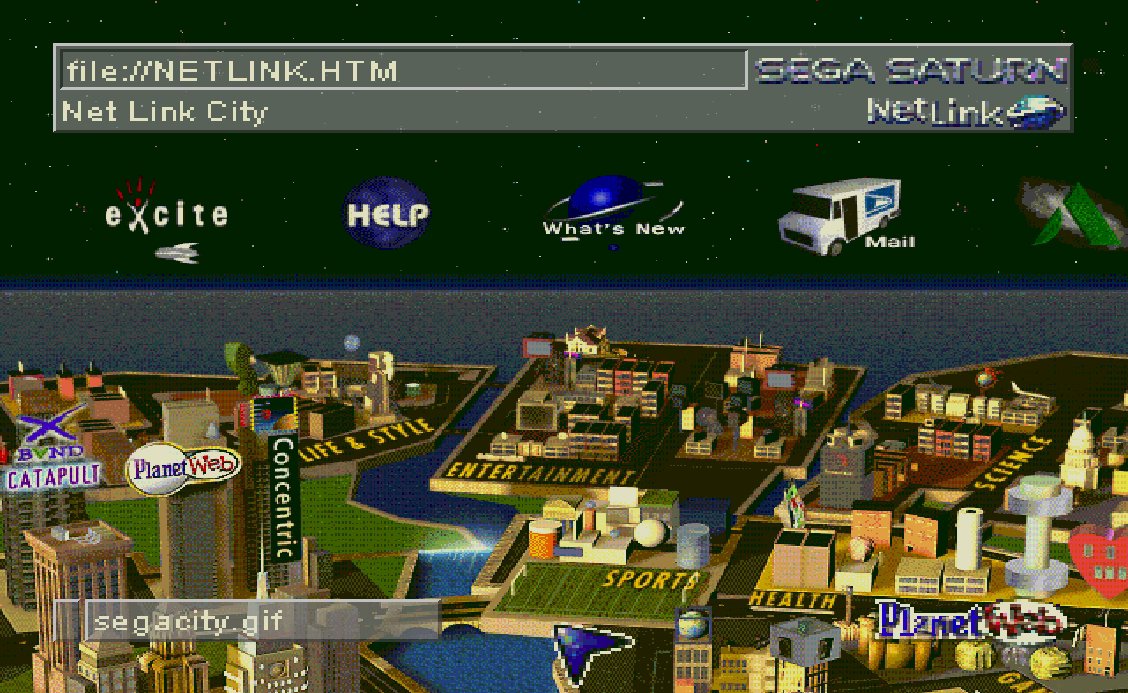
PlanetWeb also did something startups still chase today, which is building a community around the product rather than just the software. The company hosted a game-save exchange forum where Saturn owners could email their saves through the browser to share with others, and it launched Planet WebMaster, a web development and hosting platform. The browser went through versions 2 and 3, with version 3 adding IRC support and more legible fonts. A version 4 beta even introduced SSL for e-commerce and inline frame support, but Sega discontinued the Saturn in 1998 as the Nintendo 64 and PlayStation took the market, so it never saw a full release. Enthusiasts later spliced the beta together with stable builds to make a more complete browser themselves.
Apple's expensive detour
Apple's collaboration with Bandai on the Pippin in 1996 is a useful counterexample. Because the Pippin was essentially a PowerPC computer running Classic Mac OS, it could run ports of mainstream desktop browsers, including the Spyglass Mosaic-based @WORLD Browser in North America and Netscape Navigator-based builds in Japan. There was even a SurfEZ! browser for the Katz Media Player variant sold in Canada and Europe.
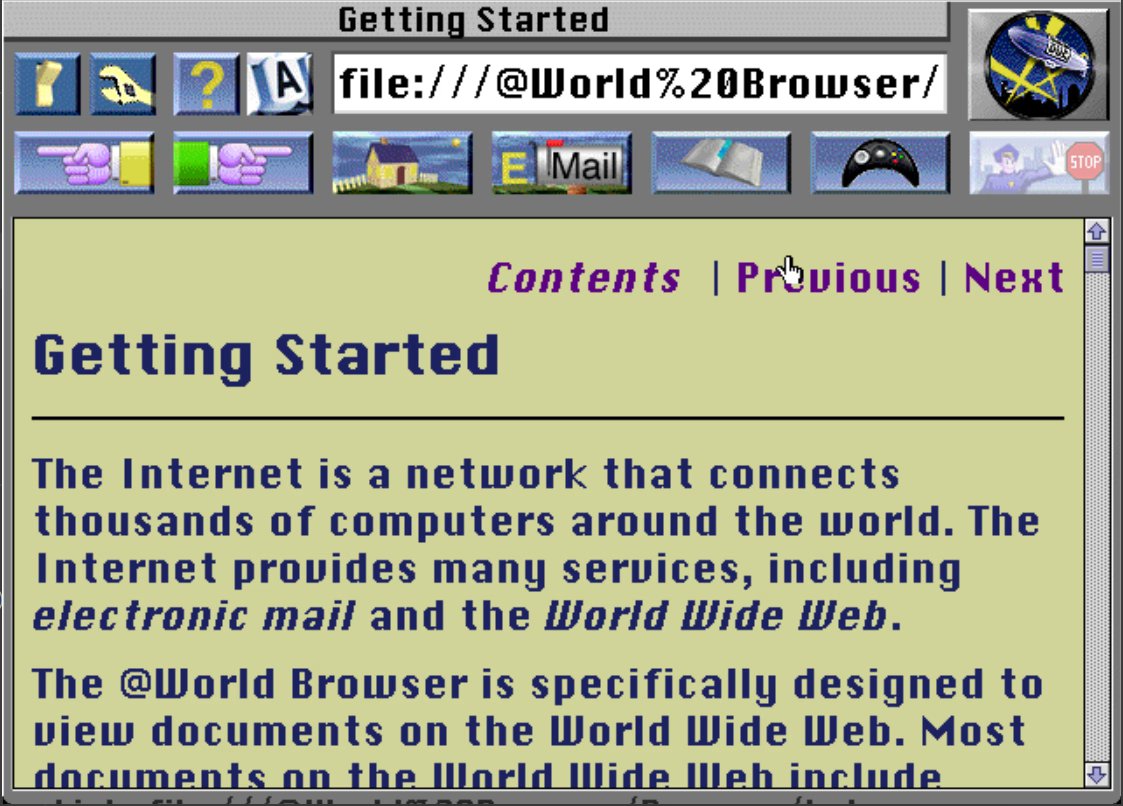
The technology was more capable than the Saturn's, and it still failed. Buyers noticed that the Saturn plus a Net Link attachment was a far cheaper route to the web than a Pippin, and Bandai dropped support by 1998 amid poor sales. The lesson is one that funding-stage founders rehearse constantly: a better-engineered product loses to a cheaper one that clears the same job for the customer. Apple wouldn't ship its own browser, Safari, until 2003, years after the Pippin was gone.
One detail from the Japanese Pippin market deserves a mention because it solved the URL-typing problem with admirable creativity. The publisher J-DATA printed website addresses as barcodes in a monthly magazine, and a scanner peripheral called the Super Cat let users point at a barcode instead of typing the address by hand.
The Dreamcast's three-way bet
Sega's final console, the Dreamcast, hedged where the Saturn had committed. It shipped with three different browser lineages depending on region: Dream Passport in Japan, a returning PlanetWeb-based Web Browser in the United States, and Dreamkey, built on Access Co's NetFront engine, across Europe and Australia.
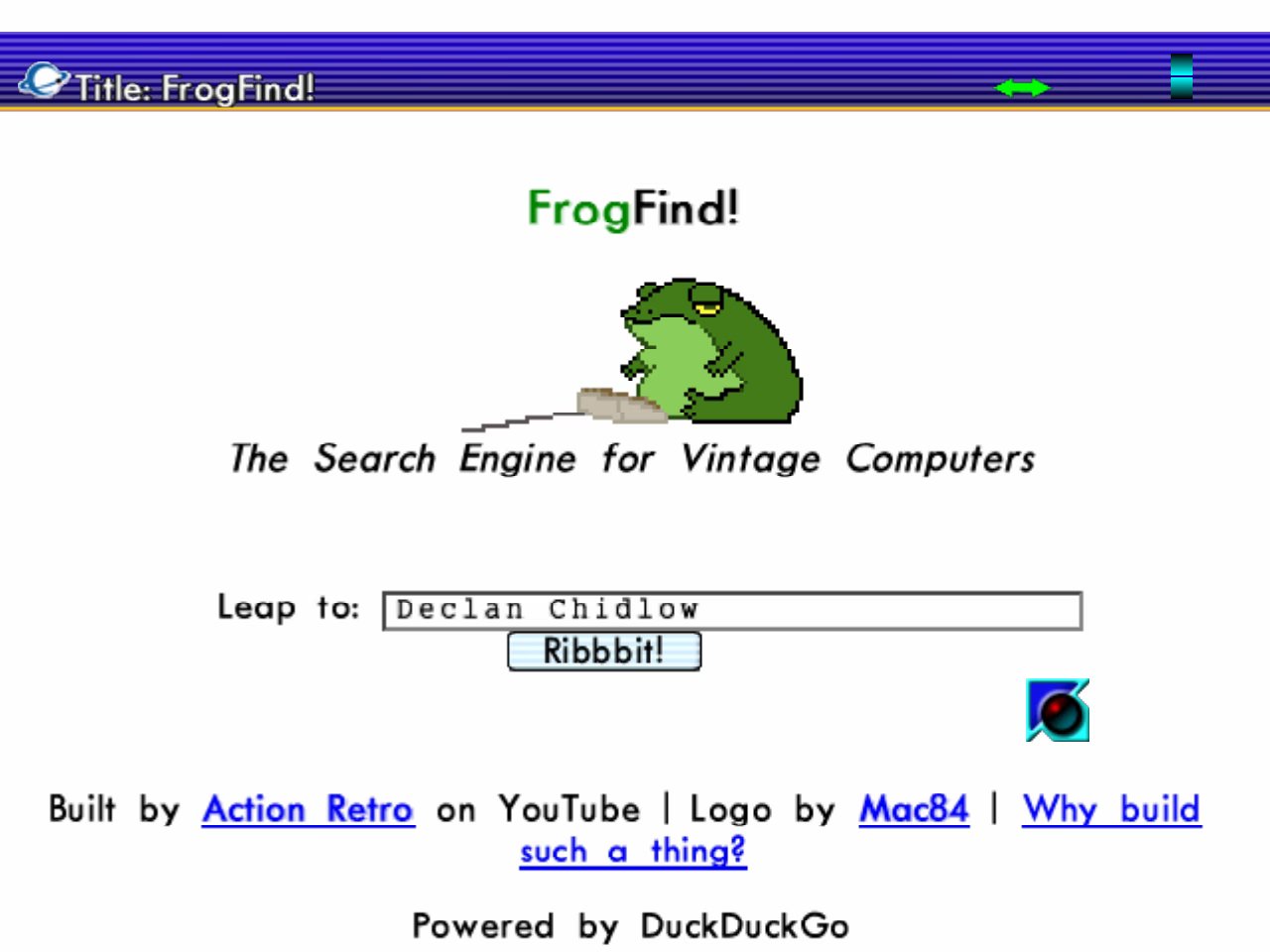
The American Web Browser is the one that kept accumulating features in a way that looks almost like a modern release cadence. Version 2.0 in 2000 added JavaScript improvements, Macromedia Flash, save-game upload and download, MP3 playback, and a full copy of the puzzle game Sega Swirl. Later releases bundled game demos and added Flash 4 and Java applet support. Dreamkey, meanwhile, included a messaging service called Dreamnote that let users on the same website see and message each other, including voice messages recorded through the Dreamcast microphone. That is a surprisingly social idea for 2001 hardware.
Dream Passport's positioning is worth flagging for anyone interested in how products find underserved markets. One variant, Dream Passport 3: Urban Style, was packaged in an Internet Starter Kit aimed explicitly at non-technical users, women in particular, bundled with a keyboard, mouse, and a guide titled The Internet for Housewives. Whatever you make of the framing, it shows companies trying to reach the exact audience the CD-i had targeted years earlier.
Sony goes deep
The PlayStation 2's PlayStation Broadband Navigator was the most ambitious online system of its generation, requiring a hard drive, memory card, and network adapter, and bundling NetFront Browser 3.0 with HTML 4.1 and JavaScript support. By the PlayStation 3, Sony shipped a browser that moved from NetFront's engine to WebKit in 2012, the same engine family behind Safari. The PS3 browser handled tabbed browsing, page screenshots, Flash, and even printing and media server connections. It is arguably the closest any console came to the 1990s dream of the TV-based computer.
The PlayStation Portable's browser, added through a free 2005 system update, was similarly capable, with bookmarks, history, tabs, proxy support, and system-level RSS. Its useful life got cut short for a reason that captures how browsers age: it relied on SSL 3.0, and when a serious vulnerability in that protocol surfaced in late 2014, the web abandoned it and left the PSP browser unable to reach most sites.
Nintendo's charm offensive
Nintendo partnered with Opera across the DS, DSi, Wii, and later built on NetFront for the 3DS and Wii U. The DS browser, released in 2006, required a Memory Expansion Pak that bumped the handheld's RAM from 4MB to 12MB, and it leaned on the touchscreen with handwriting recognition for input. Its manual cheerfully advised that if the browser ran out of memory, you should turn the DS off and on again. In a world before responsive design, a term not coined until 2010, its fit-to-width mode made desktop-only sites tolerable on a tiny screen.
The Wii U browser is the one that best illustrates a hardware feature finding genuine purpose. The interface lived on the GamePad while the television showed a theatrical stage curtain you could open and close, complete with a Mii performing idle animations if you left it shut. The bookmark menu was a literal book you flipped through, with your Mii flipping the pages in the corner. Tilting the controller scrolled the page. It was one of the rare cases where the GamePad was a real input enhancement rather than a gimmick, letting you queue videos without interrupting playback on the TV.
Microsoft and the slow convergence
Microsoft came late, shipping a modified Internet Explorer 9 on the Xbox 360 in 2012, initially locked behind Xbox Live Gold to predictable user frustration. The company published a full developer paper covering input handling, television design considerations, and feature support, and offered a SmartGlass companion app so you could drive the browser from a phone instead of an on-screen keyboard.
The Xbox One's trajectory shows where all of this converged. It launched with Internet Explorer, switched to Edge Legacy on the EdgeHTML engine in 2015, then adopted the Chromium-based New Edge in 2021. At that point the console browser became pixel-for-pixel identical to the desktop version. The decades of bespoke television engines ended in the same place desktop browsing did, on a shared Chromium core.
What the era actually leaves behind
Valve's SteamOS continues the lineage in a different form, since the Steam client itself is built on the Chromium Embedded Framework, though SteamOS 3.0 no longer exposes a general browser interface and instead relies on installing one through Linux package management.
The more telling development is the retreat. Neither the Nintendo Switch and Switch 2 nor the PlayStation 5 ships a general-purpose browser. The web engines are still in there, WebKit-based NetFront NX on the Switch and Sony's own WebKit wrapper on the PS5, but they exist to power storefronts and login flows, not arbitrary browsing. Determined users still escape these sandboxes by configuring proxies or messaging themselves links, often to chase the exploits that enable custom firmware, but performance is poor because the browsers were never meant for it.
The reason for the retreat is straightforward economics. The 1990s problem these browsers solved, getting a non-technical household online cheaply, has been solved many times over by cheap phones, tablets, and television dongles with preinstalled browsers. A console is no longer anyone's only path to the web. The value that justified building a custom anti-aliased rendering engine for a television has evaporated, leaving the exploit community as the main constituency still interested in console browsers.
There is a quieter point underneath the whole history. These machines were trying to make the web a place you would deliberately travel to, switching on a console and opening a browser as a distinct activity. That framing is gone. The web is ambient now, harder to log off from than to log onto, and the console browser is a relic of a moment when getting online was still something you had to choose to do.
Comments
Please log in or register to join the discussion