A comprehensive comparison between Intel's new Core Ultra 5 250K Plus and AMD's Ryzen 5 9600X, analyzing their architectural differences, gaming performance, productivity capabilities, power efficiency, and platform value. Both CPUs compete in the $200 price segment but offer different approaches to performance and efficiency.
Intel Core Ultra 5 250K Plus vs AMD Ryzen 5 9600X: Mid-Range CPU Showdown
The mid-range CPU segment has become increasingly competitive with Intel's release of new desktop CPUs as part of its Arrow Lake refresh lineup. This comparison focuses on two key contenders: the Core Ultra 5 250K Plus and the AMD Ryzen 5 9600X, both targeting the $200 price point but with fundamentally different approaches to performance and efficiency.
Technical Specifications: A Tale of Two Architectures
The Core Ultra 5 250K Plus represents Intel's latest hybrid architecture approach, built on TSMC's advanced 3nm process node. This chip features a total of 18 cores divided into six Lion Cove performance cores and twelve Skymont efficiency cores. Without Hyperthreading, this configuration provides 18 threads total. The P-cores can boost up to 5.3 GHz while E-cores reach 4.6 GHz. Intel has equipped this CPU with 60MB of total cache (30MB L3), matching the cache size of the more expensive Core Ultra 7 265K.
In contrast, the Ryzen 5 9600X follows AMD's more traditional approach with six physical cores and twelve threads using the Zen 5 architecture on TSMC's 4nm node. It achieves a slightly higher maximum boost clock of 5.4 GHz and features 38MB of cache (32MB L3). The AMD chip supports DDR5 memory at 5600 MT/s, while the Intel chip supports faster DDR5-7200 memory.
Power consumption differs significantly between these two CPUs. The 250K Plus has a 125W TDP with a Maximum Turbo Power (MTP) of 159W, while the 9600X has a 65W TDP with an optional 105W setting. Both chips can be overclocked, though with different approaches and limitations.
Gaming Performance: Close Competition with Clear Patterns
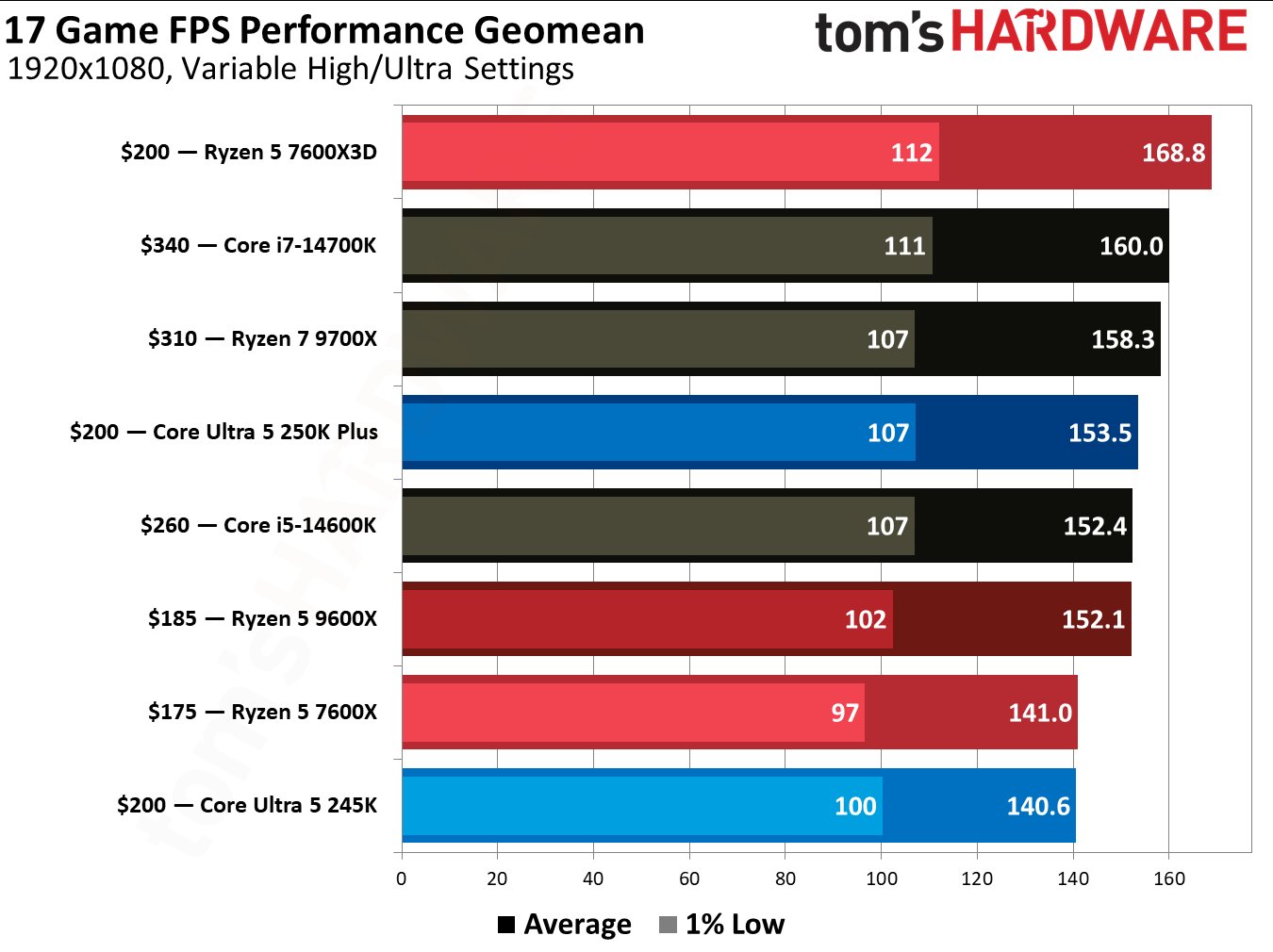
In gaming benchmarks using an RTX 5090 at 1080p resolution, these CPUs show nearly identical overall performance with Intel edging out just a 1% lead in geomean results. However, the individual game results reveal interesting patterns.
The Intel Core Ultra 5 250K Plus wins in 11 out of 17 tested games, showing particular strength in titles like Cyberpunk 2077 (110.7 FPS vs 100.6 FPS), Doom: The Dark Ages (196.8 FPS vs 175 FPS), and Starfield (125.3 FPS vs 107.4 FPS). In these games, Intel's advantage ranges from 9% to 16.7%, with significantly better 1% lows in several cases.
The AMD Ryzen 5 9600X demonstrates strength in specific titles, particularly in F1 2024 (171.3 FPS vs 148.3 FPS), Final Fantasy XIV (136.1 FPS vs 122.9 FPS), and notably Minecraft (127 FPS vs 88.9 FPS), where AMD achieves a massive 30% performance lead. Other games like A Plague Tale: Requiem and Far Cry 6 also favor the AMD chip.
Interestingly, despite its higher TDP, the Intel CPU demonstrates better gaming efficiency with 1.87 FPS/W compared to AMD's 1.76 FPS/W. The 250K Plus also consumes less power during gaming (82.3W vs 86.2W) and runs significantly cooler, with a 17-game CPU temperature geomean of 48°C compared to 59°C on the AMD chip.
Productivity Performance: Where Core Count Matters
The productivity benchmarks reveal a clear advantage for the Intel Core Ultra 5 250K Plus, primarily due to its significantly higher core and thread count. In multithreaded geomean results, Intel scores 465 points while the 9600X manages only 260 points, putting AMD roughly 79% behind Intel.
This gap is evident across various productivity workloads:
- Cinebench 2024: Intel scores 1,860 vs AMD's 971 (91% higher)
- Cinebench 2026: Intel posts 7,523 vs AMD's 4,043 (86% higher)
- HandBrake x265 video encoding: Intel achieves 24.1 FPS vs AMD's 15.6 FPS
- HandBrake x264 video encoding: Intel reaches 53.6 FPS vs AMD's 30.3 FPS (77% higher)
- JPEG-XL multi-threaded encoding: Intel processes 17.01 megapixels/second vs AMD's 8.06 (more than double)
In single-threaded tests, the gap narrows considerably, with Intel maintaining approximately a 5% lead in geomean results. However, AMD does show strength in specific tasks like audio encoding, where it finishes workloads slightly faster than Intel.
Overclocking: Different Approaches to Performance Tuning
Both CPUs support overclocking, but with fundamentally different approaches and limitations.
The Intel Core Ultra 5 250K Plus offers traditional overclocking capabilities with an unlocked multiplier, allowing users to manually adjust core ratios, voltages, and power limits through the BIOS or Intel's Extreme Tuning Utility (XTU). Intel also supports its 200S Boost feature, a one-click BIOS overclocking profile, though many of these improvements are already applied to the 250K Plus out of the box.
The Ryzen 5 9600X, while technically overclockable, behaves differently. AMD's modern Zen 5 chips are already pushed close to their limits out of the box, leaving minimal headroom for traditional manual overclocking. Instead, AMD promotes tools like Precision Boost Overdrive (PBO) and Curve Optimizer, which dynamically adjust boost clocks based on thermal and power conditions. The preferred method for the 9600X is typically undervolting using Curve Optimizer, which reduces voltage per core and allows the CPU to boost higher within its existing limits.
Power Consumption and Efficiency: A Tale of Two Workloads
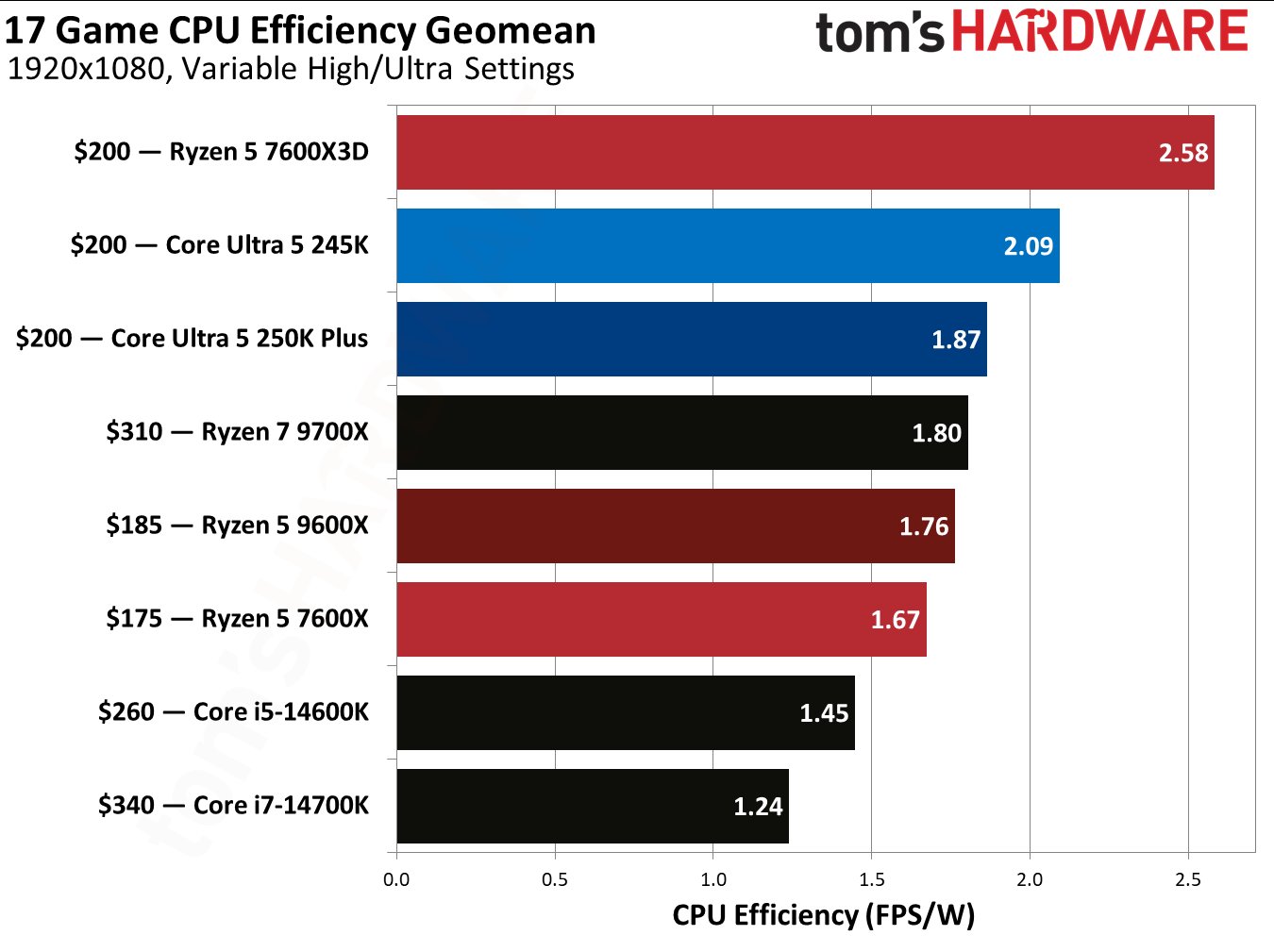
Power consumption patterns differ significantly between these CPUs depending on the workload type.
In idle states, the Ryzen 5 9600X draws approximately 22W compared to 30W for the Core Ultra 5 250K Plus—a 36% difference. Under active idle conditions (YouTube playback), the AMD chip consumes 26W while Intel draws 37W, a 42% increase.
However, the most significant differences emerge in heavy workloads. In sustained AVX workloads, the 9600X consumes 95W compared to 179W for the 250K Plus—88% less power. This advantage stems from AMD's efficient AVX-512 instructions, which aren't available on Intel's chip.
Video encoding workloads further highlight AMD's efficiency:
- x265 encoding: 9600X draws 91W vs 250K Plus's 159W (75% less)
- x264 encoding: 9600X consumes 94W vs 250K Plus's 176W (87% less)
- AV1 encoding: 9600X uses 93W vs 250K Plus's 159W (71% less)
Despite Intel's higher power consumption, it delivers significantly higher performance in these workloads. When plotting performance against total energy consumed, the 9600X consistently operates at much lower energy levels across all tested workloads, while the 250K Plus achieves higher raw performance at a substantial power cost.
Pricing and Platform Value: Total Cost of Ownership
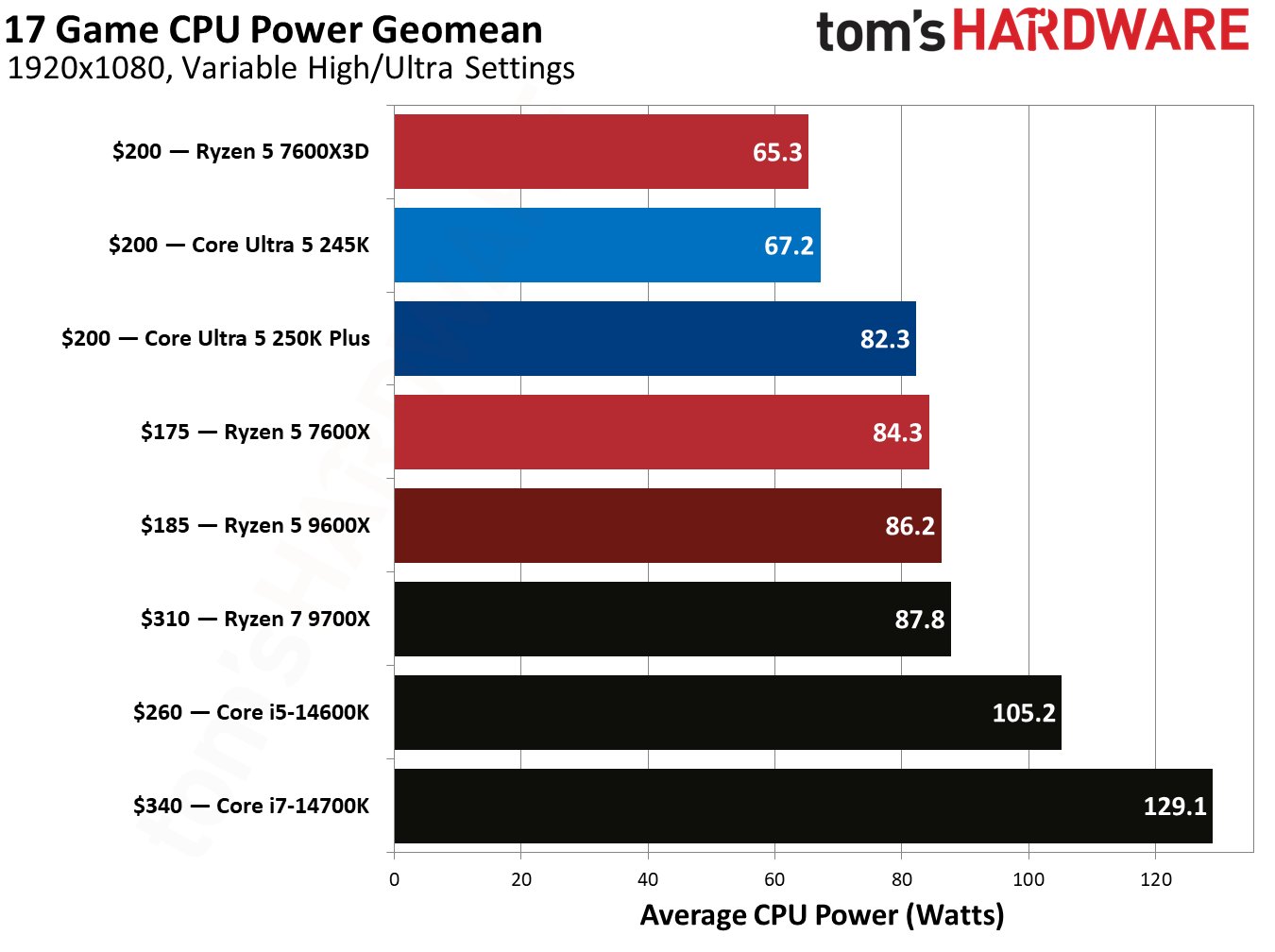
Both CPUs are priced nearly identically in the current market, with the Ryzen 5 9600X retailing around $200 (sometimes as low as $185 during sales) and the Core Ultra 5 250K Plus priced at $199. However, the total platform cost differs significantly.
The AMD AM5 platform offers more budget-friendly motherboard options, with B650 boards starting around $150. Importantly, AMD allows CPU overclocking even on B-series chipsets, providing flexibility without requiring a premium motherboard. The AM5 platform is also expected to receive longer support, with updates planned through at least 2027.
Intel's LGA 1851 socket has entry-level B860 boards starting around $120, but these don't support CPU overclocking—only memory overclocking. Z890 motherboards with full overclocking capabilities begin at approximately $150. A significant drawback is that LGA 1851 is expected to be replaced soon with Intel's next-gen Nova Lake processors, limiting future upgrade potential compared to AMD's AM5 platform.
Both platforms require DDR5 memory, with no DDR4 compatibility, which adds to the overall system cost. Cooling requirements are manageable for both CPUs, with the 9600X being particularly efficient and the 250K Plus running relatively cool during gaming despite its higher power envelope.
Conclusion: Different CPUs for Different Needs
The Intel Core Ultra 5 250K Plus ultimately wins this comparison with a 4-2 lead, primarily due to its superior gaming performance and dominant productivity capabilities. Its 18-core hybrid architecture provides significant advantages in multi-threaded workloads, while maintaining competitive gaming performance with better frame pacing and efficiency during gaming sessions.
However, the AMD Ryzen 5 9600X presents a compelling case for users who prioritize efficiency and platform value. It consumes significantly less power, especially in heavy workloads, and benefits from AMD's AM5 platform, which offers better motherboard value and a longer upgrade path.
For users seeking the best overall performance at this price point, the Core Ultra 5 250K Plus is the clear choice. For those prioritizing lower power draw, better efficiency, and a more future-proof platform with greater upgrade flexibility, the Ryzen 5 9600X stands out as the more balanced option.
The choice ultimately depends on specific use cases: Intel excels in productivity and gaming with its higher core count, while AMD offers superior efficiency and platform longevity for users planning to keep their system for several years.
Comments
Please log in or register to join the discussion