Intel unveils specifications for its Crescent Island AI GPU at Computex 2026, featuring up to 480GB of LPDDR5X memory in a unique approach to address AI inference bottlenecks. The Xe3P-based architecture aims to position Intel as a competitive alternative to established GPU players in the accelerating AI accelerator market.
At Computex 2026, Intel has provided significant new details about its upcoming Data Center GPU product, code-named Crescent Island. The announcement represents Intel's latest attempt to establish a meaningful foothold in the competitive AI accelerator market, which has been dominated by Nvidia and AMD in recent years.
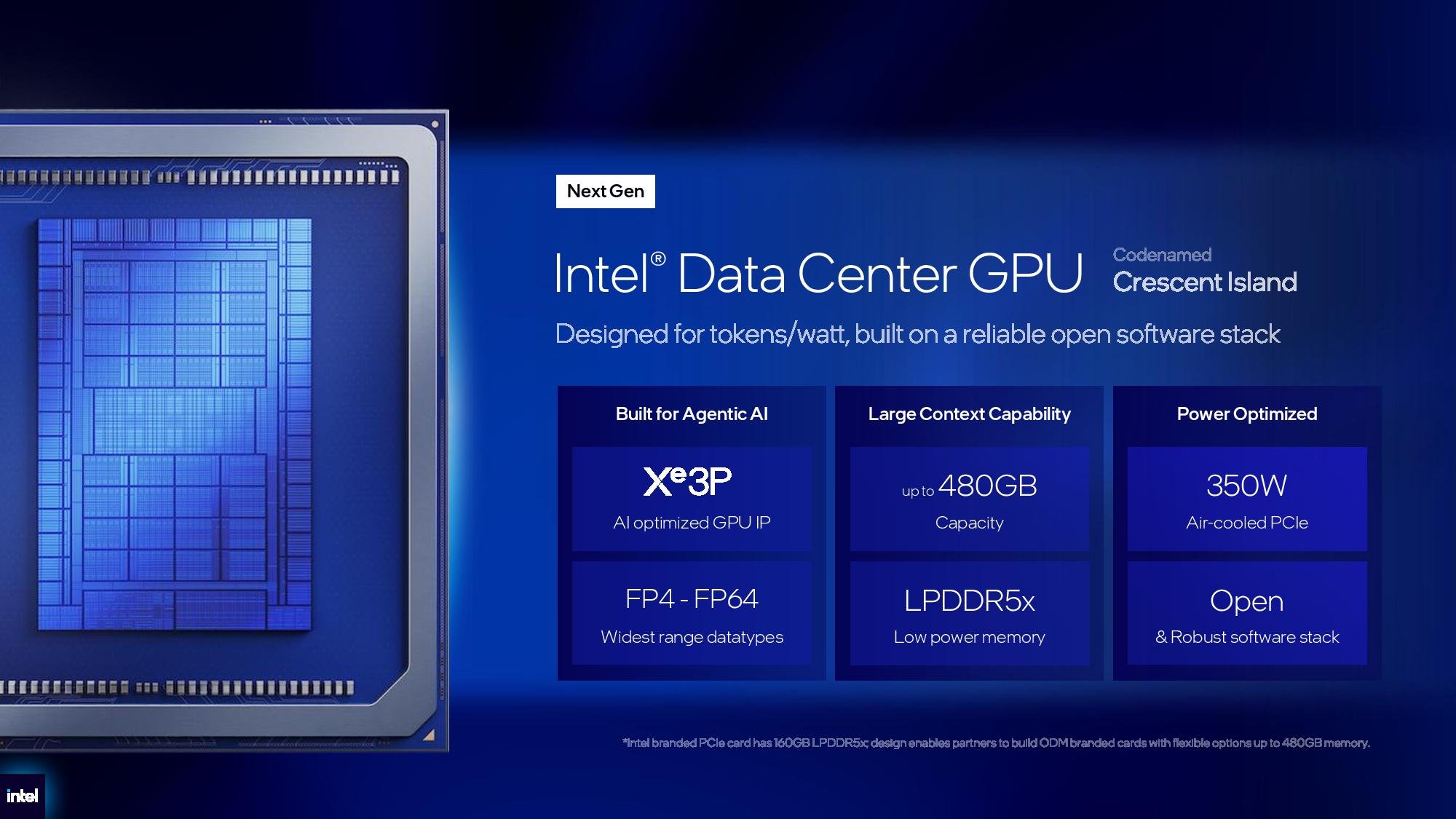
Crescent Island will be built on Intel's Xe3P GPU architecture, which the company explicitly describes as "built for agentic AI." This architectural approach supports an unusually broad range of data types, from FP4 optimized for high-performance AI inference all the way up to FP64, potentially opening doors for scientific computing applications. Notably, Intel has not provided any raw throughput specifications at this developmental stage, leaving performance comparisons with competitors like Nvidia's Blackwell architecture speculative for now.
What sets Crescent Island apart from competing AI accelerators is its unconventional memory subsystem. Instead of the GDDR or HBM memory solutions common in modern GPUs, Intel has opted for LPDDR5X. The company's reference design includes 160GB of LPDDR5X, but the chip is engineered to allow partners flexibility in building accelerators with up to 480GB of memory capacity.
Industry analysis suggests Crescent Island will implement a wide-and-slow approach with its LPDDR5X implementation. Leaks indicate a 640-bit bus connecting 20 LPDDR5X devices, enabling these extraordinary memory capacities. Basic calculations suggest partners would need to employ 24GB LPDDR5X modules to fully realize this capacity—modules already available from manufacturers like Samsung. With 10.7 Gbps LPDDR5X, Crescent Island would deliver approximately 684 GB/s of memory bandwidth.
From a technical standpoint, this memory-focused approach addresses a critical bottleneck in modern AI inference. By maximizing memory capacity while maintaining adequate bandwidth, Crescent Island aims to keep more AI data close to the GPU and reduce data movement requirements. This could potentially make it a more efficient inference engine compared to GPUs built with lower-capacity GDDR devices, particularly for large language models and other memory-intensive AI workloads.
The Crescent Island will be delivered as a PCI Express add-in card with a 350W power target, placing its power and thermal requirements in line with products like Nvidia's RTX Pro 5000 Blackwell card. This relatively modest power envelope, combined with air cooling, means the accelerator can likely drop into traditional 4U or 5U GPU servers without requiring specialized infrastructure.
This design choice has significant implications for on-premise AI deployments. Eight of these accelerators with a full 480GB of RAM each would create an impressively dense server configuration with 3.8 TB of local GPU memory. Such capacity could enable massive AI models to reside within a single server or support swarms of smaller AI agents, potentially reducing the complexity and cost of distributed AI inference systems.
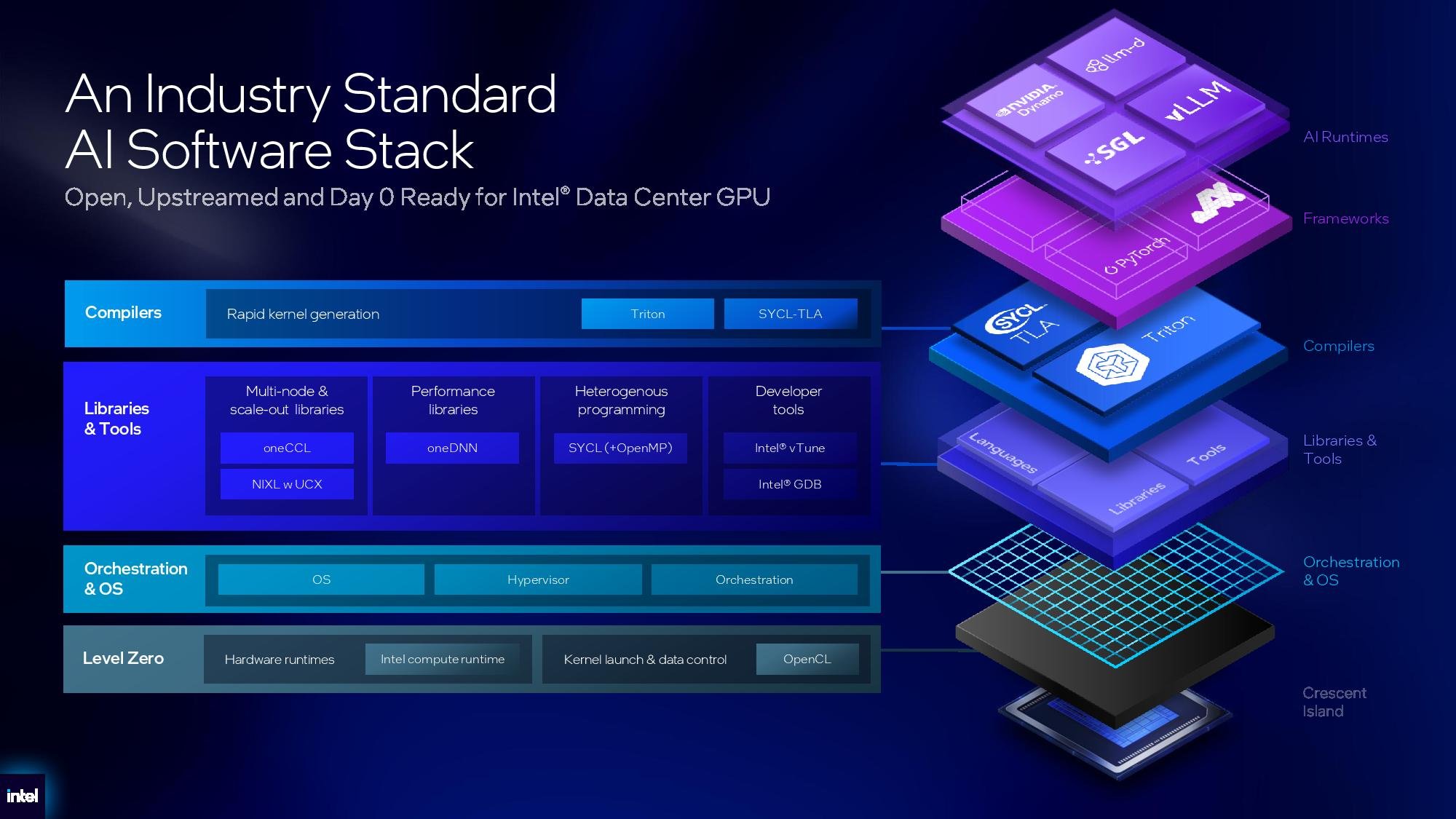
However, hardware capabilities alone don't guarantee market success. Intel touts its oneAPI software stack for use with Crescent Island, describing it as "open, upstreamed, and Day 0 ready" for the product. While oneAPI offers an alternative to CUDA or ROCm, its adoption in the AI community remains limited compared to these established platforms. Intel's ability to build a robust software ecosystem will be crucial to Crescent Island's commercial viability.

The timing of this announcement is noteworthy. Intel describes Crescent Island as "coming soon" with a target launch in the second half of 2026. This positions Intel's response to the current AI accelerator surge approximately one year after Nvidia's Blackwell architecture began shipping. The delay may reflect Intel's more deliberate approach to market entry, focusing on differentiated features rather than raw performance metrics that competitors might counter with subsequent product iterations.
From a supply chain perspective, Intel's choice of LPDDR5X over traditional GPU memory solutions represents both a challenge and an opportunity. While it leverages existing memory manufacturing capacity, it requires GPU server manufacturers to adapt their thermal and power delivery systems to accommodate the different characteristics of LPDDR5X compared to GDDR or HBM solutions.
As the AI accelerator market continues to evolve with specialized architectures emerging for different workloads, Crescent Island represents Intel's bet that memory capacity and efficiency will become increasingly differentiating factors in AI inference, particularly for emerging agentic AI applications that require both high throughput and rapid data access.
For more technical details on Intel's Xe architecture, you can visit Intel's official Xe architecture page. Information about oneAPI is available through Intel's oneAPI documentation.
Comments
Please log in or register to join the discussion