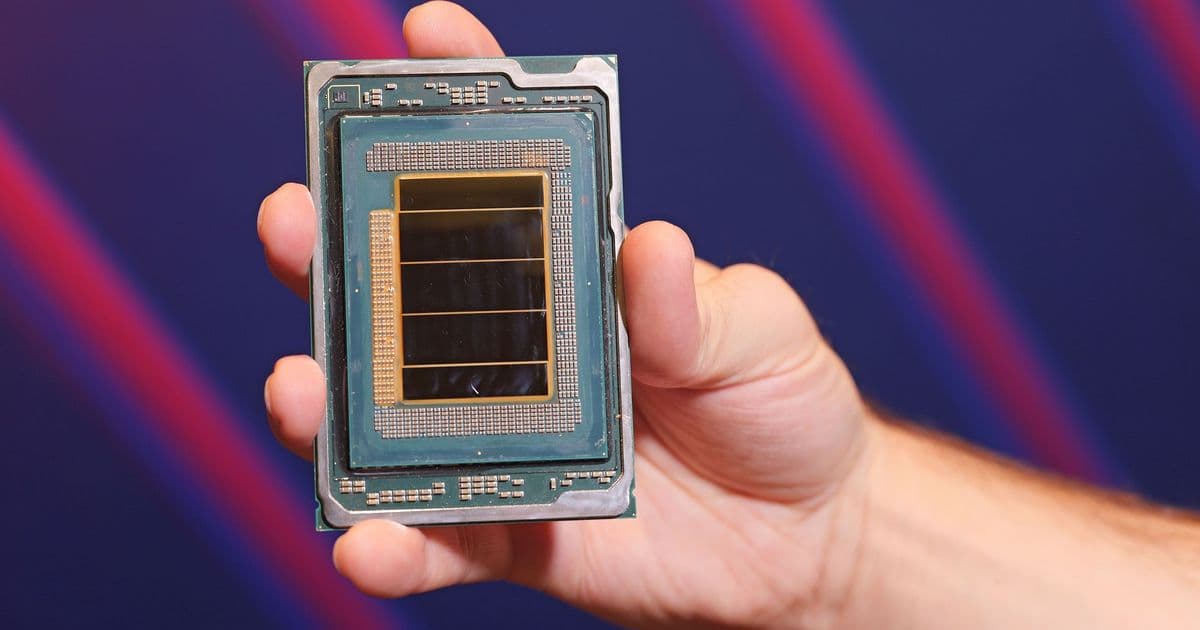
Intel launches its first 18A process node with the Xeon 6+ 'Clearwater Forest' processor, featuring up to 288 energy-efficient Darkmont cores, 1.15GB cache, and Foveros Direct 3D packaging for data center workloads.
Intel this week formally introduced its Xeon 6+ processors codenamed 'Clearwater Forest' that pack up to 288 energy-efficient Darkmont cores and are the first data center CPUs made on the company's 18A fabrication process (1.8nm-class). The launch represents a critical milestone for Intel's foundry ambitions, as 18A is the company's first process node featuring backside power delivery and gate-all-around transistors.
Technical Architecture and Packaging
The Xeon 6+ 'Clearwater Forest' processors combine 12 compute chiplets containing 24 energy-efficient Darkmont cores per tile that are produced using 18A manufacturing technology, two I/O tiles made on Intel 7 production node, as well as three active base tiles made on Intel 3 fabrication process. The compute tiles are stacked on top of the base dies using Intel's Foveros Direct 3D technology, whereas lateral connections are enabled by Intel's EMIB bridges.
This multi-chiplet design enables the processor to approach 288 cores for uniprocessor configurations and 576 cores in dual socket configurations, enabling a single server to host dozens or even hundreds of virtual machines while maintaining power efficiency and low latency.
Darkmont Core Microarchitecture
Intel's 'Darkmont' efficiency cores have received rather meaningful microarchitectural upgrades. Each core integrates a 64 KB L1 instruction cache, a broader fetch and decode pipeline, and a deeper out-of-order engine capable of tracking more in-flight operations. The number of execution ports has also been increased in a bid to improve both scalar and vector throughput under heavily threaded server workloads.
From a cache hierarchy standpoint, the design groups cores into four-core blocks that share approximately 4 MB of L2 cache per block. As a result, the aggregate last-level cache across the full package surpasses 1 GB, roughly 1,152 MB in total. This unusually large pool is intended to keep data close to hundreds of active cores and reduce dependence on external memory bandwidth, which in turn is meant to both increase performance and lower power consumption.
Platform Specifications
Platform-wise, the processor remains drop-in compatible with the current Xeon server socket, so the CPU has 12 memory channels that support DDR5-8000, 96 PCIe 5.0 lanes with 64 lanes supporting CXL 2.0. The high memory bandwidth and CXL support are crucial for the targeted workloads, which include virtualized radio access networks (vRAN), edge AI inference, and cloud computing tasks.
Targeted Workloads and Market Positioning
Intel aims its Xeon 6+ 'Clearwater Forest' processors primarily for telecom, cloud, and edge AI workloads as they feature Advanced Matrix Extensions (AMX), QuickAssist Technology (QAT), and Intel vRAN Boost technologies.
The company says operators deploying 5G Advanced and future 6G networks increasingly rely on server CPUs for virtualized RAN and edge AI inference, as they do not want to re-architect their data centers in a bid to accommodate AI accelerators. By combining matrix/vector acceleration, vRAN offloads (using the vRAN Boost), large caches, and broad I/O in one platform, the CPU can perform jobs that are normally reserved for various accelerators that consume more power and take up space.
Manufacturing Process Significance
The 18A process node represents Intel's most advanced manufacturing technology to date, featuring backside power delivery and gate-all-around transistors. This process node is critical for Intel's foundry business, as it competes with TSMC's N2 process and Samsung's SF2 process for advanced manufacturing contracts.
Intel's ability to deliver 18A products to market demonstrates progress in its manufacturing roadmap after several delays and challenges. The successful tape-out and production of Xeon 6+ processors on 18A validates Intel's manufacturing strategy and provides a foundation for future process nodes.
Availability and Market Impact
Systems based on Intel's Xeon 6+ processors will be available later this year. The launch timing is significant as it positions Intel to compete in the growing market for AI inference and 5G/6G infrastructure, where power efficiency and high core counts are increasingly important.
The 18A process node and Clearwater Forest processors represent Intel's strategy to maintain competitiveness in the data center market while building its foundry business. Success with these products could help Intel regain market share from AMD's EPYC processors and establish credibility for its foundry services.
The combination of extreme core counts, advanced packaging, and cutting-edge manufacturing process positions Intel to address the evolving needs of cloud providers and telecom operators who require both performance and power efficiency in their infrastructure.
Comments
Please log in or register to join the discussion