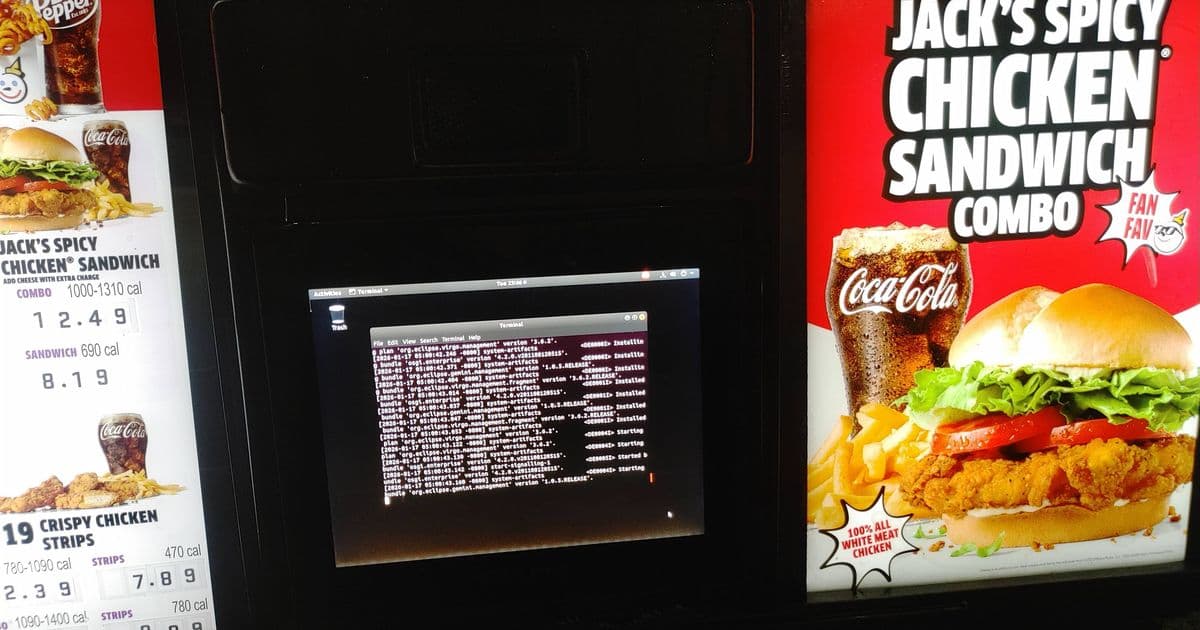
A fast-food customer in California spotted a drive-thru order screen displaying Ubuntu Linux instead of the usual menu interface, revealing the hidden tech behind fast food ordering systems.
A curious incident at a Jack in the Box drive-thru in Santa Rosa, California, has revealed the unexpected operating system powering fast-food ordering technology. Instead of displaying the usual menu interface, the drive-thru screen was showing what appeared to be an Ubuntu Linux desktop with a command line terminal window prominently displayed.
Reader Justin Wilson captured the moment when the fast-food establishment's digital ordering system decided to show its true colors - or rather, its true operating system. The image shows what looks like a standard Ubuntu desktop environment running on what should be a dedicated order confirmation screen.
This isn't the first time we've seen unexpected operating systems appearing in public-facing technology. From Windows 10 desktops appearing on billboards to the infamous Blue Screen of Death interrupting public displays, these moments offer a rare glimpse behind the curtain of everyday technology infrastructure.
The timing of this Linux revelation is particularly interesting given Jack in the Box's recent business challenges. The company has been implementing a "Jack on Track" initiative to refocus on core operations, but perhaps this technical hiccup suggests they've gotten a bit too close to the fundamentals - showing command lines to customers might not be the user experience they were aiming for.
For context, Jack in the Box has faced significant challenges in recent years. According to the company's financial reports, total revenues decreased by 5.8 percent to $349.5 million, down from $371.1 million in the previous year's quarter. The restaurant count also declined from 2,191 to 2,136 locations. While these figures represent business challenges, they're unrelated to the operating system choice - though one might wonder if the technical infrastructure is keeping pace with business needs.
The appearance of Ubuntu on a fast-food ordering system raises interesting questions about the technology choices in the quick-service restaurant industry. While most consumers might expect proprietary, locked-down systems designed specifically for point-of-sale operations, the reality is often quite different. Linux distributions like Ubuntu are popular in commercial settings due to their stability, security features, and lower licensing costs compared to proprietary alternatives.
This incident also highlights the sometimes precarious nature of public-facing technology systems. Whether the Ubuntu desktop appeared due to an ill-timed update, a system crash, or simply a misconfiguration, it demonstrates how the carefully curated user experience can quickly give way to the underlying technical reality. For customers expecting to see their burger selections confirmed, encountering a Linux terminal must have been quite the surprise.
The choice of Ubuntu is particularly noteworthy given the operating system's history. First released in 2004, Ubuntu didn't exist when Jack in the Box was dealing with its earlier controversies in the 1980s and 1990s, including a major E. coli outbreak in the early 1990s and a horsemeat contamination scandal in 1981. The operating system represents a much more recent technological era, suggesting that the company has been updating its infrastructure over time.
For Linux enthusiasts, there's a certain satisfaction in seeing their preferred operating system making its way into unexpected places. However, for the average fast-food customer, the appearance of a command line interface likely caused more confusion than delight. It's a reminder that the technology we interact with daily is often more complex and varied than we realize, and sometimes that complexity peeks through in the most unexpected moments.
The incident serves as a lighthearted reminder of the hidden technology that powers our daily experiences, from fast-food ordering to digital billboards. While Jack in the Box works to get its business "on track," perhaps they'll also want to ensure their technology stays on the right track - preferably displaying menu items rather than Linux terminals to hungry customers.
Comments
Please log in or register to join the discussion