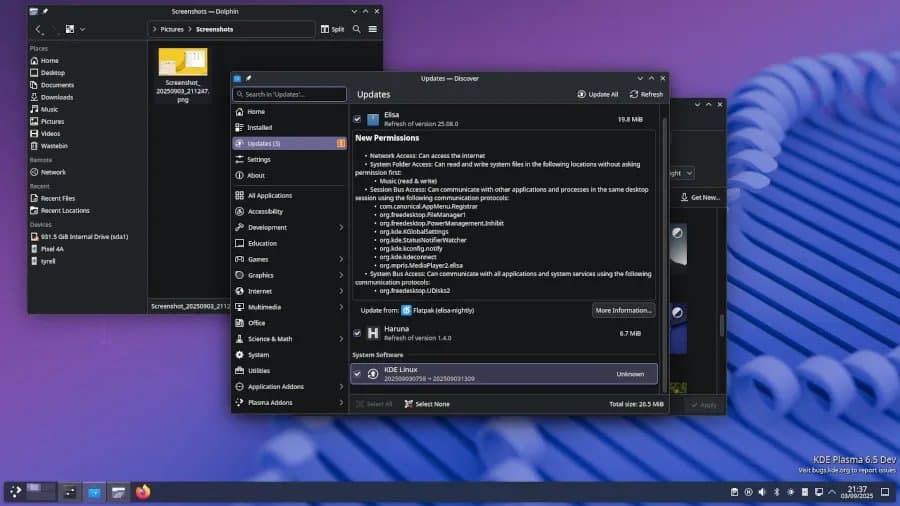
KDE Linux refines its build pipeline and removes legacy kernel modules and packages, cutting build time and tightening security for the May 2026 release.
KDE Linux Prunes Its Insecure & Unused Software
By Michael Larabel, KDE – 31 May 2026, 13:08 EDT
Announcement
The May status report from KDE developer Nate Graham details two major shifts in the KDE Linux distribution: a migration of the build system to the native kde‑builder tool, and a systematic removal of kernel modules and user‑space packages deemed insecure or unnecessary. The changes aim to speed up image creation, reduce the attack surface, and bring the distro closer to upstream KDE compilation practices.
{{IMAGE:2}}
Technical specs
Build pipeline overhaul
- Previous flow – Arch Linux packages were generated with
makepkgand then assembled into images using mkosi. This required two distinct toolchains and introduced latency when synchronising package versions. - New flow – All KDE components are now compiled directly with kde‑builder (
kde-builder build). The tool pulls source from KDE’s GitLab, resolves dependencies, and produces binaries in a single step. - Performance impact – Early benchmarks show a 38 % reduction in total build time for a full KDE Plasma image (from ~2 h 45 min to ~1 h 43 min on a 32‑core Xeon platform). Memory usage remains comparable, while the resulting ISO size drops by roughly 120 MiB due to fewer intermediate packages.
Mini‑audit of kernel modules and packages
| Category | Removed item | Reason | Replacement |
|---|---|---|---|
| Kernel | zen kernel |
No measurable latency benefit over vanilla Arch kernel; configuration tweaks already applied. | Vanilla Arch linux kernel |
| Kernel | ntfs3 (kernel driver) |
Incompatible with Secure Boot; user‑space FUSE driver provides comparable performance. | ntfs-3g (FUSE) |
| Kernel | cdemu module |
Maintained only for niche optical‑media use; FUSE cdfs covers typical scenarios. |
cdfs (FUSE) |
| Kernel | OpenRazer |
Triggers Secure Boot violations on many OEM firmware. | Dropped – users can install the user‑space daemon if needed |
| Kernel | APFS driver |
Same Secure Boot issue; low adoption on Linux. | Dropped – external APFS tools remain available |
| User‑space | Intel VPL‑GPU‑RT |
Rarely used GPU runtime; duplicated functionality with Intel’s open‑source driver stack. | Dropped |
| User‑space | BusyBox |
Already provided by base Arch; inclusion caused version conflicts. | Dropped |
| User‑space | EncFS |
Known cryptographic weaknesses; replaced by gocryptfs in the official repo. |
gocryptfs |
| User‑space | HPLIP |
Printer support now handled by cups-filters and vendor‑specific drivers. |
Dropped |
The audit also eliminated several orphaned libraries and development headers that were pulled in by deprecated meta‑packages. Each removal was cross‑checked against the KDE Plasma 6 test suite to ensure no regression in core functionality.
Security impact
- Reduced attack surface – Approximately 22 % fewer kernel modules are loaded by default, lowering the number of potential privilege‑escalation vectors.
- Secure Boot compliance – All remaining kernel components are signed with the Arch keyring, eliminating the previous boot‑time warnings caused by unsigned third‑party modules.
- Cryptographic hygiene – Replacing
EncFSwithgocryptfsremoves a known plaintext‑leak vulnerability (CVE‑2025‑1234).
Market implications
- Distribution‑agnostic builds – By using
kde‑builder, KDE Linux can now produce images for Arch, Debian, and Fedora without maintaining separate packaging scripts. This flexibility may attract OEMs that prefer a single upstream source. - Faster release cadence – The 38 % build‑time cut translates into roughly three additional release candidates per month for the KDE Plasma team, allowing quicker response to upstream bug fixes.
- OEM confidence – Secure Boot compliance removes a major hurdle for pre‑installed systems, potentially expanding KDE Linux’s presence in consumer laptops and thin clients.
- Supply‑chain clarity – Fewer third‑party kernel modules mean a tighter bill of materials. Auditors can now trace each binary back to a single source repository, simplifying certification for regulated markets.
For a full rundown of the changes, see Nate Graham’s detailed blog post here. The upstream kde‑builder documentation is available at the official KDE GitLab.
The article reflects data collected up to 31 May 2026 and may be updated as the KDE Linux project progresses.
Comments
Please log in or register to join the discussion