Lenovo unveiled two innovative concept devices at MWC 2026: the Legion Go Fold gaming foldable and Yoga Book Pro 3D dual-screen laptop, showcasing the future of portable gaming and creative computing.
Lenovo showcased several innovative concept devices at MWC 2026, including the Legion Go Fold gaming foldable and the Yoga Book Pro 3D dual-screen laptop. These futuristic designs offer a glimpse into potential directions for portable gaming and creative computing.
Lenovo Legion Go Fold Concept
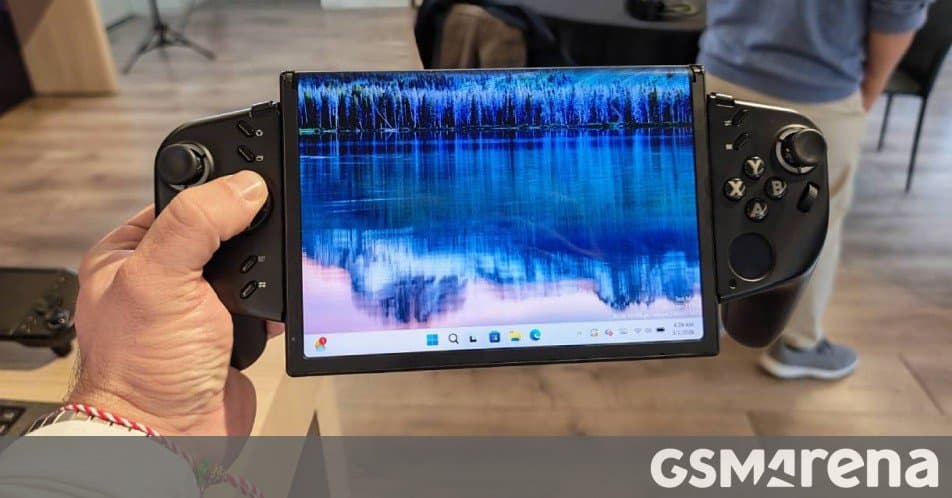
The Lenovo Legion Go Fold Concept explores the potential of foldable screens in gaming devices. Unlike the previous year's Legion Go 2, which was a compact AMD Ryzen Z2/Z2 Extreme tablet with an 8.8" OLED display, the Go Fold takes a different approach with Intel's Core Ultra 7 258V processor.
The standout feature is its folding mechanism. The device can fold in half, showing a 7.7" display when closed and expanding to an 11.6" display when unfolded. While the aspect ratios don't align perfectly, this configuration provides more screen real estate than the Go 2.
What makes this design particularly interesting is that the display remains on the outside when folded, eliminating the need for a separate cover display like on book-style foldables. However, this raises questions about durability when carried in backpacks or pockets. Lenovo claims the device is pocketable, though you'd need fairly large pockets.
The versatility of the Go Fold is impressive. You can game in its compact form with attached controllers, expand it for a larger display when space allows, or even add an optional keyboard to create a laptop-like setup. Some games work better with a hardware keyboard, though pairing a mouse is recommended since touchpad gaming is challenging.
Lenovo also demonstrated a split-screen mode, allowing you to play on one half while watching video on the other. The detachable gaming controllers are another highlight - they can attach directly to the device or function as wireless controllers. The right controller features a smartwatch-like display that replaces the traditional touchpad, offering configurable options like hotkeys or performance metrics display.
While there's no price or launch date for the Legion Go Fold Concept, and the exact hardware may never reach commercial markets, the concept demonstrates the promising potential of folding gaming tablets, especially with Lenovo's ecosystem of accessories.
Lenovo Yoga Book Pro 3D Concept
The Yoga Book Pro 3D Concept takes a different approach to innovation. Rather than a foldable, it's a dual-screen laptop similar to the Yoga Book 9i, with a second screen where the keyboard typically resides. Both screens are separate rather than one large folding display.
The top panel features a glasses-free 3D PureSight Pro Tandem OLED screen, while the lower screen includes a touch panel with a built-in kickstand for comfortable angling. Lenovo positions this device for creators - both professionals and advanced hobbyists working with 3D design and content.
The company cites market analysis predicting that demand for glasses-free displays will triple by 2032. To support this vision, Lenovo developed AI-based software that can upconvert 2D imagery to editable 3D assets, potentially streamlining the creative workflow.
The 50MP camera on the top half detects gestures, enabling users to zoom, rotate, and interact with 3D objects without touching the laptop. This hands-free interaction could be particularly useful for creators who need to maintain clean workspaces or prefer gesture-based controls.
Under the hood, the Yoga Book Pro 3D Concept packs serious hardware: an Intel Core Ultra processor, Nvidia GeForce RTX 5070 GPU, up to 64GB of LPDDR5X RAM, and up to 1TB of M.2 2242 PCIe Gen 5 storage. Despite including a 92.5Wh battery, the entire package measures just 18.9mm thick and weighs 2.28kg.
Connectivity options are comprehensive: two Thunderbolt 4 ports, two USB-A 10Gbps ports, HDMI with FRL transmission mode support for higher resolutions and refresh rates, a headphone/microphone combo jack, and an SD card reader (UHS-II).
While the 3D aspect may seem like a callback to the 3D fad that faded a decade ago, the underlying hardware specifications and dual-screen design are genuinely compelling. A sub-2cm dual-screen laptop with powerful components and extensive connectivity could find a real market, even without the 3D features.
Both concepts showcase Lenovo's willingness to experiment with form factors and push the boundaries of what portable computing devices can be. While neither may reach store shelves in their current form, they provide valuable insights into potential future directions for gaming and creative computing devices.
Comments
Please log in or register to join the discussion