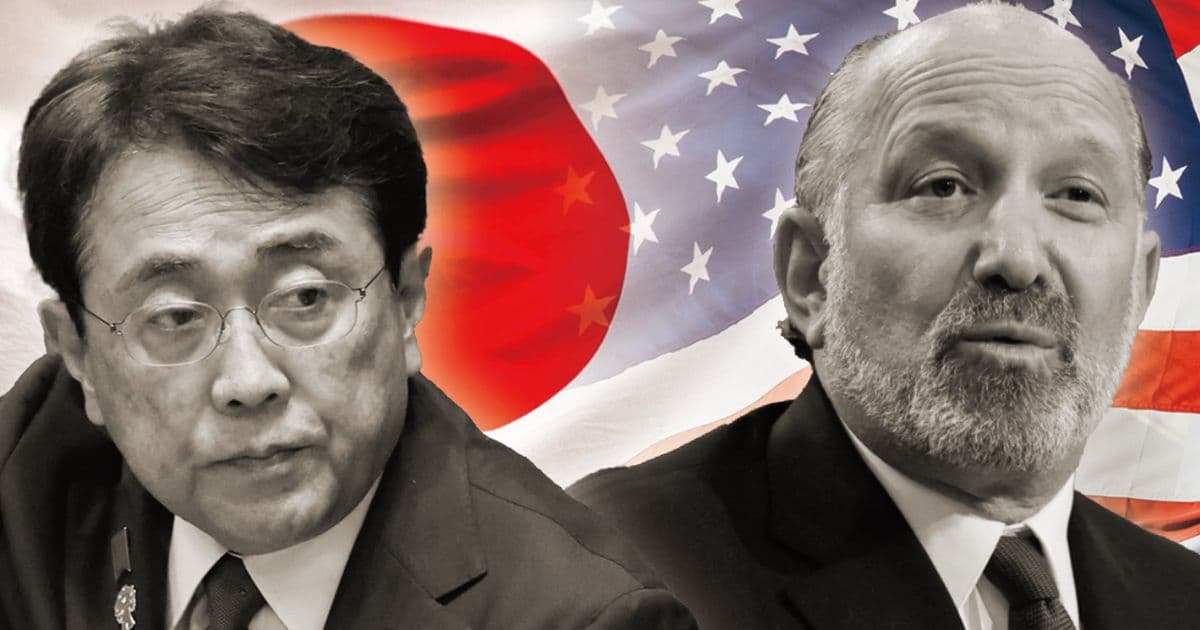
Commerce Secretary Howard Lutnick told Nikkei that Washington wants to draw on Tokyo's $550 billion investment commitment to build and expand American reactors, positioning the US to export nuclear technology globally. The plan ties trade diplomacy to an industrial bet on a power source that capital markets had written off a decade ago.
US Commerce Secretary Howard Lutnick has put a specific number behind Washington's nuclear ambitions: part of Japan's $550 billion investment pledge will be directed toward building and expanding nuclear power plants on American soil, with the stated goal of taking, in his words, "a leading position to export around the world." The comments, made to Nikkei and published June 12, reframe a financing commitment that was negotiated as part of broader trade talks into a down payment on an industrial strategy.
The $550 billion figure originated as Tokyo's contribution to easing tariff tensions with the Trump administration, a pledge that has functioned more as a flexible pool than a line-itemed budget. Lutnick's framing matters because it begins to assign that capital to concrete sectors. Nuclear construction is among the most capital-intensive infrastructure a country can undertake, with a single large reactor running well into the billions of dollars and timelines that stretch across a decade. Pointing Japanese money at that gap addresses the single hardest problem in the US nuclear sector, which is not engineering but financing.
Why the money is the bottleneck
The American nuclear industry spent the 2010s in retreat. The Vogtle expansion in Georgia, the only new reactors completed in the US in a generation, ran years late and tens of billions over budget, a cautionary tale that froze private capital. Utilities and their investors learned that the financial risk of conventional gigawatt-scale plants was difficult to underwrite, and the pipeline of new projects effectively dried up.
What changed the calculation is demand. Hyperscale data centers built for AI training and inference are pushing electricity consumption forecasts upward at a rate utilities have not planned for in decades. Operators including Microsoft, Amazon, and Google have signed power purchase agreements tied to nuclear output, including the restart of the Three Mile Island Unit 1 reactor under a Microsoft deal. That buyer demand changes the risk profile, but it does not solve the upfront construction cost. Foreign capital that is willing to absorb early-stage risk is exactly what an industry restart requires, and that is the role Lutnick is describing for Japanese funds.
Japan's industrial logic
For Tokyo, the appeal runs through its own supply chain. Japanese heavy-industry firms are among the few remaining global suppliers of the large forgings, reactor pressure vessels, and turbine components that nuclear construction depends on. Mitsubishi Heavy Industries and IHI Corporation have both reported expanding order books tied to the nuclear resurgence, and both are racing to train the specialized welders and plant workers that a construction wave would consume. Channeling investment into US projects that buy Japanese-made components turns a financing pledge into industrial demand for Japanese manufacturers, a circularity that makes the commitment easier to justify domestically.
Japan is simultaneously rebuilding its own nuclear fleet, with plans to replace up to five aging reactors by the 2040s. The expertise and supplier base it maintains at home become exportable assets when paired with American projects and American export ambitions. The arrangement Lutnick sketches is less a one-way capital flow than a joint bid to dominate a market that China and Russia have moved aggressively to capture through their own state-backed reactor exports.
The export contest
That competitive framing is the strategic core of Lutnick's pitch. Rosatom of Russia and China's state nuclear firms have spent years signing reactor construction deals across emerging markets, bundling financing, fuel supply, and decades of operational dependency into single packages. Each export locks a host country into a multi-decade relationship with the supplier. The US and its allies have largely ceded that terrain, and Lutnick's language about a "leading position to export" is an explicit statement of intent to contest it.
The vehicle most analysts expect to carry that effort is small modular reactor technology, where US developers such as NuScale Power and a field of startups have concentrated. Smaller, factory-built units promise lower upfront cost and faster deployment than gigawatt plants, which makes them more financeable and more exportable. Tying Japanese capital to a domestic build-out gives American SMR designs the reference projects they need before any country will buy them abroad. No nation imports a reactor design that the originating country has not built and operated itself.
What it means
For markets, the signal is that nuclear has moved from a stranded-asset story to a sector with sovereign backing and identified capital. Reactor component makers, fuel suppliers, and the engineering firms that survived the lean years stand to benefit if the financing materializes. The caveat is that pledges and disbursements are different things, and the $550 billion figure remains a political instrument whose allocation can shift with the trade relationship that produced it.
The deeper read is that nuclear power has become an arena where energy policy, AI infrastructure demand, and great-power competition intersect. Washington is treating reactor exports the way it once treated commercial aviation or telecom equipment, as strategic industries where leadership carries geopolitical weight. Whether Japanese money actually flows into American concrete will depend on project economics that have humbled the industry before. But the framing alone tells utilities, suppliers, and rival exporters that the US intends to compete for a market it abandoned, and that it has found a partner willing to help pay for the attempt.
Comments
Please log in or register to join the discussion