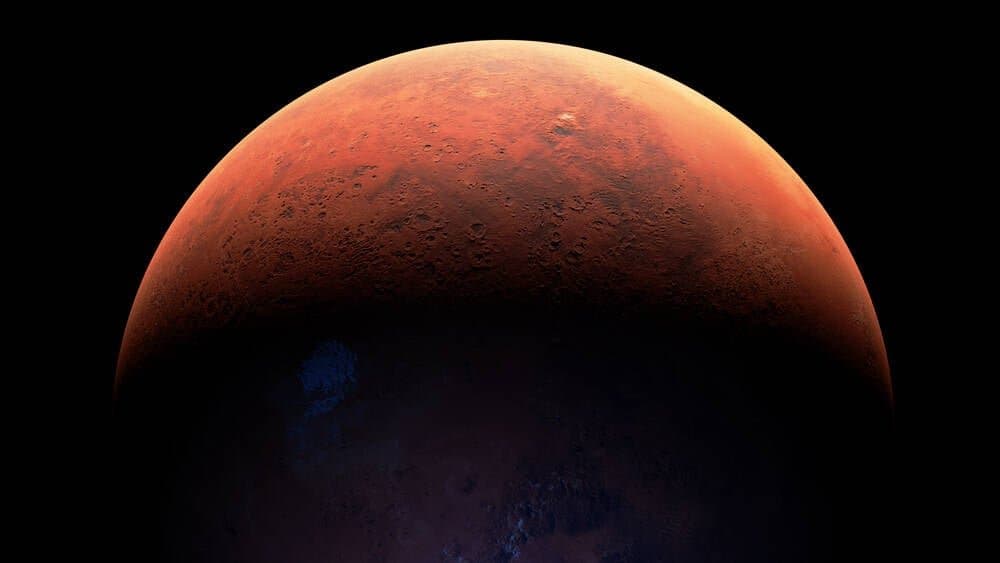
ESA's Mars orbiters turned a solar storm into a scientific opportunity, using radio occultation to reveal dramatic changes in the Martian atmosphere.
When a powerful solar storm struck Mars in May 2024, it caused computer glitches on ESA's Mars Express and ExoMars Trace Gas Orbiter (TGO). But the veteran spacecraft quickly recovered and scientists seized the opportunity to study how the storm affected the red planet's atmosphere.
Solar storm creates dramatic atmospheric changes
The storm, which had previously triggered spectacular auroras visible as far south as Mexico on Earth, arrived at Mars with enough force to cause "computer errors" on both orbiters. According to ESA Research Fellow Jacob Parrott, such glitches are "a typical peril of space weather, as the particles involved are so energetic and hard to predict."
Fortunately, both spacecraft were designed with radiation-resistant components and error-detection systems that allowed them to recover quickly. But the real scientific opportunity came from using radio occultation to probe the Martian atmosphere during the storm.
How radio occultation revealed atmospheric secrets
Scientists used a clever technique where Mars Express beamed a radio signal to TGO just as the latter was disappearing over the Martian horizon. As TGO vanished, the radio signal passed through different layers of Mars's atmosphere, getting refracted in ways that revealed detailed information about each atmospheric layer.
The results were striking. The solar superstorm caused a dramatic increase in electrons in two distinct layers of Mars's atmosphere at altitudes of around 110 and 130 km. The electron density jumped by 45 percent in one layer and an astonishing 278 percent in the other - "the most electrons we've ever seen in this layer of Martian atmosphere," Parrott noted.
A technique with decades of history
ESA project scientist Colin Wilson, co-author of the study published in Nature Communications, explained that this technique has actually been used for decades to explore the Solar System, but traditionally using signals beamed from spacecraft to Earth.
"It's only in the past five years or so that we've started using it at Mars between two spacecraft," Wilson said. The orbiters normally use their radios to beam data between orbiters and rovers, making this dual-purpose use particularly elegant.
The findings were confirmed using observations from NASA's MAVEN mission, though MAVEN's fate remains uncertain. The spacecraft has not been heard from since December 6, and NASA is currently evaluating recovery efforts.
Veteran spacecraft continue delivering science
Both Mars Express and TGO are well past their primary missions but continue to produce valuable science. Mars Express, launched in June 2003, is now in its third decade of operations.
In 2025, a software update allowed controllers to operate the spacecraft while keeping the gyros used for pointing - which are wearing out - deactivated most of the time. "We can run the wheel offloadings now with the gyros fully off thanks to a typically MEX hand-compiled software patch directly to the star tracker RAM," an ESA source explained.
From a hardware perspective, Mars Express could potentially operate into the 2030s, possibly supporting Japan's Martian Moons Exploration (MMX) mission scheduled for launch in 2026. However, such an extension would require budgetary approval from ESA later this year.
This research demonstrates how space weather events, while potentially hazardous to spacecraft, can also provide unique opportunities to study planetary atmospheres in ways that wouldn't be possible under normal conditions.
Comments
Please log in or register to join the discussion