
NAND wafer costs jumped 25% in February 2026, with DRAM prices also rising sharply as AI infrastructure demand continues to outstrip supply, prompting warnings of potential industry-wide disruption.
Memory spot prices rose broadly in February 2026, with NAND flash wafer costs leading the way, according to DigiTimes market data compiled this month. Amidst the report of specific increases, the article warns that the increasing gap between demand and supply of memory is driving "rapid" spot price increases and procurement capital pressures, which, if continued, could lead to an "industry cycle collapse."
DRAM and NAND Price Movements
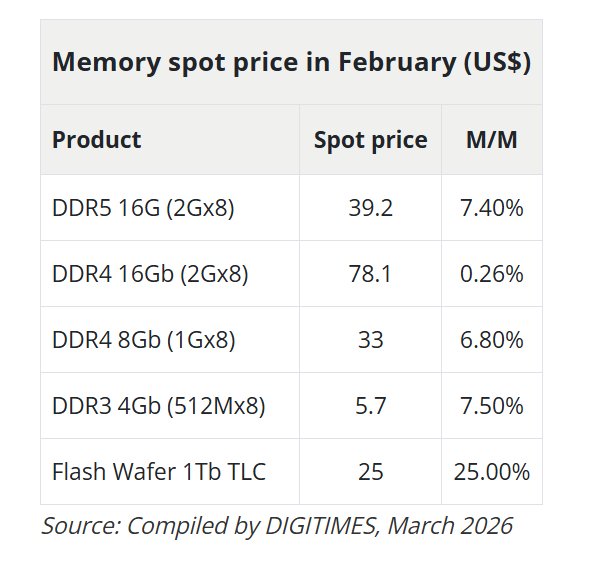
DDR5 16G (2Gx8) chips averaged $39, up 7.4% month-over-month, while 1Tb TLC flash wafers jumped 25% to $25 — the steepest single-month gain reported. These increases came despite a Lunar New Year slowdown that briefly cooled trading activity in mid-February, with spot markets rebounding once the holiday passed.
DDR4 posted more mixed results, with the 16Gb (2Gx8) variant holding nearly flat, rising just 0.26% to $78.10, while the 8Gb (1Gx8) gained 6.8% to $33. DDR3 4Gb (512Mx8) chips rose 7.5% to $5.70.
The slower DDR4 gains reflect a moderation from the 20-30% monthly increases seen across DRAM products in January, though market analysts say this pullback is "partly seasonal rather than a sign of easing structural pressure."
Contract Price Forecasts Revised Sharply Higher
The February spot data comes against a backdrop of sharply higher contract price forecasts, with TrendForce revising its Q1 2026 conventional DRAM contract price outlook upward in early February, raising its estimate from a prior 55-60% quarter-over-quarter increase to 90-95%. PC DRAM is now projected to more than double quarter-over-quarter, which TrendForce described as a new quarterly record.
Meanwhile, NAND flash contract prices are forecast to rise 55-60% QoQ, also revised up from an earlier 33-38% estimate.
AI Infrastructure Driving Market Disruption
We're all aware at this point that it's AI infrastructure that's driving these increases, having continued to pull memory capacity toward server DRAM and high-bandwidth memory, leaving conventional DRAM and consumer NAND segments undersupplied. North American cloud service providers have been pulling forward orders since late 2025, locking in allocations and pushing other buyers down the priority queue.
TrendForce noted that even tier-1 PC OEMs with secured supplier allocations have seen inventory levels decline.
NAND Market Shows Troubling Long-Term Trend
On the NAND side, the February spot jump extends a troubling, longer-term trend. According to DigiTimes, which cited ChinaFlashMarket data, 1Tb QLC/TLC flash wafer prices have roughly tripled since October 2025, with 512Gb TLC prices up nearly fivefold over the same period.
This is because suppliers have been redirecting capacity toward enterprise SSDs, where margins are higher, limiting wafer availability for module makers and sustaining upward pressure across the category.
The memory market's current trajectory presents a complex challenge for the broader technology industry. With AI data centers consuming unprecedented amounts of memory and storage, the traditional balance between supply and demand has been fundamentally disrupted. The warnings of potential "industry cycle collapse" reflect growing concerns that if these price pressures continue unabated, they could trigger cascading effects throughout the semiconductor supply chain.
For consumers and businesses alike, these trends suggest that memory and storage costs will likely remain elevated for the foreseeable future, potentially impacting everything from PC pricing to cloud service costs. The market's ability to respond to these pressures through increased production capacity will be critical in determining whether these price increases represent a temporary spike or a more permanent shift in the memory market landscape.
Comments
Please log in or register to join the discussion